
Dangerous Goods Shipping to West Africa: What You Can and Cannot Send From Dubai
A practical guide to dangerous goods shipping from Dubai to Ghana, Nigeria and Côte d'Ivoire: perfume, aerosols, lithium batteries and paints, the IMDG and IATA basics, and the items each country prohibits or restricts.
Perfume, deodorant sprays, power banks and phones are among the most traded goods between Dubai and West Africa, and every one of them is classed as dangerous goods for transport. Dangerous goods shipping is regulated at sea by the IMDG Code, which has been mandatory under the SOLAS Convention since 1 January 2004 according to the International Maritime Organization, and in the air by the IATA Dangerous Goods Regulations. This guide explains which everyday items count, how they move from Dubai, and what Ghana, Nigeria and Côte d'Ivoire prohibit or restrict on arrival.
In practice, almost nothing on this list is impossible to ship; it simply has to be declared, packed and booked as what it is. The real risks for importers are undeclared cargo hidden inside a mixed consignment and goods that are legal to carry but banned or permit controlled at the destination port.
What counts as dangerous goods in shipping#
Dangerous goods (often shortened to DG or hazmat) are substances and articles that can harm people, ships, aircraft or the environment in transport. The UN system groups them into nine classes, from explosives (Class 1) to miscellaneous dangerous goods such as lithium batteries (Class 9). Each product gets a four digit UN number, which is what carriers use to accept or refuse a booking.
The quickest way to know whether your cargo is DG is to ask the supplier for the Safety Data Sheet (SDS). Section 14 of the SDS lists the UN number, the class and the packing group; if it says "not regulated for transport", the goods ship as general cargo.
Need this handled end to end?
Tell us your lane and cargo profile and we'll come back with a routing plan and an all-in rate.
Everyday goods that ship as dangerous goods from Dubai#
| Item | Typical class and UN number | By sea from Dubai | By air from Dubai | Watch at destination |
|---|---|---|---|---|
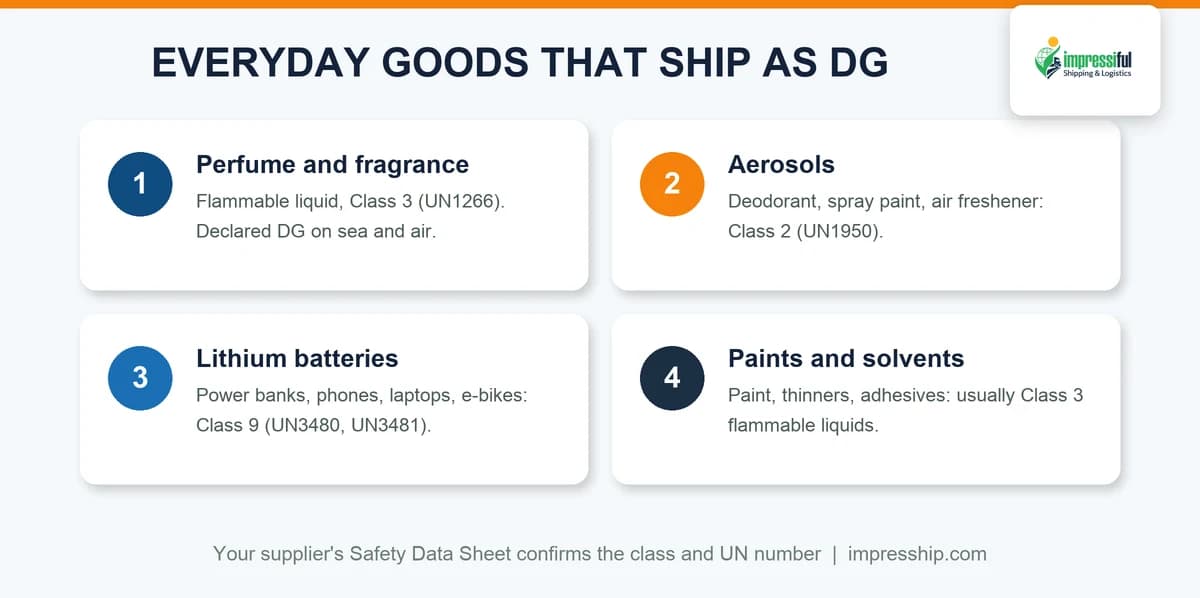
| Perfume, oud oils with alcohol | Class 3, UN1266 | Yes, declared as DG (small retail bottles often as limited quantity) | Restricted, DG declaration and quantity limits | Cosmetics registration rules apply in all three countries |
| Aerosols (deodorant, spray paint) | Class 2, UN1950 | Yes, declared as DG | Heavily restricted | Treated as cosmetics or chemicals by product |
| Power banks, loose lithium ion batteries | Class 9, UN3480 | Yes, declared as DG | Cargo aircraft only, limited state of charge | Check quality standards and conformity rules |
| Phones and laptops (battery packed with or inside) | Class 9, UN3481 | Yes, declared as DG | Allowed within packing instruction limits | Conformity certificates such as SONCAP in Nigeria |
| Paints, thinners, adhesives | Class 3, for example UN1263 | Yes, declared as DG | Restricted | Standard customs entry |
| Car and generator batteries (wet, acid) | Class 8, UN2794 | Yes, declared as DG | Restricted | Used items may face extra checks |
| Gas cylinders (LPG, refrigerant) | Class 2 | Usually only empty and purged, or as DG with approval | Generally not accepted | Permits may apply |
| Fireworks, ammunition | Class 1 | Specialist carriers only | Generally not accepted | Licence or outright ban |
The classes and UN numbers are the common ones; your SDS is the final word for each product.
IMDG and IATA: the two rulebooks for dangerous goods shipping#
By sea, the IMDG Code applies. It sets how DG is classified, packed, marked, labelled, stowed on the vessel and segregated from incompatible cargo. The current edition, Amendment 42-24, became mandatory on 1 January 2026 and added many new references to lithium batteries. Your forwarder needs the SDS and a signed dangerous goods declaration before the carrier will confirm space, which is why DG bookings typically take a few extra working days on our ocean freight service.
By air, the IATA DGR applies. Air rules are stricter because a fire in the hold is harder to contain. Some goods that sail easily, such as aerosols and many perfumes in bulk, are limited or refused on passenger aircraft. If speed matters, compare the options in our air freight vs ocean freight guide before you promise a delivery date.
Lithium batteries need extra care#
Lithium batteries are the DG item West African importers ship most often, usually inside phones, laptops, solar kits and e-bikes. IATA explains on its lithium battery guidance page that whether a battery can fly depends on its configuration and watt hour rating. Loose lithium ion batteries and power banks (UN3480) cannot travel on passenger aircraft and must be shipped at a reduced state of charge; from 1 January 2026 a 30 percent state of charge limit also applies to larger lithium ion batteries packed with equipment.
By sea, lithium batteries are accepted as declared Class 9 cargo. Damaged or recalled batteries are a different matter and need specialist approval, so never mix them into a general load.
Perfume and aerosols#
Perfume is a flammable liquid because of its alcohol content. Small retail bottles can often move as "limited quantity" DG, which reduces the paperwork but still requires declaration and marking. Aerosols are pressurised gas containers and are treated similarly. If you are sending mixed retail stock, tell the forwarder exactly how many cartons of each are in the load; one undeclared carton can hold up a whole consolidation.
What Ghana, Nigeria and Côte d'Ivoire prohibit or restrict#
Transport rules decide how goods move. Customs rules decide whether they may enter. Check both before you buy.
Ghana. The Ghana Revenue Authority publishes its import prohibitions and restrictions. Absolute prohibitions include counterfeit currency, obscene articles and dangerous knives such as flick knives. Arms, ammunition and explosives need a permit or licence from the Ministry of the Interior, mercury needs a licence from the Ministry of Mines, and plants and soil need a Ministry of Food and Agriculture permit. For duty and levies on permitted goods, see our Ghana customs duty calculation guide.
Nigeria. Nigeria Customs Service maintains an import prohibition list, reproduced with HS codes on the government's Nigeria Trade Information Portal. It includes frozen poultry, pork and beef, bagged cement, soaps and detergents in retail packs, spaghetti and noodles, mosquito repellent coils, used fridges and air conditioners, and several common medicines. The list is revised from time to time, so confirm the current version before you order. Our Dubai to Nigeria shipping guide covers Form M and the rest of the Lagos clearance process.
Côte d'Ivoire. The US Commercial Service's Côte d'Ivoire import guide lists bans on sugar, ordinary plastic bags and analogue television sets. Pharmaceutical, medical and cosmetic products must be registered with the DPML, and beverages over 20 percent alcohol need an import licence. Read our Dubai to Ivory Coast guide for the BSC and the Abidjan duty stack.
How to book dangerous goods shipping from Dubai without delays#
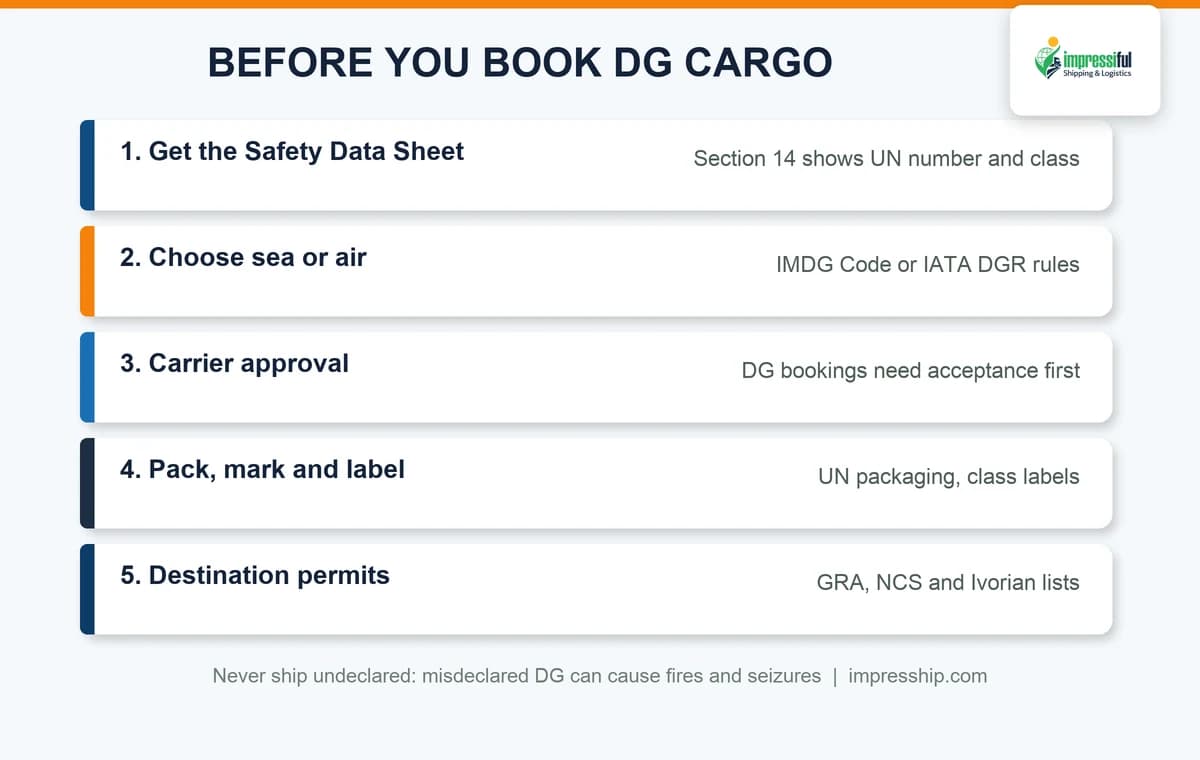
- Send the SDS with your enquiry. Without it, nobody can confirm the class, packing rules or carrier acceptance.
- Pick the mode after the DG check, not before. Some goods only make sense by sea.
- Allow time for approval. Every dangerous goods shipment needs approval before it is booked, so build that step into your timeline.
- Use proper packaging and labels. UN specification packaging, class labels and marks are the shipper's responsibility.
- Line up destination permits early. A permit applied for after arrival means storage charges at the port; our customs clearance documents guide lists the core paperwork.
Frequently asked questions#
What items cannot be shipped by sea?#
Very few goods are banned from sea freight outright; most dangerous goods can sail if they are declared, packed and stowed under the IMDG Code. The practical limits are carrier acceptance (some lines refuse certain Class 1 explosives or damaged batteries) and destination bans, such as the items on Nigeria's import prohibition list.
Can I ship perfume from Dubai to Africa?#
Yes. Perfume is a Class 3 flammable liquid, so it must be declared as dangerous goods, but small retail bottles often qualify as limited quantity by sea. Cosmetics registration rules then apply in Ghana, Nigeria and Côte d'Ivoire, so check them before you buy; our ocean freight service is usually the practical route for volume.
Can lithium batteries be shipped by sea?#
Yes. Lithium batteries ship by sea as Class 9 dangerous goods with the correct UN number, packaging and labels, and sea freight avoids most of the state of charge and passenger aircraft limits that apply by air under the IATA rules. Damaged or recalled batteries need specialist approval.
What are the 9 classes of dangerous goods?#
The nine classes are explosives (1), gases (2), flammable liquids (3), flammable solids (4), oxidisers and organic peroxides (5), toxic and infectious substances (6), radioactive material (7), corrosives (8) and miscellaneous dangerous goods such as lithium batteries (9). The IMO applies the same classes at sea through the IMDG Code.
What items are prohibited from being imported into Ghana?#
Ghana's absolute prohibitions include counterfeit currency, obscene articles, food declared unfit for consumption and dangerous knives, while arms, explosives, mercury and plant material need a permit or licence. The full list is on the GRA prohibitions page, and our Dubai to Ghana cost guide covers the rest of the lane.
Send your cargo details for a same-day quote#
Tell us what you are shipping, the CBM or weight and your destination port in Ghana, Nigeria or Côte d'Ivoire. If the load includes perfume, aerosols, batteries or chemicals, say so and attach the Safety Data Sheet. We ship dangerous goods as well as general cargo, with every dangerous goods shipment subject to approval, and we will confirm the handling it needs.
Request a same-day quote or message us on WhatsApp with your cargo details. You can also see how we handle customs clearance at destination.