
Ghana Customs Duty Calculation: How Your Import Bill Is Worked Out
How Ghana customs duty is calculated on general cargo in 2026: the HS code that sets your band, the CIF value it is charged on, the levies on top and the new VAT stack under Act 1151, with a worked example.
Ghana's VAT reform under the Value Added Tax Act, 2025 (Act 1151) took effect on 1 January 2026, abolished the 1 percent COVID-19 levy and put VAT at 15 percent with NHIL and GETFund at 2.5 percent each on the same base, according to the Ghana Revenue Authority. That changed the last line of every import bill at Tema and Kotoka. This guide walks through Ghana customs duty calculation for general cargo step by step: the HS code that decides your band, the CIF value it is charged on, the levies on top and a worked example you can adapt.
For most importers, the calculation comes down to two decisions made before the goods ever leave Dubai: the HS code on the invoice and the CIF value you can prove. Get those right and the duty, levies and VAT that ICUMS applies are predictable, typically about 25 to 50 percent of CIF for standard rated goods outside the 35 percent band.
The five steps in a Ghana customs duty calculation#
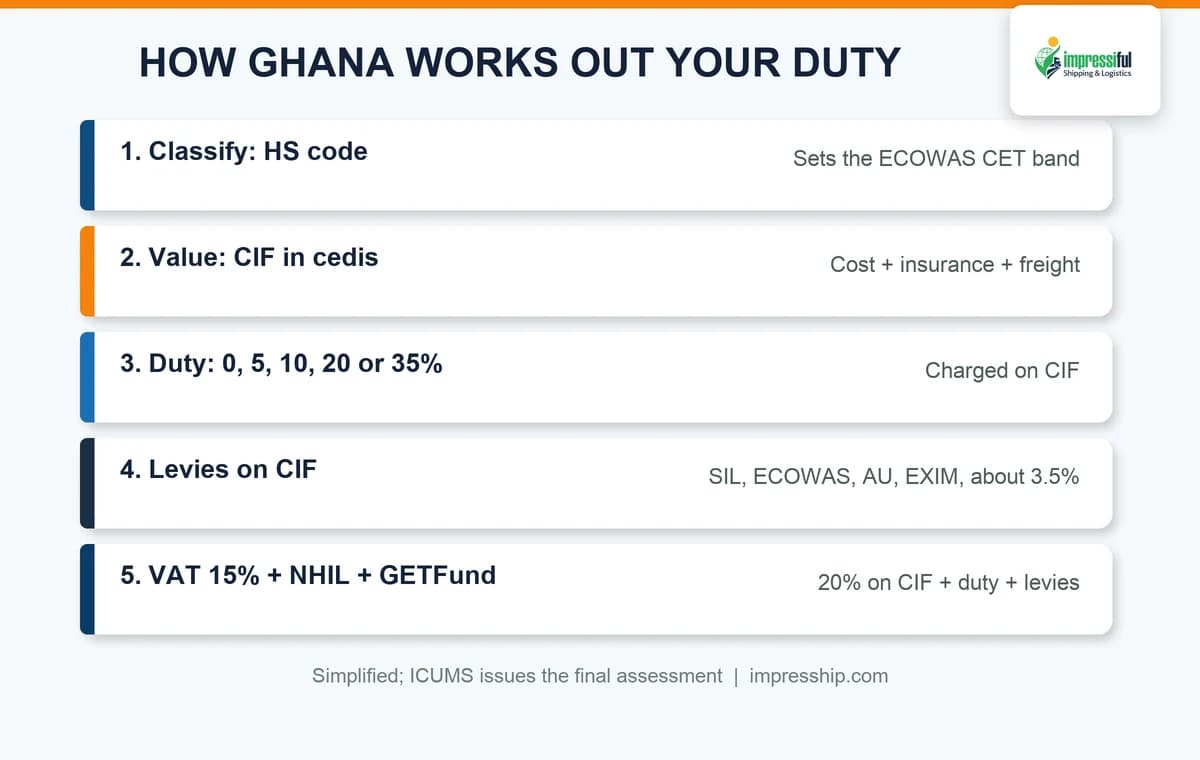
Every general cargo declaration in Ghana is lodged and assessed on ICUMS, the Integrated Customs Management System, through a licensed customs agent. Whatever the product, the system follows the same order.
- Classify the goods. The HS code decides the duty band and whether any special levy or exemption applies.
- Value the goods on a CIF basis. Cost, insurance and freight to the Ghana port, converted into cedis at the customs exchange rate.
- Apply import duty. The band rate is charged on the CIF value.
- Add the levies. A handful of small percentages, mostly on CIF.
- Apply the VAT stack. VAT, NHIL and GETFund on the value including duty and levies.
Need this handled end to end?
Tell us your lane and cargo profile and we'll come back with a routing plan and an all-in rate.
Step 1: the HS code decides your duty band#
Ghana applies the ECOWAS Common External Tariff, which has five bands. The US International Trade Administration summarises them as 0 percent for essential social goods such as medicine, 5 percent for raw materials and capital goods, 10 percent for intermediate goods, 20 percent for consumer goods and 35 percent for a short list of goods the government protects more heavily.
The band follows the 10 digit Ghana tariff line, built on the World Customs Organization's Harmonized System. Two products that look alike can sit in different bands, so a vague description such as "household items" invites a reclassification at the highest plausible rate. Our customs documents checklist covers how to describe goods on the invoice so the code holds up.
If you import the same product repeatedly, GRA Customs offers free advance rulings on classification, applied for online by ICUMS registered importers, with a target turnaround of 90 days once the file is complete. A ruling binds Customs on your future imports of that product.
Step 2: the CIF value is the base#
Ghana charges import duty on the CIF value: the price paid for the goods plus insurance and freight to the port of entry. That is why a FOB invoice from a Dubai supplier is not the number duty is calculated on; Customs adds the freight and insurance to it. Our FOB vs CIF guide explains how the Incoterm on your invoice affects what you declare.
Freight is therefore part of your duty base, and a cheaper route lowers both your shipping bill and your duty. The Dubai to Ghana shipping cost guide carries current planning ranges for containers, LCL and air, so we will not repeat them here.
Insurance matters too. Since 1 February 2026, imported goods other than personal effects must be insured with a local insurer under Section 222 of the Insurance Act, 2021 (Act 1061), enforced by GRA with the National Insurance Commission, as the Ghana Shippers' Authority reports. Budget for a Ghanaian marine cargo policy rather than relying on cover bought in Dubai.
Steps 3 and 4: duty, then the levies#
Duty is the band rate multiplied by the CIF value. A further group of levies is then added, most of them charged on CIF. The rates below are the ones published for general imports at the time of writing; your agent's ICUMS assessment is the final word, since exemptions and product specific charges apply.
| Charge | Typical rate | Charged on |
|---|---|---|
| Import duty | 0, 5, 10, 20 or 35 percent | CIF value |
| Special Import Levy | 2 percent (some goods exempt) | CIF value |
| ECOWAS levy | 0.5 percent (non ECOWAS origin) | CIF value |
| African Union levy | 0.2 percent (non AU origin) | CIF value |
| EXIM levy | 0.75 percent | CIF value |
| ICUMS fee | about 0.4 percent | FOB value |
| Withholding tax | 1 percent (creditable against income tax) | CIF value |
| VAT | 15 percent | CIF plus duty and levies |
| NHIL and GETFund | 2.5 percent each | Same base as VAT |
A few products carry extra charges, such as excise on specified goods or the 5 percent import levy on certain textiles and poultry, and some duty free imports pay a 1 percent processing fee instead. Goods with ECOWAS origin and a valid certificate can qualify for preferential treatment, which matters if you are routing cargo via Dubai and need the origin to stay accurate.
Step 5: the 2026 VAT stack under Act 1151#
Before 2026, NHIL, GETFund and the COVID-19 levy were calculated in layers, which pushed the effective rate on imports above 21 percent. Under Act 1151, VAT at 15 percent and NHIL and GETFund at 2.5 percent each are charged on the same base, for a flat 20 percent on the duty inclusive value. For VAT registered importers, NHIL and GETFund are now recoverable as input tax along with VAT, which turns much of the stack into a cash flow cost rather than a final one.
A worked Ghana customs duty calculation#
Here is an illustrative calculation for a consumer product in the 20 percent band, with a CIF value of USD 10,000 (FOB about USD 9,000), non ECOWAS origin and standard rated for VAT. Ghana assesses in cedis, so multiply by the customs exchange rate on your declaration.
| Line | Base | Amount (USD) |
|---|---|---|
| Import duty, 20 percent | 10,000 CIF | 2,000 |
| Special Import Levy, 2 percent | 10,000 CIF | 200 |
| ECOWAS, AU and EXIM levies, 1.45 percent | 10,000 CIF | 145 |
| ICUMS fee, about 0.4 percent | 9,000 FOB | 36 |
| VAT, NHIL and GETFund, 20 percent | 12,345 (CIF plus duty and levies) | 2,469 |
| Withholding tax, 1 percent | 10,000 CIF | 100 |
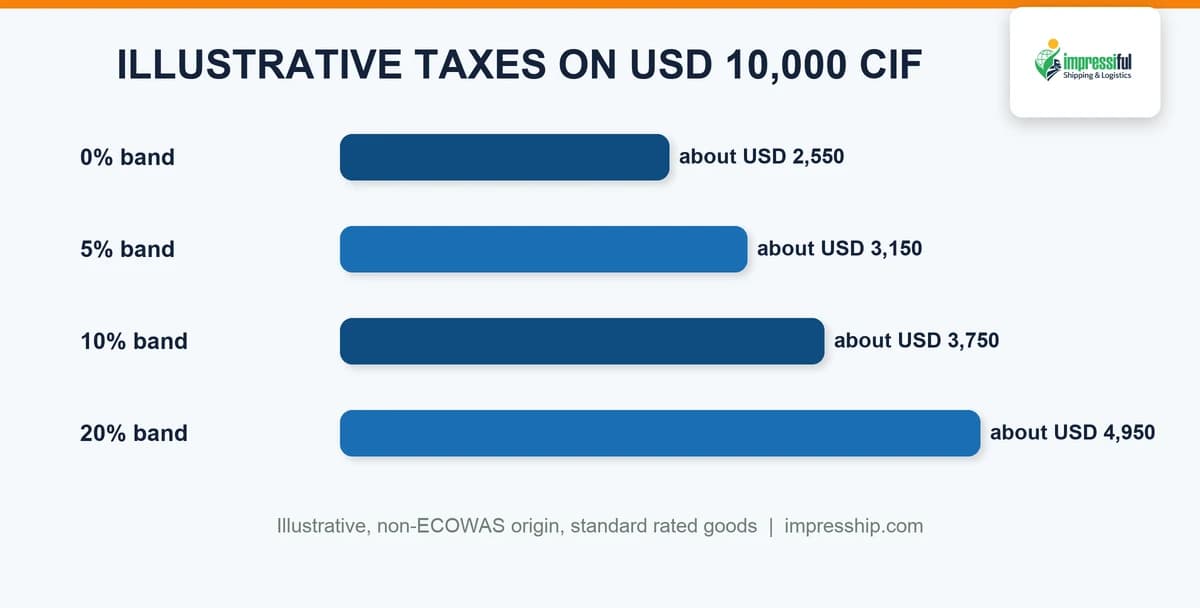
| Total taxes and charges | about 4,950 |
That is roughly half the CIF value. The same shipment in the 10 percent band comes to about USD 3,750, in the 5 percent band about USD 3,150, and even a 0 percent item pays about USD 2,550 because the levies and VAT still apply.
Port handling, storage and your agent's fees sit on top of this and are not taxes (a good forwarder shows them separately, as our guide to finding a freight forwarder in Dubai explains); plan them separately, and keep the goods moving, because storage starts once free time ends. Whether you ship by ocean freight from the UAE or air freight to Accra, the duty maths is identical; only the freight inside CIF changes.
Frequently asked questions#
How is import duty calculated in Ghana?#
Import duty in Ghana is calculated by multiplying the CIF value of the goods in cedis by the duty rate for their HS code, which is 0, 5, 10, 20 or 35 percent. Levies such as the Special Import Levy, ECOWAS, AU and EXIM levies are then added, and VAT, NHIL and GETFund are charged on the total. The US International Trade Administration summarises the same structure.
What is the import duty rate in Ghana?#
There is no single rate. Ghana uses the ECOWAS Common External Tariff, so essential goods start at 0 percent, raw materials and capital goods pay 5 percent, intermediate goods 10 percent and most consumer goods 20 percent, with 35 percent on a short protected list. Your HS code decides the band, which is why getting it right on the invoice and documents matters.
What is the VAT rate on imports in Ghana in 2026?#
Since 1 January 2026, imports pay VAT at 15 percent plus NHIL and GETFund at 2.5 percent each, all on the same base, for 20 percent in total. The reform under Act 1151 also abolished the 1 percent COVID-19 levy, as the Ghana Revenue Authority confirms on its VAT page.
Is customs duty in Ghana charged on CIF or FOB?#
Ghana charges import duty on the CIF value, so freight and insurance to the Ghana port are added to the price of the goods before the rate is applied. A FOB invoice is still accepted, but Customs adds the freight and insurance to it. Our FOB vs CIF guide explains the difference for African importers.
How do I find the HS code for my goods in Ghana?#
Start with a precise product description and ask your clearing agent to match it to the Ghana tariff on ICUMS before you ship. For repeat imports, you can request a free binding classification through GRA's advance ruling service, which Customs then follows on your future shipments of that product.
Send your cargo details for a same-day quote#
Tell us what you are shipping, its value and whether it is going to Tema or Kotoka, and we will quote the freight and insurance that make up your CIF value, so you can work out the likely duty with your clearing agent before you load.
Request a same-day quote or message us on WhatsApp with your cargo details. You can also see our full range of freight services.