FOB vs CIF: Choosing Incoterms as an African Importer Buying via Dubai
FOB, CIF, FCA or EXW? How each Incoterm shifts cost, risk and insurance when you buy in Dubai or China, why West African duty is on CIF value either way, and which term to ask for.
The ICC's Incoterms 2020 set out 11 trade terms, yet almost every supplier quote an African importer receives from Dubai or China says one of two things: FOB or CIF. The choice between FOB vs CIF decides who books the ship, who carries the risk at sea and what insurance protects your cargo, and under CIF the seller only has to buy minimum Institute Cargo Clauses (C) cover. This guide shows what each term really transfers, why West African duty barely changes between them, and which term to ask for when your goods move through Dubai.
For most importers with a forwarder they trust, the better answer is FOB, or its container friendly cousin FCA: you control the routing, the transshipment and the insurance, and your duty bill stays the same because West African customs values goods on CIF either way. CIF still suits a first small order with an unknown market.
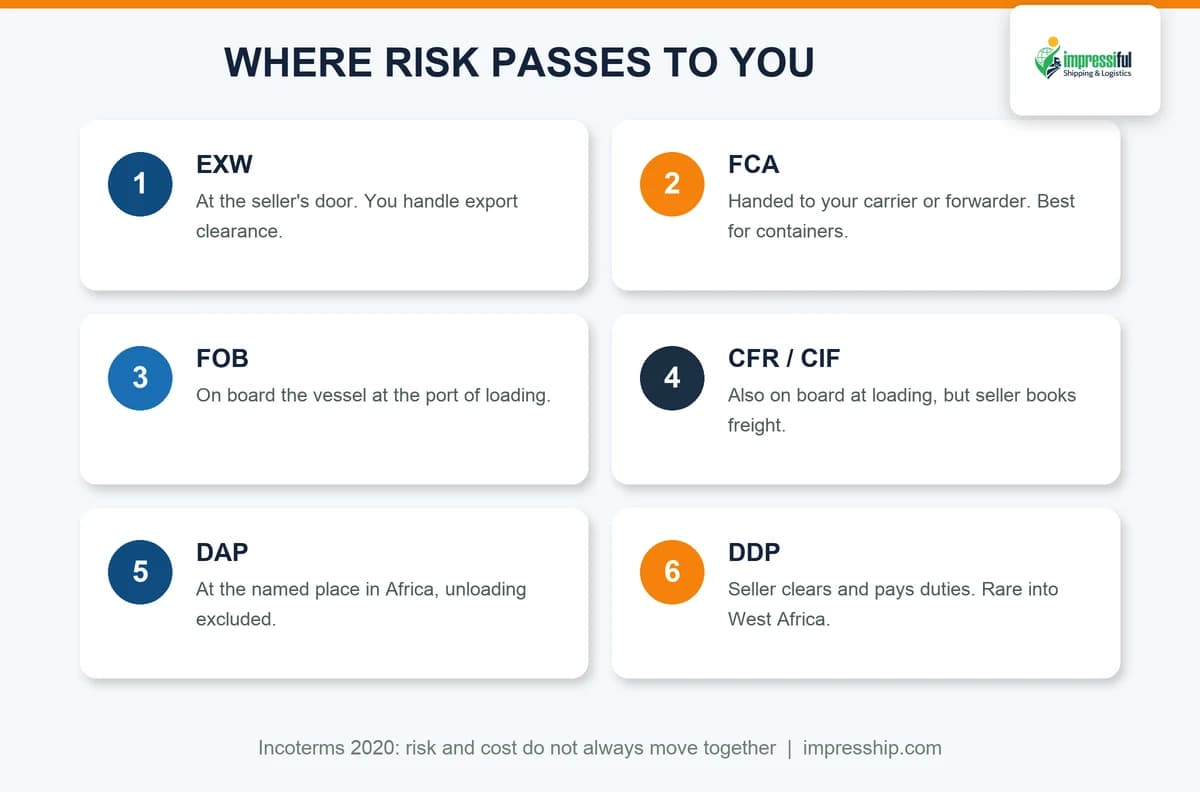
Incoterms in one table: who pays, who carries the risk#
An Incoterm answers three questions: where the seller's delivery ends, who pays the main carriage, and who insures it. It does not set the price, the payment terms or who owns the goods; those live in your sales contract.
| Term | Risk passes to buyer | Main freight booked by | Insurance | Fit for Dubai or China to Africa |
|---|---|---|---|---|
| EXW | At seller's premises | Buyer | Buyer | Good for Dubai trader purchases you consolidate |
| FCA | When handed to buyer's carrier | Buyer | Buyer | Best for containers and consolidation |
| FOB | On board the vessel at loading | Buyer | Buyer | Common and workable for sea freight |
| CFR | On board the vessel at loading | Seller | Buyer | Seller books ship, you still carry sea risk |
| CIF | On board the vessel at loading | Seller | Seller, minimum cover | Easy for first orders, least control |
| DAP | At named place in Africa | Seller | Seller | Rare; seller rarely knows African ports |
| DDP | At named place, duties paid | Seller | Seller | Very rare into West Africa |
The detail most buyers miss: under both FOB and CIF, risk passes to you when the goods are on board at the loading port. CIF changes who pays for freight and insurance, not who suffers if the container is damaged at sea.
Need this handled end to end?
Tell us your lane and cargo profile and we'll come back with a routing plan and an all-in rate.
FOB vs CIF when you buy from Dubai or China#
Under FOB, your supplier clears the goods for export and loads them at, say, Ningbo or Jebel Ali. Your forwarder books the vessel, so you choose the carrier, the routing and the number of transshipments, which on West African lanes is where weeks are won or lost. You also pick your own insurer and cover level.
Under CIF, the supplier books the freight and buys the insurance to your destination port. It is convenient, but the supplier chooses the cheapest service that meets the contract, often with extra transshipments, and some suppliers add a margin to the freight. You then meet destination charges from a line and agent you did not choose. Our UAE to West Africa ocean freight guide shows how much routing changes real transit times.
The practical rule many experienced importers follow: buy FOB once you have a forwarder, accept CIF for a trial order, and compare the supplier's CIF price against FOB plus your own freight quote before deciding.
Why West African duty ignores the term you choose#
A common argument for FOB is that duty is lower because the value excludes freight. That is true in markets that value imports on an FOB basis, but not in most of West Africa. The WTO Customs Valuation Agreement lets each member decide whether freight and insurance to the port of import form part of customs value, and ECOWAS customs services generally include them. Côte d'Ivoire assesses duty on CIF value according to the US Commercial Service, and the Ghana Revenue Authority does the same.
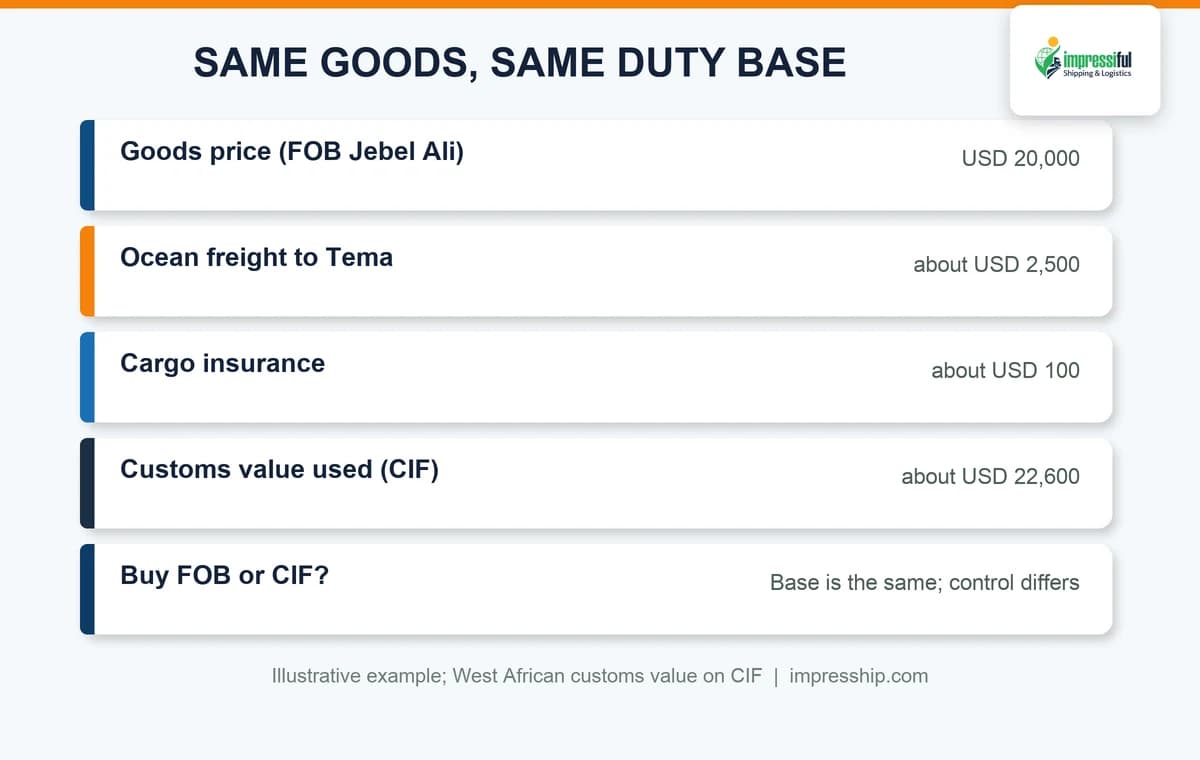
If you buy FOB, customs simply adds your actual freight and insurance to reach the CIF figure. An illustrative shipment to Tema:
| Line | Bought FOB | Bought CIF |
|---|---|---|
| Goods price on the invoice | USD 20,000 (FOB) | USD 22,600 (CIF) |
| Freight shown separately | about USD 2,500 | Included |
| Insurance shown separately | about USD 100 | Included |
| Customs value used | about USD 22,600 | about USD 22,600 |
So the choice is about control and cost of freight, not duty. Keep freight and insurance invoices clean either way, because customs will ask for them; the customs documents checklist lists what to keep, and our Ghana cost guide shows how duty fits into the full landed cost.
The insurance gap in CIF, and Nigeria's local cover rule#
Under Incoterms 2020, a CIF seller only has to buy insurance to Institute Cargo Clauses (C), the most basic level, for at least 110 percent of the contract price. Clauses (C) cover major casualties such as fire, sinking or stranding, but not theft or most handling damage, which are the claims West African importers actually make. If you buy CIF, ask for all risks cover in the contract or top it up yourself.
Nigeria adds a rule of its own. Since September 2020, banks process an e-Form M only with a digital marine insurance certificate from the Nigerian Insurers Association (CBN circular TED/FEM/FPC/GEN/01/006), so cover is placed with a Nigerian insurer and most Nigerian importers buy FOB or CFR. Our Dubai to Nigeria shipping guide covers the rest of the Lagos paperwork.
Which term to use when your cargo moves through Dubai#
Buying from several Dubai traders: ask for EXW or FCA delivered to your forwarder's warehouse. Dubai wholesalers rarely load vessels themselves, and handing goods to one consolidator lets everything travel on one bill of lading. Our cargo consolidation and warehousing service is built for exactly this.
Buying from China and routing via Jebel Ali: FOB at the Chinese port keeps the freight in your hands, so your forwarder can combine it with Dubai purchases and ship onward in one container. CFR or CIF to Jebel Ali also works when the supplier's freight is genuinely cheap.
Full containers loaded at the supplier's factory: FCA is the cleaner term. The ICC notes that FOB is meant for goods placed on board a vessel, while FCA was revised in 2020 so the buyer can still get an on board bill of lading for the bank. Lanes such as Dubai to Côte d'Ivoire work best on FCA or FOB with your own booking. See our freight services and supply chain solutions for what we handle on each leg.
Frequently asked questions#
Which is better, FOB or CIF?#
For an importer with a reliable forwarder, FOB is usually better because you control the carrier, routing, transit time and insurance. CIF is simpler for a first or very small order, but you give up control of the sea leg while still carrying the risk from loading. If you need a forwarder for FOB bookings, our team can quote both options side by side.
Is customs duty calculated on FOB or CIF?#
It depends on the importing country. Most West African customs services, including Ghana and Côte d'Ivoire, assess duty on CIF value, adding freight and insurance to an FOB invoice, while countries such as the United States use a value closer to FOB. The WTO valuation rules leave that choice to each member.
Who pays freight charges under FOB?#
The buyer pays the main ocean freight under FOB, while the seller pays all costs up to loading the goods on board, including export clearance. Charges at the destination port, customs duties and inland delivery are also the buyer's. The bill of lading will usually show freight collect, so check it against the term you agreed.
What is the difference between EXW and FOB?#
Under EXW the seller only makes the goods available at its premises, so the buyer arranges pickup, export clearance and loading. Under FOB the seller handles export clearance and loads the goods on the vessel. For purchases from several Dubai suppliers, EXW into a consolidation warehouse often costs less overall.
Who is responsible for insurance under CIF?#
The seller must buy insurance under CIF, but only minimum Institute Cargo Clauses (C) cover for at least 110 percent of the contract value, as set out in Incoterms 2020. Because risk has already passed to the buyer at loading, the buyer is the one who claims, so it pays to check the policy before shipment.
Send your cargo details for a same-day quote#
Send us the supplier's Incoterm, the pickup point and your destination, and we will quote the freight leg and show you whether FOB, FCA or the supplier's CIF price works out cheaper.
Request a same-day quote or message us on WhatsApp with your cargo details.