
Bill of Lading Explained: Types, Telex Release and What African Importers Must Check
Bill of lading explained for importers shipping from Dubai to Ghana, Nigeria and Côte d'Ivoire: what the document does, the main types, original vs telex release vs sea waybill, and the fields to check on every draft.
Container shipping issues roughly 45 million bills of lading a year, and when carriers made their digital pledge in 2023 only 1.2 percent of them were electronic, according to Global Trade Review. That means the paper document you receive from your forwarder still decides who can collect your container at Tema, Lagos or Abidjan. This bill of lading explained guide covers what the document does, the types you will see, the difference between an original, a telex release and a sea waybill, and the fields every African importer should check before the vessel sails.
For most importers, the bill of lading matters for one reason: whoever holds the right version of it controls the cargo. Choose the release method before the bill is issued, check the draft line by line, and most of the delays and extra charges at the destination port simply never happen.
What a bill of lading does#
A bill of lading (B/L or BL) is issued by the carrier, or by a forwarder acting as carrier, once your goods are received or loaded. It does three jobs at the same time:
- Receipt. It confirms what was loaded, how many packages, the weight and the container and seal numbers.
- Evidence of the contract of carriage. It records who shipped what, from which port to which port, and on what terms.
- Document of title. A negotiable bill of lading represents the goods themselves; transferring it transfers the right to collect them.
That third function is why banks use bills of lading in letters of credit, and why a lost original is a serious problem.
Need this handled end to end?
Tell us your lane and cargo profile and we'll come back with a routing plan and an all-in rate.
The main types of bill of lading#
Master and house bills. The shipping line issues a master bill of lading (MBL) to the forwarder. When your goods share a container with other shippers, the forwarder issues you a house bill of lading (HBL). This is normal for LCL loads; our LCL vs FCL guide explains when a shared container makes sense, and our consolidation guide shows how several suppliers end up on one bill.
Straight, order and bearer bills. A straight bill names one consignee and cannot be transferred. An order bill is made out "to order" (often of a bank) and can be endorsed to someone else. A bearer bill releases the goods to whoever holds it and is rarely used because of the risk.
Clean and claused bills. A clean bill has no remarks about damaged or short cargo. A claused (or "dirty") bill notes a problem at loading, and banks usually refuse it under a letter of credit.
Shipped on board and received for shipment. A shipped on board bill confirms the goods are on the vessel, with a date. A received bill only confirms the carrier has them, which most banks will not accept.
Through and multimodal bills. A through bill covers more than one leg, for example a transshipment in Dubai on the way from China, as described in our China to Africa via Dubai guide. Forwarders that are FIATA members may also issue the FIATA multimodal bill, which FIATA's eFBL FAQ explains in detail.
Original, telex release, sea waybill: bill of lading release options explained#
| Option | Negotiable? | Document of title? | How the cargo is released | Best used when |
|---|---|---|---|---|
| Original bill of lading | Yes, if made out to order | Yes | Consignee presents one endorsed original (usually from a set of three) | Letter of credit, new supplier, payment not yet made |
| Telex release | Originals surrendered at origin | Title stops travelling once surrendered | Carrier instructs its destination agent to release to the named consignee | Supplier already paid, speed matters |
| Sea waybill | No | No | Named consignee proves identity and collects | Trusted or related parties, paid in advance |
| Electronic bill of lading | Yes, on an approved platform | Yes | Title transferred digitally | Both parties and the carrier use the same platform |
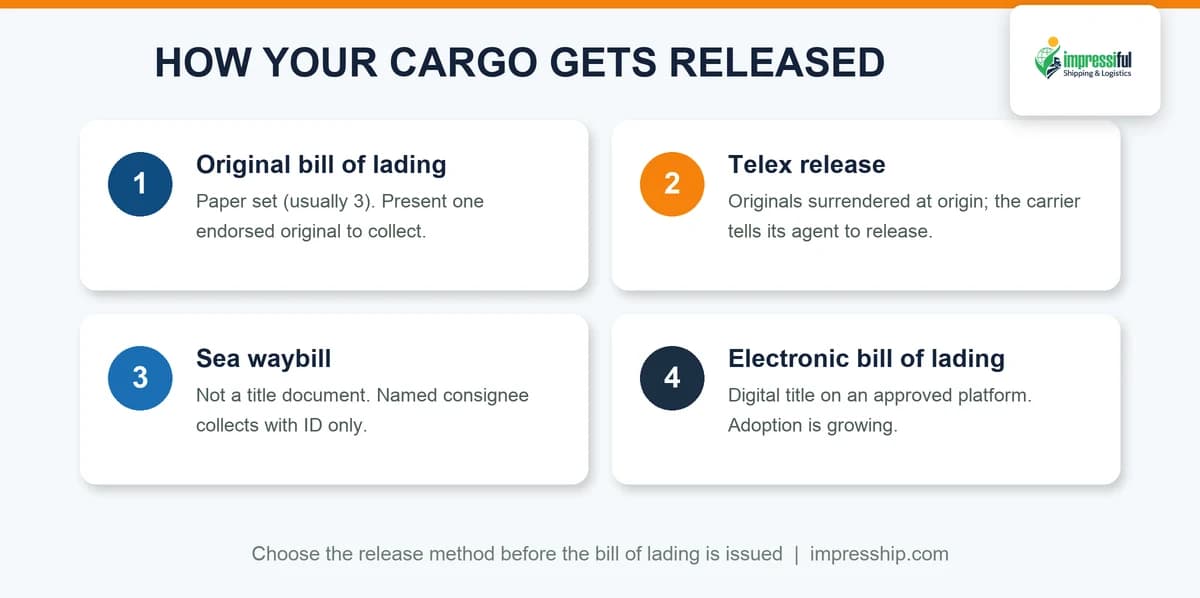
Original bill of lading#
The carrier prints a full set, typically three originals. Your supplier sends them through the bank or by courier, and you hand one over at the destination to get a delivery order. If the originals arrive after the vessel, the container waits and storage and demurrage start to build.
Telex release#
With a telex release, the shipper surrenders the full set of originals to the carrier at origin, and the carrier tells its agent at destination to release the cargo. Today that "telex" is usually an email or a system message. The TT Club notes that telex release always concerns bills of lading, never sea waybills, and warns about fake release emails. Only ask for one once your supplier is paid and you trust the arrangement.
Sea waybill#
A sea waybill is a receipt and contract, but not a title document. Nothing needs to be presented; the named consignee just identifies itself. It is fast and cheap, but the shipper gives up control, so it suits suppliers you already trust or goods paid for in advance.
Electronic bills of lading#
Electronic bills of lading are growing. The carriers in the Digital Container Shipping Association have committed to 100 percent eBL adoption by 2030, with half of their bills digital within five years of the 2023 pledge. Before choosing an eBL, confirm that your bank, your supplier and the destination agent can all accept it.
How the bill of lading links to your Incoterm#
The bill of lading shows "freight prepaid" or "freight collect", and that must match the Incoterm agreed with your supplier. Under CIF the seller pays freight, so the bill should say prepaid; under FOB you usually pay, so it may say collect. Our FOB vs CIF guide explains who pays what, and the ICC Incoterms page has the official rules. A mismatch here is a classic cause of surprise charges at the destination.
What African importers must check on the draft bill of lading#

Always ask for a draft before the final bill is issued. Corrections after issue usually mean a fee and a new release cycle.
- Consignee name and details. They must match your tax and customs registration exactly, not a trading name or an abbreviation.
- Notify party. Usually your clearing agent or yourself, with a working phone number and email.
- Port of discharge and place of delivery. Tema, Lagos (Apapa or Tin Can) or Abidjan, written as the carrier lists it.
- Cargo description, packages and weight. They must agree with the commercial invoice and packing list, because customs compares all three.
- Container and seal numbers. They must match the loading report.
- Freight terms and number of originals. Prepaid or collect, and how many originals are issued.
- Country specific links. In Côte d'Ivoire the BSC cargo tracking note is raised against the bill of lading before arrival; our Dubai to Ivory Coast guide explains it.
For the rest of the document set, including invoices and conformity certificates, read our customs clearance documents guide.
Frequently asked questions#
What is a bill of lading and why is it important?#
A bill of lading is the document a carrier issues for goods it carries by sea: it is a receipt, evidence of the contract of carriage and, when negotiable, a document of title. It matters because the holder of the right version controls who can collect the cargo at the destination port. Our ocean freight service covers FCL and LCL bookings, so ask us which release option suits your shipment.
What are the different types of bill of lading?#
The most common are master and house bills, straight and order bills, clean and claused bills, shipped on board and received for shipment bills, and through or multimodal bills. Most small importers who share containers receive a house bill of lading from their forwarder, as explained in our LCL vs FCL guide.
What is the difference between a telex release and an original bill of lading?#
With an original bill of lading, the paper original must be presented at destination before the cargo is released. With a telex release, the originals are surrendered at the port of loading and the carrier tells its destination agent to release the goods to the named consignee. The TT Club recommends verifying every release instruction because of email fraud.
Is a sea waybill the same as a bill of lading?#
No. A sea waybill is a receipt and evidence of the contract, but it is not a document of title and cannot be traded or used as security. It suits paid in advance or related party shipments, while a letter of credit normally needs an original order bill of lading.
What happens if the original bill of lading is lost?#
The carrier will not release the cargo without it, so you will usually need to provide a letter of indemnity, often backed by a bank guarantee, before a delivery order is issued. This takes time and costs money, which is why many importers switch to a telex release or sea waybill once they trust a supplier. Our customs clearance documents guide covers the rest of the paperwork at the destination.
Send your cargo details for a same-day quote#
Send us what you are shipping, the CBM or weight, your destination port in Ghana, Nigeria or Côte d'Ivoire and how you want the cargo released, and we will send an itemised, dated quote from Dubai. We provide telex release bills of lading, so your consignee can collect the cargo without waiting for couriered originals.
Request a same-day quote or message us on WhatsApp with your cargo details. You can also read about our customs clearance service at destination.