
How to Find a Freight Forwarder in Dubai: An Honest Checklist for African Importers
What to check before you hand your cargo to a freight forwarder in Dubai: the licence, FIATA and NAFL membership, lane experience, the quote, and the red flags that should make you walk away.
Dubai's non-oil trade with Ghana alone reached AED 39.6 billion in 2025, up 60.1 percent in a year, according to the Dubai Media Office. Behind that growth sit hundreds of forwarders offering to move your goods from Jebel Ali to Tema, Lagos or Abidjan, and the difference between a good one and a bad one only shows once your money has left. This guide explains how to find a freight forwarder in Dubai you can trust: what to verify, what to ask and which red flags mean you should walk away.
In practice, the right forwarder is the one whose licence, memberships and track record you can confirm yourself, not the one with the lowest rate on WhatsApp. Verify the trade licence, check any FIATA claim on FIATA's own directory, ask for recent sailings on your lane and insist on an itemised, dated quote before paying anything.
What a freight forwarder in Dubai actually does for you#
A forwarder does not own the ship. It books space with carriers such as the lines calling at Jebel Ali, collects or receives your goods, prepares the export paperwork, issues or arranges the bill of lading and coordinates with an agent at the destination port. Good forwarders also consolidate purchases from several suppliers, which is how most small and mid sized African importers ship; our consolidation and warehousing guide shows that process step by step.
Because the forwarder sits between you, the carrier and two customs authorities, its mistakes become your delays. That is why checking one properly is worth an afternoon.
Need this handled end to end?
Tell us your lane and cargo profile and we'll come back with a routing plan and an all-in rate.
The checklist: six things to verify#
| Check | What to ask for | How to verify it |
|---|---|---|
| Trade licence | Licence number and issuing authority | Dubai Department of Economy and Tourism for mainland, or the free zone authority (for example JAFZA) |
| Licensed activity | Freight forwarding or cargo services listed on the licence | The activity list on the licence record, not the company profile |
| Industry membership | FIATA or NAFL membership claim | The FIATA members directory and NAFL, never a certificate PDF alone |
| Lane experience | Recent bills of lading or sailings to your port | Track the container number on the carrier's own website |
| Destination agent | Name of the agent at Tema, Lagos or Abidjan | Call the agent independently |
| Quote and terms | Itemised, dated quote with exclusions | Compare like for like with at least two other quotes |
1. A valid trade licence with the right activity#
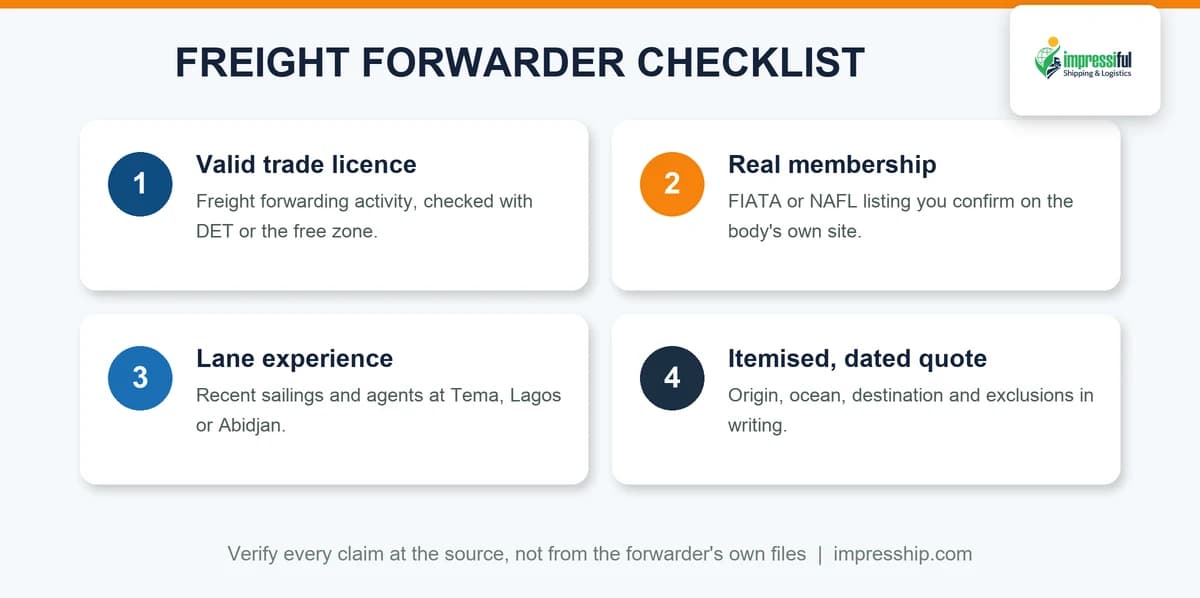
Every forwarder operating in Dubai needs a trade licence, issued either by the Department of Economy and Tourism for mainland companies or by a free zone authority such as JAFZA. Ask for the licence number and check that it is current and that freight forwarding or cargo services appears among the licensed activities. A general trading licence alone is not the same thing.
If the forwarder will also clear goods through UAE customs itself, ask how it is registered with Dubai Customs; many forwarders use a separate licensed broker for that step, which is fine as long as they tell you.
2. FIATA and NAFL membership, checked at the source#
FIATA, the International Federation of Freight Forwarders Associations, keeps a members directory. In the UAE, its national association is NAFL, the National Association of Freight and Logistics, founded in Dubai in 1992. Membership is not a licence, but it signals that the company accepts an industry code and, for FIATA documents, carries liability cover.
That last point is practical. FIATA states that anyone issuing its negotiable multimodal bill of lading must be a valid FIATA or national association member with valid liability insurance, according to the FIATA eFBL FAQ. A FIATA logo on a website proves nothing; a directory listing does.
3. Real experience on your West African lane#
Ask for two or three recent sailings to your port and the container numbers. You can track each one on the carrier's website in a minute. A forwarder that ships to Tema every week will know the documents Ghana and Nigeria require, the free time at the port and which shipping lines are reliable this season.
4. An itemised, dated quote#
A serious quote lists origin charges, ocean or air freight, destination charges you will pay locally, the validity date and what is excluded. A single "all in" figure with no breakdown usually hides charges that appear on arrival. Check that the Incoterm matches what you agreed with your supplier; our FOB vs CIF guide explains why that changes who pays for what.
Compare at least three quotes using the same CBM, weight and destination. The Dubai to Ghana cost guide and the Dubai to Nigeria guide carry planning ranges, so you can spot a rate that is too good to be real. For small loads, also ask the forwarder to price both options in our LCL vs FCL guide.
5. A named contact and a physical office#
You should be able to visit the warehouse or office, call a landline or named staff member and receive emails from a company domain. A business that exists only as a WhatsApp number is not automatically a scam, but it needs far more checking.
6. Clear insurance and claims terms#
Ask what the forwarder's liability is per kilo, whether it offers cargo insurance and how a claim is made. If you import into Ghana, remember that goods must now be insured locally, which our Ghana customs duty guide explains along with how insurance feeds into the CIF value.
Red flags that should make you walk away#
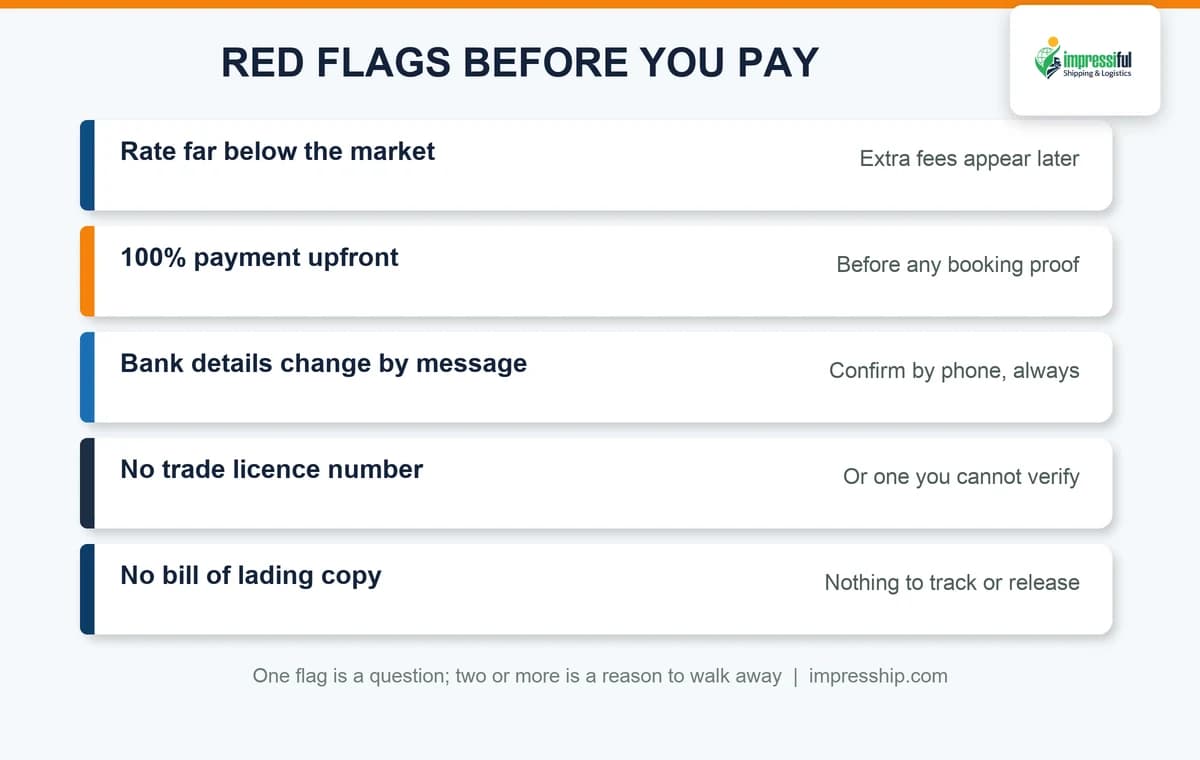
- A rate far below everyone else. Freight has real costs; the gap is usually recovered later as "release fees" at destination.
- 100 percent payment upfront before you see a booking confirmation or a draft bill of lading.
- Bank details that change by message or email. Always confirm a new account by calling a number you already trust.
- No licence number, or one you cannot verify with the issuing authority.
- No bill of lading copy after sailing. Without it, nothing can be tracked or released at the destination port.
- Pressure to decide today because "space is closing", with no booking number to prove it.
One flag on its own is a question to ask. Two or more is a reason to choose someone else.
Frequently asked questions#
How do I choose a freight forwarder in Dubai?#
Start by verifying the trade licence and its freight forwarding activity, then check any FIATA or NAFL membership on the association's own website. After that, ask for recent sailings on your lane and compare itemised, dated quotes from at least three companies. Our freight services page lists what a full service forwarder should cover.
Do freight forwarders need a licence in the UAE?#
Yes. A forwarder needs a trade licence that lists freight forwarding or cargo services as an activity, issued by the Department of Economy and Tourism for mainland Dubai or by a free zone authority. Clearing goods through UAE customs is a separate registration with Dubai Customs, which some forwarders hold and others contract to a broker.
What is FIATA and why does it matter?#
FIATA is the International Federation of Freight Forwarders Associations, the global body for the industry, and the UAE is represented through NAFL. Membership is not a licence, but issuers of the FIATA multimodal bill of lading must be members with liability insurance, as the FIATA eFBL FAQ explains. Always check the claim in FIATA's own directory.
How do I know if a freight forwarder is legitimate?#
Check that the licence number is current with the issuing authority, that the office exists and that the company can show container numbers you can track on the carrier's website. Be wary of rates far below the market, full payment upfront and bank details that change by message. A small trial shipment, ideally consolidated in Dubai, is the safest test.
What documents should a freight forwarder give me?#
You should receive a booking confirmation, a draft and then final bill of lading or air waybill, and copies of the export declaration and any certificates the destination requires. Our customs clearance documents guide lists what African ports expect.
Send your cargo details for a same-day quote#
Send us what you are shipping, the CBM or weight and your destination port in Ghana, Nigeria or Côte d'Ivoire, and we will send an itemised, dated quote from Dubai with destination charges shown, so you can compare it line by line.
Request a same-day quote or message us on WhatsApp with your cargo details. You can also read about our team before you decide.