
Shipping from China to Africa via Dubai: When the Jebel Ali Route Pays
When routing Chinese cargo through Dubai beats a direct sailing to Ghana, Nigeria or Côte d'Ivoire, the three ways to do it, and the documents that keep re-exports duty free.

China's trade with Africa reached a record USD 348.05 billion in 2025, and Chinese exports to the continent jumped 25.8 percent to USD 225.03 billion, according to the NTU Centre for African Studies. A growing share of those goods does not sail straight to Africa. Shipping from China to Africa via Dubai lets importers combine Chinese and Gulf purchases, split cargo between countries and hold stock close to West Africa. This guide shows when the Dubai route pays, how it works and what paperwork keeps it duty free.
For a single full container from one Chinese factory, a direct sailing to Tema, Lagos or Abidjan is usually faster and cheaper. The Dubai route earns its place when you buy from several suppliers in China and the UAE, ship mixed or smaller loads, serve more than one African market, or need part of the order to fly onward quickly.
When shipping from China to Africa via Dubai makes sense#
Dubai is not on the shortest line between Shanghai and Tema, so the case for it is never distance. It is about what can happen to your cargo at Jebel Ali, which handled 15.5 million TEUs in 2024, its highest throughput since 2015, according to DP World. That volume means frequent southbound sailings, deep warehouse capacity and plenty of consolidators who already serve West Africa.
| Your situation | Direct from China | Via Dubai |
|---|---|---|
| One supplier, one full container | Usually best: one booking, fewer handlings | Adds a transshipment for little gain |
| Several Chinese suppliers, small volumes | Several LCL bills of lading, several clearances | Consolidate into one shipment and one clearance |
| Buying in China and Dubai markets | Two separate shipments to Africa | Both meet in one Dubai warehouse |
| Cargo for Ghana and Nigeria together | Split at origin, decide early | Hold in Dubai, split when orders confirm |
| Part of the order is urgent | Air from China, often costly | Sail to Dubai, fly the urgent part on |
| Typical total sea time to West Africa | Typically 35 to 50 days | Longer; plan an extra 2 to 4 weeks |
The honest trade off is time. Cargo that stops in Dubai to be stored, repacked or combined takes longer than a through sailing, so the route suits planned stock, not emergencies. Our UAE to West Africa ocean freight guide shows realistic transit times on the Jebel Ali leg.

Need this handled end to end?
Tell us your lane and cargo profile and we'll come back with a routing plan and an all-in rate.
Three ways to route Chinese cargo through Dubai#
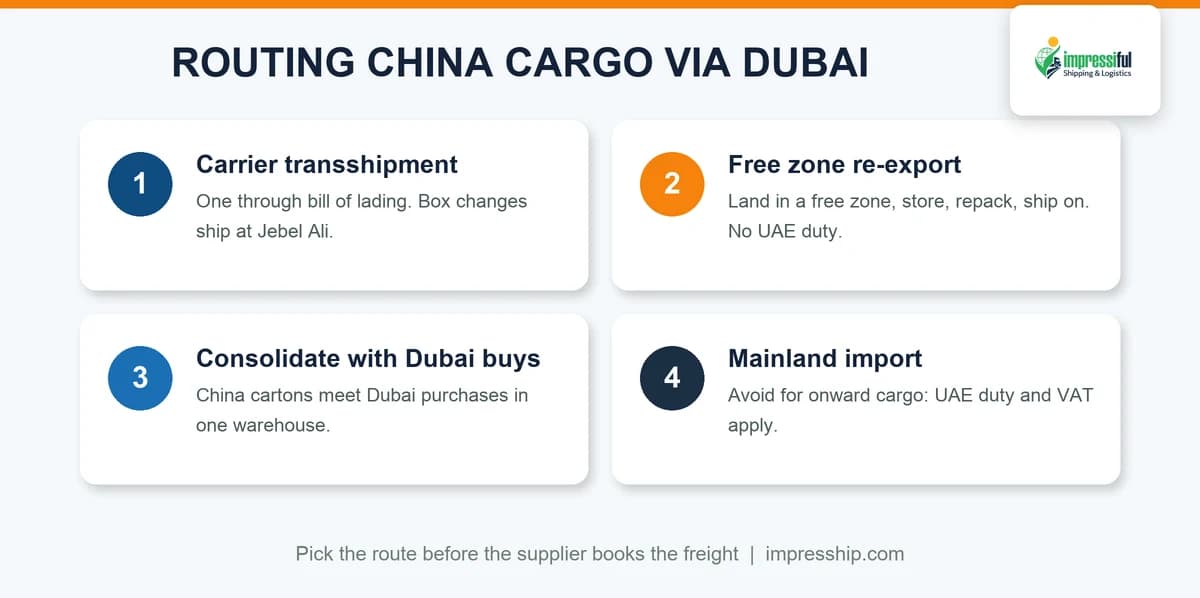
1. Carrier transshipment on one bill of lading. The shipping line moves your container from China to Jebel Ali and onto a West Africa service under a single through bill of lading. You never touch the cargo in Dubai; the box simply changes vessels. This is the lightest option, but it gives you none of the consolidation benefits.
2. Free zone storage and re-export. Goods land in a Dubai free zone such as JAFZA, next to the port, where they can be stored, relabelled, repacked and shipped on under customs suspension. As long as the cargo leaves the UAE for a non GCC destination through a proper transit or re-export declaration with Dubai Customs, no UAE import duty or VAT is paid on it.
3. Consolidation with your Dubai purchases. Chinese cartons are delivered to a Dubai warehouse, meet the goods you bought in Deira or Dragon Mart, and leave as one shipment. This is where the route saves the most, because you pay for one container or one block of LCL space and clear once at destination. Our cargo consolidation and warehousing service explains the receiving and repacking steps.
What to avoid: clearing Chinese goods into mainland Dubai and then exporting them again. That triggers UAE duty and VAT on the way in, and recovering them on re-export takes paperwork most importers never complete.
Buying terms that keep the freight in your hands#
The Incoterm on your Chinese supplier's invoice decides who controls the first leg. Buying FOB at a Chinese port, or CFR to Jebel Ali when the supplier's freight is genuinely cheap, lets your forwarder plan the whole chain to Africa. A supplier quoting CIF Tema will book a direct sailing, and your Dubai consolidation plan disappears. Our FOB vs CIF guide for African importers covers which term to ask for.
Size the Dubai to Africa leg once everything has arrived. Mixed loads under about 15 CBM usually ship as shared space, while larger combined orders fill a container; our LCL vs FCL from Dubai guide works through the break-even. If the cargo is time sensitive, compare air freight against ocean for the urgent share.
Documents, origin and destination customs#
Routing through Dubai does not change where your goods were made. Under rules of origin used by customs services worldwide, storage, repacking and relabelling do not confer a new origin, so Chinese goods stay Chinese at Tema or Lagos. Keep the Chinese commercial invoice, packing list and any certificate of origin, and make sure the Dubai re-export documents match them line by line.
Each destination then applies its own rules on the CIF value at arrival:
- Ghana: duty and levies assessed by the Ghana Revenue Authority; our Dubai to Ghana cost guide shows the full landed cost.
- Nigeria: the Form M must be opened before shipment and name the right origin and port of loading; see our Dubai to Nigeria shipping guide.
- Côte d'Ivoire: a BSC cargo tracking note is needed for the Jebel Ali to Abidjan leg, covered in our Dubai to Ivory Coast guide.
The customs documents checklist lists each paper and the errors that trigger holds.
Frequently asked questions#
Is it cheaper to ship from China or Dubai to Africa?#
For one full container from a single factory, a direct sailing from China is usually cheaper because there is only one booking and no Dubai handling. Dubai becomes cheaper overall when you combine several suppliers or Gulf purchases into one shipment, because you avoid paying for multiple partial loads and multiple clearances. Our team can price both routes side by side for your cargo.
How long does it take to ship from China to Ghana?#
A direct sailing from a major Chinese port to Tema typically takes about 35 to 50 days door to port, depending on the origin port and transshipments. Routing via Dubai adds the China to Jebel Ali leg and any storage time, so plan an extra two to four weeks. The Jebel Ali to Tema leg on its own is covered in our Ghana shipping cost guide.
Can I ship goods from China to Dubai and then to Nigeria?#
Yes. Goods can arrive at Jebel Ali under transshipment or into a free zone, then ship onward to Lagos as FCL or LCL. Make sure your Nigerian Form M and shipping documents reflect the real origin and port of loading, as our Nigeria shipping guide explains.
Do I pay customs duty in Dubai on re-exported goods?#
Not if the goods stay under customs control. Cargo held in a free zone such as JAFZA or moved under a transit declaration and re-exported outside the GCC pays no UAE import duty or VAT. Clearing goods into mainland Dubai first is what creates a duty bill.
What documents do I need to import from China to Africa through Dubai?#
You need the Chinese commercial invoice and packing list, a bill of lading for each leg or a through bill, any certificate of origin, and the Dubai re-export or transit declaration. The destination country then adds its own requirements, such as Nigeria's Form M or Côte d'Ivoire's BSC.
Send your cargo details for a same-day quote#
Tell us where your Chinese suppliers ship from, what you are adding in Dubai and which West African port it is going to, and we will quote the route end to end with the Dubai handling itemised.
Request a same-day quote or message us on WhatsApp with your cargo details.