
Volumetric Weight Explained: The Formula and How Air Cargo Is Charged
Volumetric weight explained for shippers in Dubai: the formula, why couriers divide by 5,000 and air cargo by 6,000, chargeable weight on four real shipments, and how to pay for less of it.
Volumetric weight explained in one line: it is why a light carton of clothes can cost more to fly than a heavy box of spare parts. Air cargo carries less than 1 percent of world trade by volume but more than 33 percent by value, according to IATA, so space on an aircraft is scarce and airlines charge for it. This guide explains the volumetric weight formula, why the divisor is 5,000 or 6,000, how chargeable weight is worked out on real shipments from Dubai, and how to pay for less of it.
Put simply, carriers measure every package, turn its size into a notional weight, and bill whichever is greater: that figure or the weight on the scale. It is the basis of every quote from our air freight services, so working it out before you book shows you what you will actually be charged on.
The volumetric weight formula#
The formula has three steps:
- Measure the length, width and height of each package in centimetres, at its widest points.
- Multiply the three figures to get cubic centimetres.
- Divide by the carrier's divisor to get the volumetric weight in kilograms.
Volumetric weight (kg) = length x width x height (cm) / divisor
Then compare it with the actual weight. The higher of the two is the chargeable weight, and that is the figure the freight rate is applied to. In inches and pounds the same idea applies with a different divisor (one inch is exactly 2.54 cm under the international definition), and our volumetric weight calculator converts the units for you.
5,000 or 6,000: which divisor applies#
The divisor depends on the type of service, not on the route.
| Service | Divisor | 1 CBM counts as | When we use it |
|---|---|---|---|
| Express courier, door to door | 5,000 | 200 kg | Our air shipments up to 50 kg chargeable weight |
| Standard air cargo | 6,000 | about 167 kg | Larger air cargo, quoted per shipment |
| Shared sea freight (LCL) | 1,000 | 1,000 kg | Sea freight is charged per CBM or per tonne |
A lower divisor gives a higher volumetric weight, so the same carton is billed heavier by a courier than as air cargo. That is why it is worth checking which divisor a quote uses before you compare two prices.
Volumetric weight explained with real shipments#
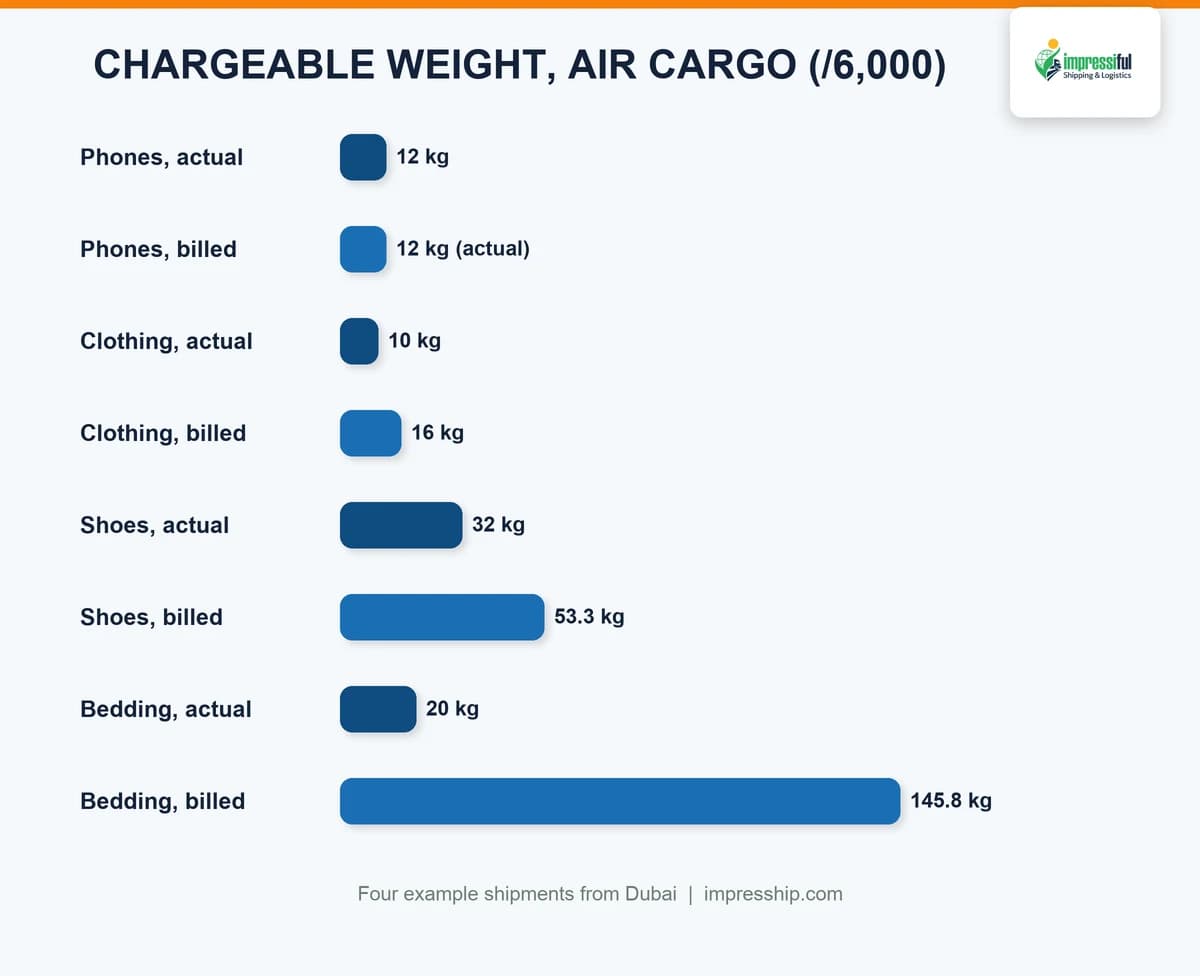
The table below runs four typical Dubai shipments through the formula at the 6,000 air cargo divisor.
| Shipment | Size and pieces | Actual weight | Volumetric weight | Chargeable weight |
|---|---|---|---|---|
| Phone accessories | 1 carton, 30 x 20 x 20 cm | 12 kg | 2 kg | 12 kg (actual) |
| Clothing samples | 1 carton, 60 x 40 x 40 cm | 10 kg | 16 kg | 16 kg (volumetric) |
| Shoes | 4 cartons, 50 x 40 x 40 cm | 32 kg | 53.3 kg | 53.3 kg (volumetric) |
| Pillows and bedding | 5 cartons, 70 x 50 x 50 cm | 20 kg | 145.8 kg | 145.8 kg (volumetric) |
Dense goods such as phone accessories pay on their real weight. Bulky, light goods pay for the space they take, and the pillows above are billed at more than seven times what they weigh. Carriers then round the chargeable weight up, usually to the next 0.5 kg, so 53.3 kg is billed as 53.5 kg.
Want the chargeable weight checked before you book?
Send us the carton sizes, pieces and weights. We will work out the chargeable weight, tell you whether air or sea suits the cargo better and quote it to your destination.
Per piece or for the whole shipment#
Some carriers compare the total actual weight with the total volumetric weight of the shipment. Others take the greater figure for each piece and add them up, which can cost more when you mix heavy and light cartons. If your shipment has both, ask which method the quote uses; our calculator shows both totals.
On pallets, the whole loaded pallet is measured as one piece, including the pallet base and any overhang, so a half full pallet is billed as if it were full to its highest point.
How to lower your chargeable weight#
- Use the smallest carton that protects the goods. Empty space inside the box is billed like cargo.
- Compress soft goods. Clothing, bedding and soft toys can often be vacuum packed or packed tighter.
- Combine parcels from several suppliers. Cartons collected at our shared warehouse in Dubai can be repacked into fewer, fuller boxes. Our cargo consolidation guide explains how it works.
- Send bulky, light goods by sea. In shared sea freight, 1 CBM counts as 1,000 kg before weight matters, so the pillows above would be a small LCL shipment. Sea already carries around 80 percent of world trade by volume, per UNCTAD. Our CBM calculator gives the volume, and the air vs ocean freight guide helps you decide.
Air freight from Dubai to Africa#
For lane details, our guides to air freight from Dubai to Accra and air cargo from Dubai to Lagos cover transit times, documents and clearance at destination. We do not publish air prices per kilogram because they change with fuel and capacity; the shipping calculator gives an estimate for small air shipments, and larger air cargo is quoted per shipment.
Frequently asked questions#
Why divide by 6000 for volumetric weight?#
The 6,000 divisor is the standard airlines use for general air cargo. It treats every 6,000 cubic centimetres as 1 kg, an assumed density of about 167 kg per cubic metre. Cargo lighter than that fills the hold before it reaches the weight limit, so it pays for the space it takes instead of its weight.
How to calculate volumetric weight?#
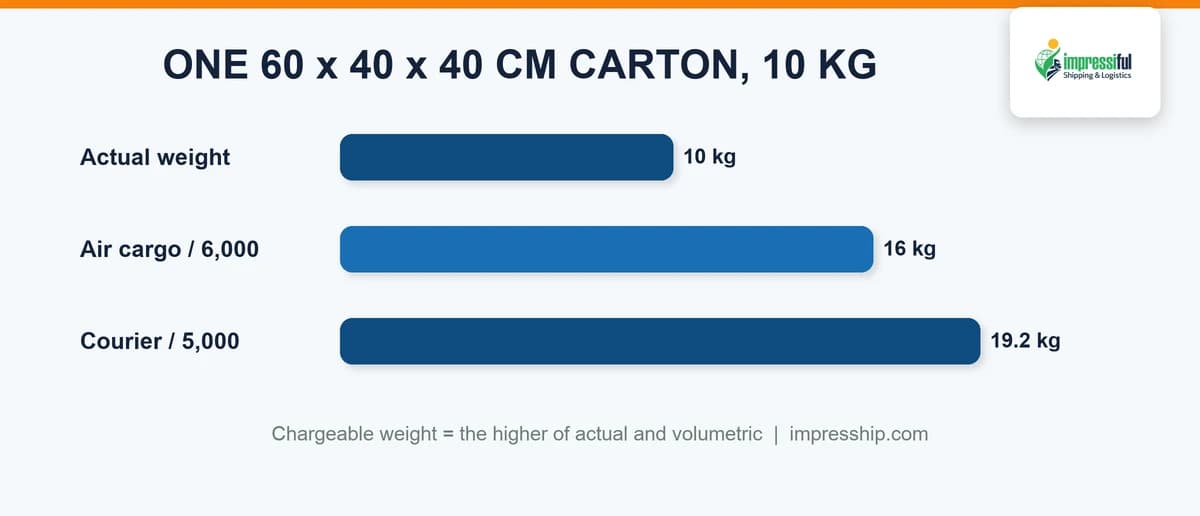
Multiply the length, width and height of the package in centimetres and divide by the divisor: 5,000 for most express couriers or 6,000 for standard air cargo. A 60 x 40 x 40 cm carton is 96,000 cubic centimetres, so it is 19.2 kg at 5,000 or 16 kg at 6,000, and our volumetric weight calculator does the sums for several cartons at once.
Is volumetric weight 5000 or 6000?#
Both are used. Express courier and parcel services usually divide by 5,000, while standard air cargo booked through a forwarder divides by 6,000. On our air service, shipments up to 50 kg chargeable weight use 5,000, and larger air cargo uses 6,000, as the shipping calculator notes explain.
Why is 1 CBM 167 kg?#
One cubic metre is 1,000,000 cubic centimetres, and dividing that by the 6,000 air cargo divisor gives 166.7 kg, rounded to 167 kg. So every cubic metre of air cargo is billed as at least 167 kg, or 200 kg at the courier divisor of 5,000, while in shared sea freight the same cubic metre counts as 1,000 kg.
How to calculate air cargo charges?#
Work out the chargeable weight first, the greater of the actual and volumetric weight, then multiply it by the rate for that weight band and add surcharges such as fuel and security. Rates change often, so ask for a quote on our contact page with your carton sizes, weights and destination airport.
Send your cargo details for a same-day quote#
Tell us what you are sending, the carton sizes, number of pieces, weights and the destination. We will confirm the chargeable weight, recommend air or sea, and quote the shipment with the destination charges spelled out. We can handle destination customs clearance, or you can use your own agent.
Request a same-day quote or message us on WhatsApp with your cargo details. See the UAE to Africa shipping guide for every lane we serve.