
Landed Cost in Ghana: How to Calculate the True Cost of Imports from Dubai
How to calculate the landed cost in Ghana for imports from Dubai: the CIF base, import duty bands, levies and the 2026 VAT stack, port and clearing charges, and a worked USD example down to the cost per unit.
Since 1 January 2026, every import into Ghana pays VAT at 15 percent plus NHIL and GETFund at 2.5 percent each, a flat 20 percent on the duty inclusive value, as the Ghana Revenue Authority notice on the VAT Act, 2025 (Act 1151) confirms. Add import duty of 0 to 35 percent and a handful of levies, and the taxes alone can come close to half of the goods' value. That is why working out the landed cost in Ghana before you pay a Dubai supplier matters so much. This guide gives you the formula, a worked example in US dollars and a simple way to turn the total into a cost per unit you can price from.
In practice, the landed cost in Ghana is everything you pay to get the goods onto your shelf: the supplier's price, Dubai origin charges, sea freight, insurance, import duty, levies, the VAT stack, port and clearing charges and delivery to your warehouse. Divide that total by the units shipped and you have the number your selling price must beat.
What the landed cost in Ghana includes#
Some costs sit inside the customs value that Ghana taxes, and some are added afterwards. Knowing which is which stops you from double counting or, worse, leaving a line out.
| Cost line | Who charges it | Part of the customs value? |
|---|---|---|
| Goods (supplier invoice) | Supplier in Dubai | Yes |
| Origin charges and export documents | Forwarder in Dubai | Yes, up to loading on the vessel |
| Sea freight to Tema | Forwarder or shipping line | Yes |
| Cargo insurance | Local insurer in Ghana | Yes |
| Import duty and levies | Ghana Revenue Authority, via ICUMS | No, charged on it |
| VAT, NHIL and GETFund | Ghana Revenue Authority, via ICUMS | No, charged on value plus duty and levies |
| Port, terminal and delivery order charges | Terminal and shipping line | No |
| Clearing agent fee | Licensed customs agent | No |
| Delivery to your warehouse | Haulier | No |
Ghana charges duty on the CIF value, meaning cost, insurance and freight to the port of entry. Our FOB vs CIF guide explains how the Incoterm on your invoice changes what you declare.
The landed cost formula, step by step#
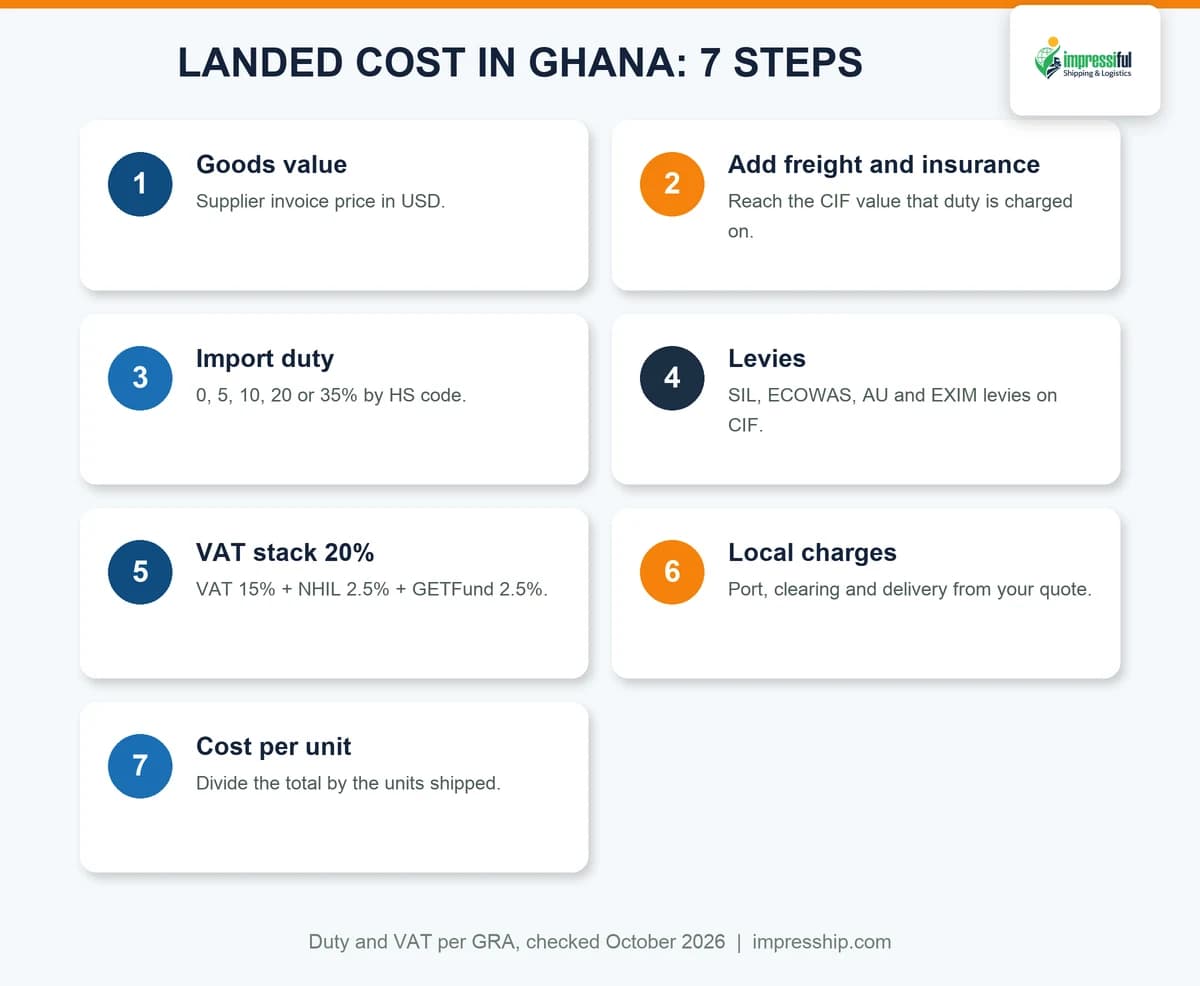
Every landed cost calculation for Ghana follows the same order, whatever the product.
- Start with the goods value. Use the price on the commercial invoice, in US dollars.
- Add freight and insurance to reach CIF. This is the base that duty is charged on.
- Apply import duty. The rate depends on the HS code of the goods.
- Add the levies. Most are small percentages of the CIF value.
- Apply the 20 percent VAT stack. It is charged on CIF plus duty and levies.
- Add the local charges. Port, clearing and delivery costs from your dated quote.
- Divide by the units shipped. That gives your landed cost per unit.
Freight and insurance: the CIF part of the sum#
Freight is not only a shipping bill. Because it sits inside CIF, every dollar of freight is also taxed, so a cheaper route lowers your duty and VAT as well.
Our sea freight estimates from Dubai to Tema are about USD 337 per CBM for LCL, USD 10,500 to 12,500 for a 20ft container and USD 11,700 to 15,000 for a 40ft, with about 30 to 48 days at sea. These are estimates for sea freight only. They depend on the product, and Dubai pickup, destination charges, duty and clearance are extra. You can bring your cargo to us or ask for a pickup quote. For most loads up to roughly 30 CBM, LCL is the sensible choice; once a load approaches a full container, our team recommends a 40ft. Our LCL vs FCL guide shows the arithmetic, and the CBM calculator helps you measure the volume first. For air freight, use the shipping calculator, which shows current estimates for both modes.
Insurance belongs in CIF too. Since 1 February 2026, imported goods other than personal effects must be insured locally under Section 222 of the Insurance Act, 2021 (Act 1061), as the Ghana Shippers' Authority reported on 9 April 2026. Budget for a Ghanaian marine cargo policy; our cargo insurance guide explains how cover works.
Working out the landed cost of a Ghana shipment?
Send the goods value, CBM and weight, and we will quote the sea freight to Tema so the CIF line in your calculation is a real number.
Duty, levies and VAT at Tema#
The GRA customs tariffs and levies page sets out the five ECOWAS bands Ghana applies: 0 percent for essential social goods, 5 percent for basic raw materials and capital goods, 10 percent for intermediate goods, 20 percent for finished consumer goods and 35 percent for specific goods. GRA also lists the charges that sit alongside duty, including VAT, NHIL, GETFund, the ECOWAS and African Union levies and the Special Import Levy.
The rates we use below are the ones in our import duty calculator, checked on 14 October 2026: Special Import Levy 2 percent (not charged on most machinery and electrical goods), ECOWAS levy 0.5 percent, African Union levy 0.2 percent and EXIM levy 0.75 percent, all on CIF. Our Ghana customs duty calculation guide goes through each line in detail. Your clearing agent's assessment on ICUMS is always the final word.
A worked landed cost calculation in USD#
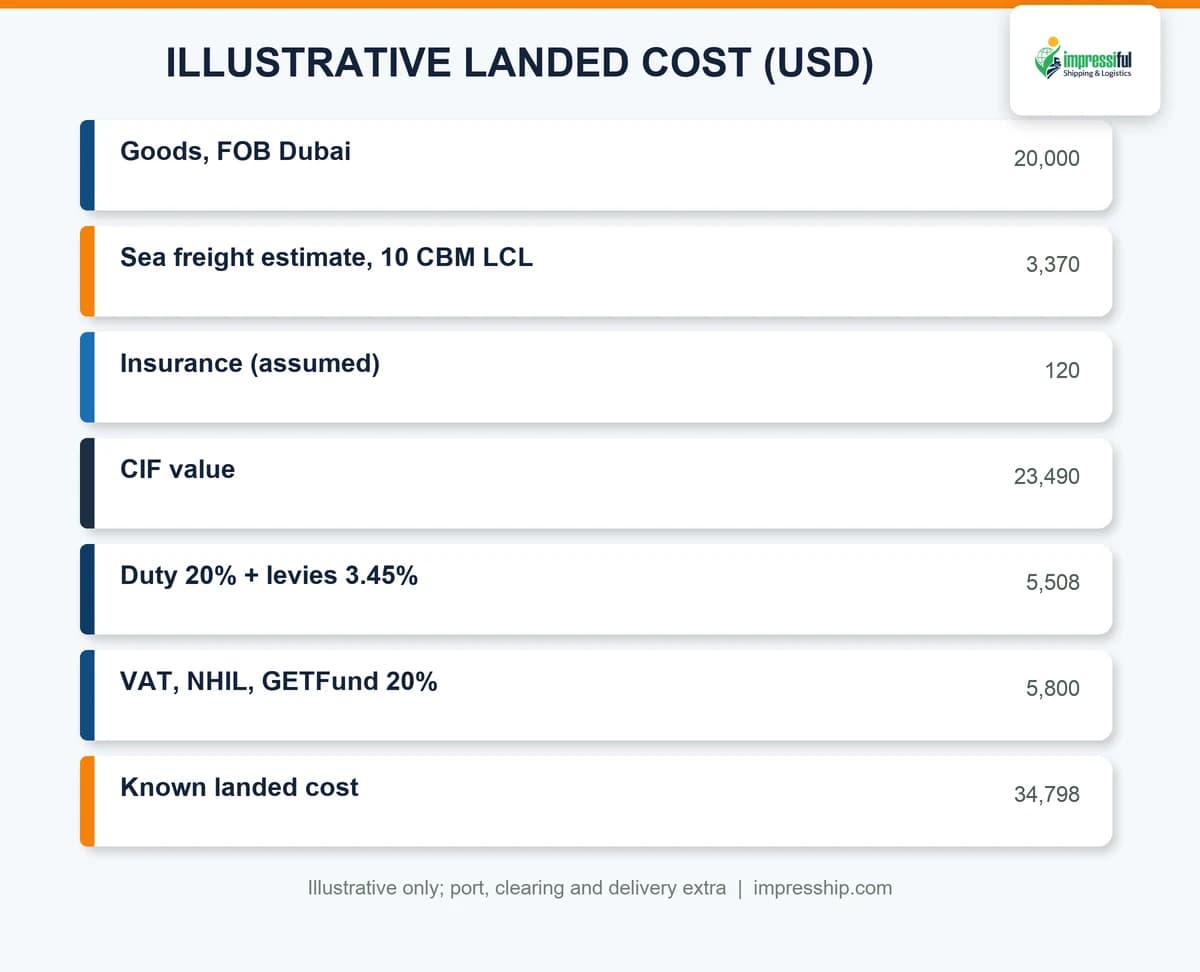
This example is illustrative only. It assumes 1,000 units of clothing (a 20 percent band product) bought for USD 20,000 FOB Dubai, shipped as 10 CBM of LCL at our estimate of about USD 337 per CBM, with insurance assumed at USD 120. Ghana assesses in cedis at the customs exchange rate, so your figures will differ slightly.
| Line | How it is worked out | USD |
|---|---|---|
| Goods, FOB Dubai | Supplier invoice | 20,000 |
| Sea freight estimate | 10 CBM x 337 | 3,370 |
| Insurance (assumed) | Local policy | 120 |
| CIF value | Goods + freight + insurance | 23,490 |
| Import duty, 20 percent | 23,490 x 20% | 4,698 |
| Levies, 3.45 percent | SIL, ECOWAS, AU and EXIM on CIF | 810 |
| VAT, NHIL and GETFund, 20 percent | (23,490 + 4,698 + 810) x 20% | 5,800 |
| Taxes at Tema | Duty + levies + VAT stack | 11,308 |
| Known landed cost | CIF + taxes | 34,798 |
| Port, clearing and delivery | From your dated quote | add |
On these assumptions the known landed cost is about USD 34.80 per unit before port, clearing and delivery charges. The figures leave out the ICUMS fee, withholding tax and any inspection fees, as our duty calculator does, because their current rates could not be confirmed. Ask your clearing agent to add them.
From landed cost to cost per unit#
The per unit figure is where landed cost becomes useful. Three adjustments make it accurate.
- Recover VAT if you can. Under Act 1151, NHIL and GETFund are treated as input tax along with VAT, so a VAT registered importer can usually claim the USD 5,800 back. In the example, that brings the cost per unit down to about USD 29.00.
- Split shared costs sensibly. For mixed shipments, share freight by volume or weight and duty by the value of each product line, because each HS code carries its own rate.
- Use dated quotes. Freight estimates and the cedi rate both move, so recalculate before each order rather than reusing last quarter's number.
Five mistakes that distort the landed cost#
- Calculating duty on FOB. Ghana charges it on CIF, so freight and insurance must be added first.
- Forgetting the VAT stack sits on top of duty. The 20 percent applies to CIF plus duty and levies, not CIF alone.
- Leaving out local charges. Port, terminal, clearing and delivery costs are real costs even though they are not taxed.
- Using a guessed HS code. GRA lists the documents a declaration needs on its import procedures page, and the invoice description has to support the code you declare.
- Paying for half empty containers. Consolidating several Dubai suppliers into one shipment spreads the fixed costs; our consolidation and warehousing guide explains how.
Frequently asked questions#
How to calculate landed cost of imported goods?#
Add the goods value, origin charges, freight and insurance to reach the CIF value, then add import duty, levies and VAT, and finally the port, clearing and delivery charges. For Ghana, the taxes follow the GRA tariff bands and levies and are assessed on ICUMS. Dividing the total by the number of units gives the landed cost per unit.
How to calculate import duty in Ghana?#
Multiply the CIF value in cedis by the duty rate for the HS code, which is 0, 5, 10, 20 or 35 percent, then add the levies and the 20 percent VAT stack on the total. Our Ghana customs duty calculation guide works through a full example, and your clearing agent confirms the assessment on ICUMS.
How to calculate total landing cost?#
Total landing cost is the same as landed cost: every cost from the supplier's price to delivery at your warehouse. Build it line by line in a spreadsheet, keep the taxed lines (goods, freight, insurance) separate from the untaxed local charges, and check the result against the estimate from our import duty calculator.
How can I calculate import fees?#
Import fees are the duty, levies and VAT that customs charges, plus the port and clearing charges you pay to release the goods. The taxes depend on the HS code and CIF value, while the local charges come from your forwarder's and clearing agent's quotes. For the freight part, the shipping calculator gives a starting estimate.
Is VAT part of the landed cost in Ghana?#
Yes, it is paid at the port, so it is part of the cash you need to clear the goods. If you are VAT registered, VAT, NHIL and GETFund can usually be claimed back as input tax, so your long term cost per unit is lower than the cash paid at Tema, as the GRA notice on Act 1151 explains.
Send your cargo details for a same-day quote#
Tell us what you are buying in Dubai, the goods value, the volume and weight, and whether the cargo is going to Tema or inland. We will quote the sea freight to Tema with the destination charges spelled out, so the freight line in your landed cost is a real number. We ship general cargo and dangerous goods to Ghana, with every dangerous goods shipment subject to approval, and we provide telex release bills of lading.
Request a same-day quote or message us on WhatsApp with your cargo details. Our customs clearance service can also check your invoice and HS codes before loading.