
Cargo Insurance Explained: ICC A, B and C for UAE to Africa Shipments
Cargo insurance explained for importers shipping from the UAE to Africa: what ICC (A), (B) and (C) cover, why carrier liability is limited, who insures under CIF and CIP, how much cover to buy and how to claim.
An estimated 1,478 containers were lost at sea in 2025, up from 576 in 2024, according to the World Shipping Council. That is a tiny share of the roughly 280 million containers moved, but total losses are only part of the risk: theft, water damage and rough handling hit far more shipments. This guide to cargo insurance explains what the Institute Cargo Clauses (A), (B) and (C) cover, why the carrier's liability rarely pays the value of your goods, how much cover to buy and how to claim on a UAE to Africa shipment.
For most importers, the short version is this: the carrier's liability is capped by law and depends on proving fault, so cargo insurance is what actually protects the value of your goods. ICC (A) gives the widest cover, ICC (B) and (C) only pay for named events, and the Incoterm you agree decides who has to buy it.
Why carrier liability is not cargo insurance#
Many importers assume the shipping line pays if a container is lost or damaged. It does, but only up to a limit, and only when the carrier is at fault. Under the Hague-Visby Rules, which shape most ocean bills of lading, a carrier's liability is capped at 666.67 units of account (SDR) per package or 2 SDR per kilogram, whichever is higher, as set out in the Carriage of Goods by Sea Act 1971 schedule. For a carton of phones or perfume, that cap can be a small fraction of the invoice value.
Carriers can also rely on defences such as perils of the sea or fire not caused by their fault. A cargo insurance policy pays for covered loss without you having to prove the carrier was negligent; the insurer then pursues the carrier itself. Your bill of lading sets out the carrier's terms, so read it alongside your policy.
Need this handled end to end?
Tell us your lane and cargo profile and we'll come back with a routing plan and an all-in rate.
ICC (A), (B) and (C): what each clause covers#
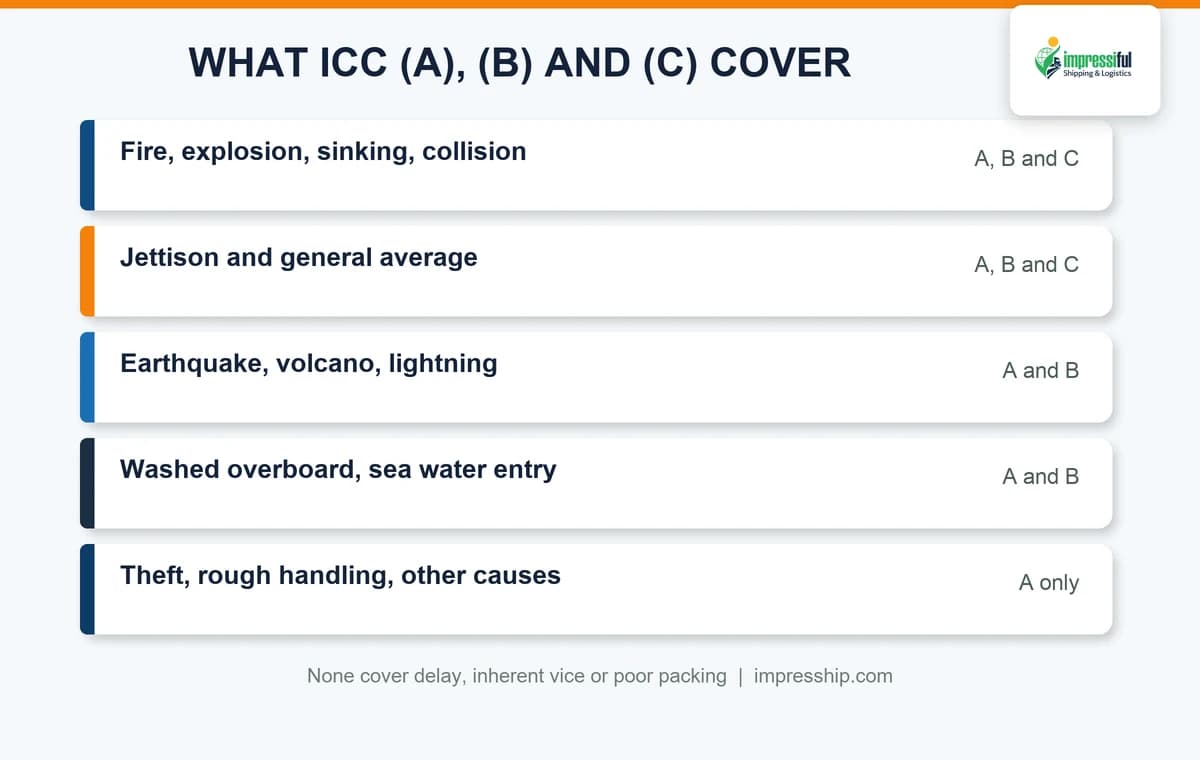
Most marine cargo policies worldwide are written on the Institute Cargo Clauses, published by the London market. There are three main sets:
| Risk | ICC (A) | ICC (B) | ICC (C) |
|---|---|---|---|
| Fire or explosion | Covered | Covered | Covered |
| Vessel sinking, stranding or capsizing, collision | Covered | Covered | Covered |
| General average sacrifice and jettison | Covered | Covered | Covered |
| Earthquake, volcanic eruption, lightning | Covered | Covered | Not covered |
| Washing overboard, sea or river water entering the container | Covered | Covered | Not covered |
| Whole package lost overboard or dropped during loading | Covered | Covered | Not covered |
| Theft, pilferage, non delivery | Covered | Not covered | Not covered |
| Rough handling, breakage, other accidental damage | Covered | Not covered | Not covered |
ICC (A) is often called all risks: it covers any loss or damage except what the clause specifically excludes. ICC (B) and ICC (C) are named perils covers; if the cause of loss is not on the list, there is no claim. For mixed retail goods, electronics or anything theft prone, ICC (A) is usually the sensible choice.
What no standard clause covers#
All three sets exclude loss caused by delay, inherent vice (the nature of the goods themselves, such as natural spoilage), ordinary leakage and wear, insufficient or unsuitable packing, and wilful misconduct by the insured. War and strikes are excluded too and are added through separate Institute War and Strikes Clauses. If your cargo includes perfume, aerosols or batteries, declare them correctly; misdeclared dangerous goods can invalidate a claim as well as a booking.
Who buys cargo insurance: the Incoterm decides#
Under Incoterms 2020, only two rules oblige the seller to insure. The International Chamber of Commerce explains that CIF keeps Institute Cargo Clauses (C) as the default minimum, while CIP now requires cover compliant with Institute Cargo Clauses (A). In both cases the minimum insured amount is the contract price plus 10 percent.
Under EXW, FCA, FOB, CFR and CPT, risk passes to the buyer at or near origin, so an importer buying FOB Khor Fakkan carries the risk for the whole voyage to Tema, Lagos, Mombasa or Durban. If you buy CIF, check whether your supplier's cover is only ICC (C) and whether you can claim on it in your own country. Our FOB vs CIF guide shows how the choice also changes your duty base.
How much cover to buy and what it costs#
Insure the CIF value plus 10 percent. The extra 10 percent is the market standard for expected profit and incidental costs, and it matches the Incoterms minimum. Insuring only the supplier's invoice leaves the freight and your margin uncovered.
Premiums are a percentage of the insured value. For general containerised cargo on ICC (A), rates are typically a fraction of 1 percent. They rise for fragile, high value or theft prone goods, used items, and routes rated as higher risk; the International Union of Marine Insurance notes that the Gulf of Guinea remains a high risk zone attracting additional war risk and piracy premiums.
| Factor | Effect on the premium |
|---|---|
| ICC (A) instead of ICC (C) | Higher rate, much wider cover |
| Electronics, phones, perfume, other theft prone goods | Typically higher |
| Used goods or minimal packing | Higher, or cover limited to total loss |
| LCL consolidation with extra handling | Can be higher than a sealed FCL |
| Destination rated as high risk | War and strikes cover may cost extra |
Annual or single shipment. Regular importers often take an annual open cover that insures every shipment automatically; occasional shippers buy single shipment cover. Some African markets also require or encourage imports to be insured with local insurers, so check the rules in your country before you buy cover abroad.
How to make a cargo insurance claim#
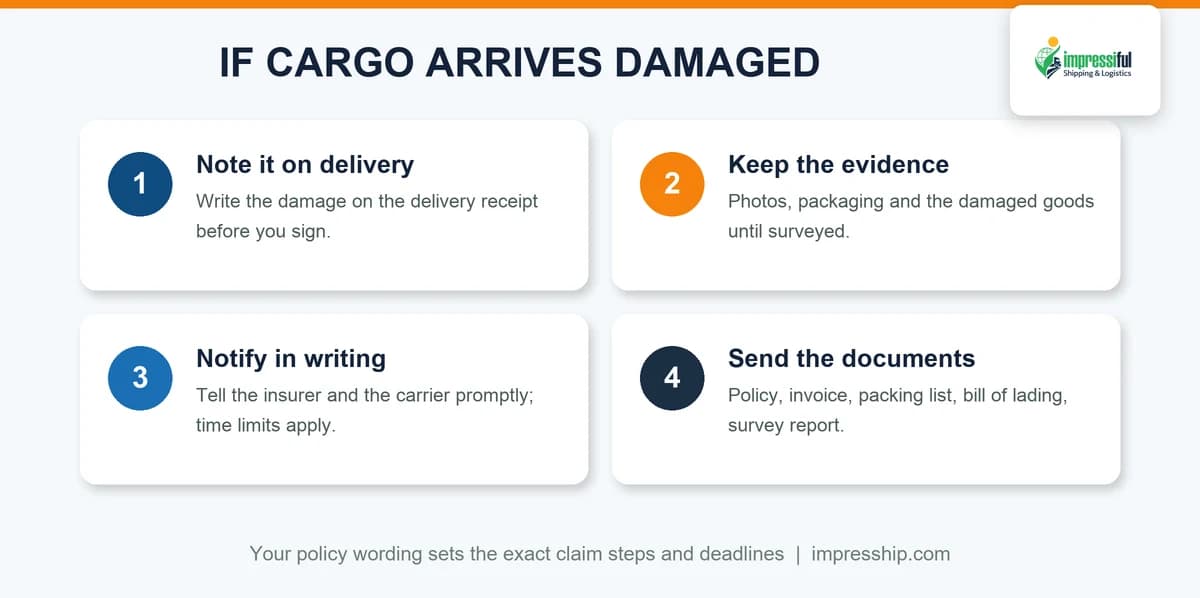
- Inspect before you sign. Write any visible damage or shortage on the delivery receipt; a clean signature makes recovery harder.
- Keep the evidence. Photograph the container, seals, packaging and goods, and keep the damaged items until a surveyor has seen them.
- Notify in writing, quickly. Tell your insurer and the carrier. Under the Hague-Visby Rules, hidden damage must be notified to the carrier within three days of delivery, and court action must be started within one year.
- Send the documents. Policy or certificate, commercial invoice, packing list, bill of lading, survey report and your claim letter.
Cover usually runs warehouse to warehouse, from the moment goods leave the supplier's premises until delivery at the final warehouse, within the time limits in the policy. If cargo waits at a consolidation warehouse in Dubai first, confirm that period is covered too; our consolidation and warehousing guide explains how that stage works.
Frequently asked questions#
What is meant by cargo insurance?#
Cargo insurance pays for physical loss of or damage to goods in transit, up to the insured value, for the risks listed in the policy. You pay a premium based on the goods, route and cover, and if a covered loss happens the insurer pays you and then recovers what it can from the carrier. It works alongside your ocean freight or air booking, not inside it.
What are the different types of cargo insurance?#
The standard types are the Institute Cargo Clauses, bought for a single shipment or under an annual open cover. The standard types are the Institute Cargo Clauses, bought for a single shipment or under an annual open cover. ICC (A) covers all risks except listed exclusions, while ICC (B) and ICC (C) only cover named events such as fire, sinking and collision. ICC (B) adds earthquake, lightning and water entry, and only ICC (A) covers theft and rough handling. The ICC's Incoterms 2020 guidance sets ICC (C) as the CIF minimum and ICC (A) for CIP.
What is the minimum cargo insurance coverage?#
In most trades there is no legal minimum, because cargo insurance is not usually compulsory. The minimum is set by contract: under CIF the seller must buy at least ICC (C) cover for 110 percent of the contract value, and under CIP ICC (A), and banks often require it under a letter of credit. Some countries require imports to be insured locally, so check before you ship; our Dubai to Nigeria guide covers the Lagos side of the process.
What is the cost of cargo insurance?#
The premium is a percentage of the insured value, usually the CIF value plus 10 percent. For general cargo on ICC (A) it is typically a fraction of 1 percent, rising for theft prone goods, used items and higher risk routes.
What does cargo insurance not cover?#
Standard clauses exclude delay, inherent vice, ordinary leakage and wear, poor packing and wilful misconduct, and war and strikes need separate clauses. Losses caused by misdeclared cargo can also be refused, which is why accurate customs clearance documents and cargo descriptions matter.
What is general average in shipping?#
General average is a maritime rule under which all cargo owners share the cost of a sacrifice made to save the voyage, such as jettisoning cargo or paying for salvage. Each owner contributes in proportion to the value of their goods, even if their own cargo is undamaged, and the cargo will not be released until security is given. All three ICC sets cover your general average contribution, which is often the strongest reason to insure.
Send your cargo details for a same-day quote#
Tell us what you are shipping, the invoice value, the Incoterm you have agreed with your supplier and the destination port in Africa. We will quote the freight and flag where the risk sits on your terms, so you know whether you or your supplier needs to arrange cover. We ship general cargo and dangerous goods, with every dangerous goods shipment subject to approval, by ocean or air freight.
Request a same-day quote or message us on WhatsApp with your cargo details.