
Container Sizes Guide: 20ft vs 40ft vs 40ft High Cube for UAE to Africa Shipping
Container sizes compared for shipping from the UAE to Africa: 20ft vs 40ft vs 40ft high cube dimensions, CBM, payload, which box suits your cargo, VGM weight rules and how the size changes your cost.
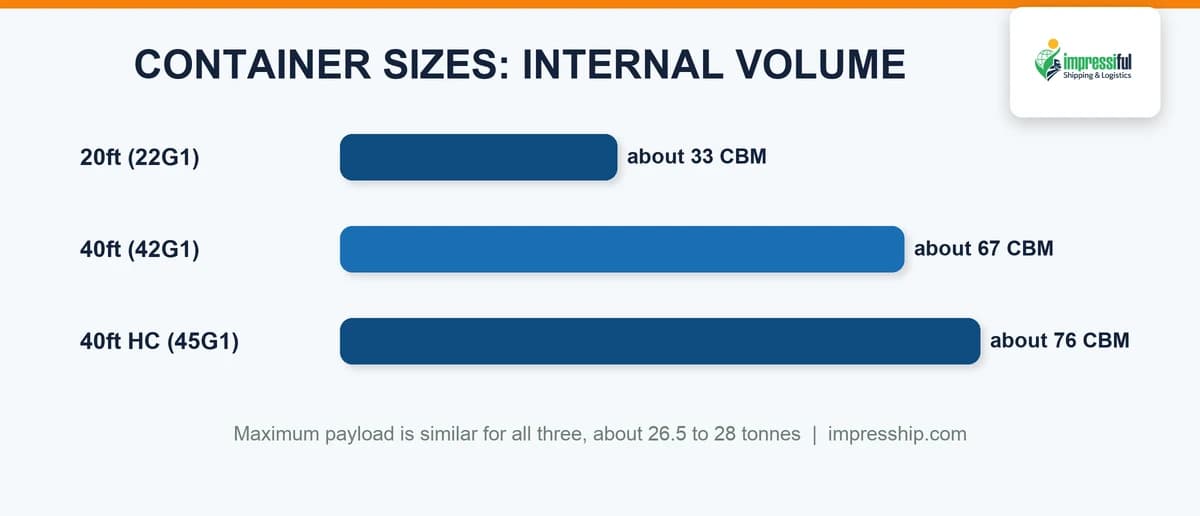
A 20ft container holds about 33 CBM, a 40ft about 67 CBM and a 40ft high cube about 76 CBM, yet all three carry a similar maximum weight. That one fact decides most container bookings from the UAE to Africa. This guide to container sizes compares the 20ft, 40ft and 40ft high cube on dimensions, payload, realistic loading and cost, shows which box suits which cargo, and explains the weight rules that apply before your container is allowed on a vessel.
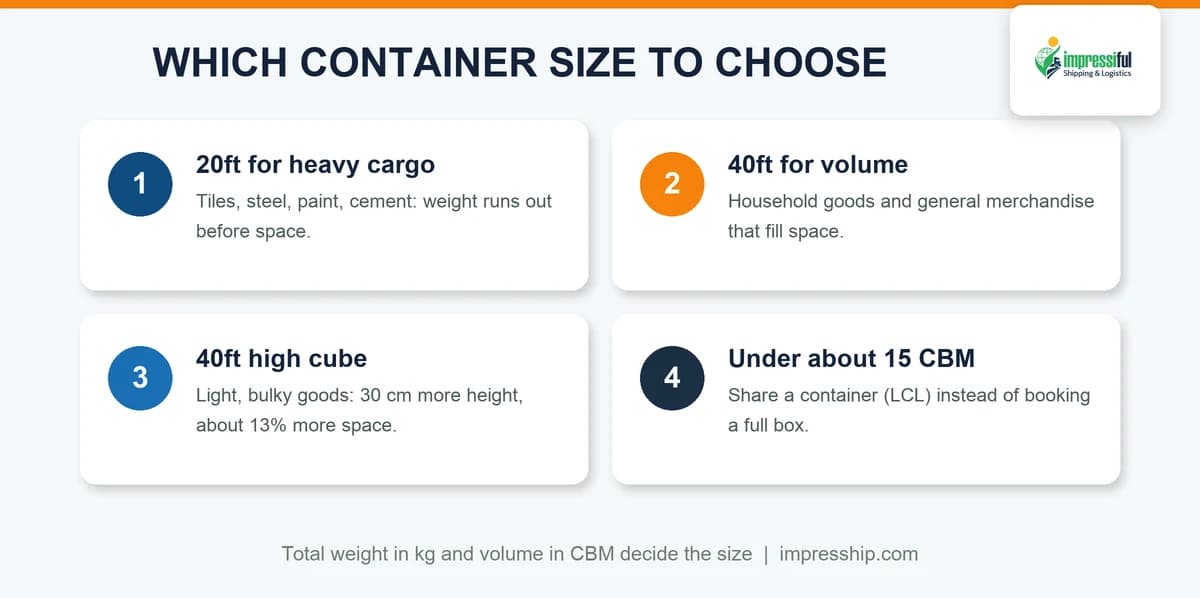
For most UAE to Africa shippers, choosing between container sizes comes down to weight versus volume. Heavy, dense cargo such as tiles, steel or paint fills a 20ft by weight long before it fills it by space. Light, bulky cargo such as furniture, mattresses or mixed retail goods needs the space of a 40ft, and usually the extra height of a 40ft high cube.
Container sizes at a glance#
The figures below are typical for general purpose dry containers built to the ISO 668 standard. Exact weights vary by box and carrier, so the data plate on the door and your booking confirmation always take priority.
| Specification | 20ft standard | 40ft standard | 40ft high cube |
|---|---|---|---|
| ISO size type code | 22G1 | 42G1 | 45G1 |
| External length x width x height | 6.06 x 2.44 x 2.59 m | 12.19 x 2.44 x 2.59 m | 12.19 x 2.44 x 2.90 m |
| Internal length x width x height (approx.) | 5.90 x 2.35 x 2.39 m | 12.03 x 2.35 x 2.39 m | 12.03 x 2.35 x 2.69 m |
| Internal volume | about 33 CBM | about 67 CBM | about 76 CBM |
| Realistic load for cartons | 25 to 28 CBM | 55 to 58 CBM | 65 to 68 CBM |
| Tare (empty) weight | about 2,200 to 2,400 kg | about 3,700 to 3,900 kg | about 3,900 to 4,200 kg |
| Maximum payload (typical rating) | about 28,000 kg | about 26,500 to 28,500 kg | about 26,500 to 28,500 kg |
| Pallets, one layer (1.2 x 1.0 m) | 10 | 20 to 21 | 20 to 21 |
The codes on the container door follow the BIC size type code system: the first digit is the length (2 for 20ft, 4 for 40ft), the second is the height (2 for 8 ft 6 in, 5 for 9 ft 6 in high cube), and G1 means general purpose. So 45G1 is a 40ft high cube, not a 45ft box.
20ft container: for heavy, dense cargo#
The 20ft is the workhorse for building materials, machinery parts, tiles, paint, cables and other heavy goods. Because its weight limit is close to that of a 40ft, a 20ft loaded with dense cargo is the cheapest way to move the most kilograms.
It is also the natural first step up from shared space. For most loads up to roughly 30 CBM, consolidation usually wins; our LCL vs FCL guide shows the arithmetic, and once your load approaches a full container our team recommends a 40ft. A 20ft is easier to truck on poor inland roads too, which matters on long corridors to landlocked countries served through gateway ports listed on our destinations page.
40ft container: for volume, not extra weight#
A 40ft standard gives you twice the floor length and about twice the volume of a 20ft, but not twice the payload. It suits household goods, furniture, packaged foods, general merchandise and anything that fills space before it reaches the weight limit.
The common mistake is booking a 40ft for heavy cargo because it looks like better value. If your goods weigh 24 tonnes but only take 18 CBM, a 40ft carries the same weight with half the box empty, at a higher freight rate. Two 20ft containers are often the better choice for very heavy loads.
Not sure which container size you need?
Send your packing list with weights and CBM, and we will recommend 20ft, 40ft or high cube and quote the full lane to your African port.
40ft high cube: the extra 30 cm#
A 40ft high cube is the same length and width as a 40ft standard but about 30 cm taller inside, which adds roughly 9 CBM, about 13 percent more space. For light, bulky cargo that often means one more layer of cartons or pallets, and it is typically priced at or close to the 40ft standard rate.
High cubes are the default for e-commerce stock, mixed retail goods, furniture and consolidated loads built from several suppliers. If you consolidate purchases in Dubai first, our consolidation and warehousing guide explains how a warehouse plans the load to use that extra height.
High cube or HQ: the same container#
"HC" and "HQ" are simply two abbreviations for high cube, the same 9 ft 6 in tall container. Some lines also write 40HC or 45G1 on the booking. Ask for the size type code if you need to be certain.
Which container size for your cargo?#
| Cargo | Usual choice | Why |
|---|---|---|
| Tiles, marble, steel, cement, paint | 20ft | Reaches the weight limit before the volume limit |
| Machinery parts, generators, cables | 20ft or 40ft | Depends on dimensions and weight per piece |
| Furniture, mattresses, household goods | 40ft high cube | Light and bulky, benefits from extra height |
| Mixed retail goods, electronics, e-commerce stock | 40ft high cube | Maximum cartons per box lowers cost per unit |
| One car or SUV | 20ft | Most cars fit with room for securing |
| Two or more vehicles | 40ft or 40ft high cube | Space for two cars, more with racking |
| Dangerous goods (perfume, batteries, aerosols) | 20ft usually | Smaller lots, segregation and placard rules |
Dangerous goods need correct classification and packing before any container is booked; we ship them, with every dangerous goods shipment subject to approval, and our dangerous goods guide covers the paperwork.
Weight limits: payload, VGM and road rules#
The container's rated payload is only the first limit. Since 1 July 2016, the shipper must provide a verified gross mass (VGM) for every packed container before it can be loaded, under the SOLAS rules explained by the International Maritime Organization. The VGM is either the weighed packed container, or the weight of all cargo, packing and securing material plus the container's tare. A container without a VGM should not be loaded.
Carriers and roads set their own limits. Some lines cap the weight of 20ft boxes on certain services, and many African countries enforce axle load limits on trucks leaving the port. A 20ft packed to 28 tonnes may need a heavier trailer or a split load for inland delivery, so share your final destination when you ask for a quote.
Load evenly and secure the cargo. Heavy items go on the floor and spread across the length, with nothing able to shift at sea. The CTU Code, the IMO, ILO and UNECE code of practice for packing cargo transport units, is the reference most warehouses follow.
What each container size costs on African lanes#
Ocean freight is charged per container, not per CBM, so a full box gets cheaper per unit as it gets bigger. On our Dubai to Nigeria lane, our sea freight estimates into Lagos are USD 11,300 to 13,500 for a 20ft and USD 12,600 to 16,200 for a 40ft. That is only modestly more money for twice the space, which is why a well filled 40ft or high cube usually gives the lowest cost per carton, and why our team recommends a 40ft for full loads. These are estimates for sea freight only and depend on the product: Dubai pickup, destination charges, duty and clearance are extra, and you can bring your cargo to us or ask for a pickup quote.
Destination charges follow the same logic: terminal handling, clearing and trucking are mostly priced per container, so one 40ft is normally cheaper to clear than two 20ft boxes. Our Dubai to Ghana cost guide breaks those charges down for Tema. Container prices are unstable, so treat these as estimates and ask for a dated quote for ocean freight.
Frequently asked questions#
What is the difference between a 20ft and 40ft container?#
A 40ft container is twice as long as a 20ft and holds about twice the volume, roughly 67 CBM against 33 CBM, but its maximum payload is about the same. A 20ft suits heavy, dense cargo, while a 40ft suits light, bulky goods. Our LCL vs FCL guide explains when either beats shared space.
What size is a 40ft and 20ft container?#
Externally, a 20ft is about 6.06 m long and a 40ft about 12.19 m, both 2.44 m wide and 2.59 m high. Inside, the usable length is about 5.90 m and 12.03 m, with roughly 2.35 m of width and 2.39 m of height. The ISO 668 standard sets the external dimensions and ratings.
What are the sizes of a 20ft container?#
A 20ft standard measures about 5.90 m long, 2.35 m wide and 2.39 m high inside, giving about 33 CBM of volume. Its door opening is about 2.34 m wide and 2.28 m high, which limits the size of single items you can load. In practice most carton loads reach 25 to 28 CBM.
Can a car fit in a 20 foot container?#
Yes, most cars and many SUVs fit in a 20ft container, with space left to lash the wheels to the floor. Measure the vehicle's width with mirrors folded against the door opening of about 2.34 m. Two or more vehicles need a 40ft or high cube, and our bill of lading guide explains the document you will receive for the shipment.
What is a 40 ft HC container?#
A 40ft HC, or high cube, is a 40ft container that is 9 ft 6 in tall instead of 8 ft 6 in, giving about 76 CBM of internal volume. It carries the size type code 45G1 and is the usual choice for light, bulky cargo from Dubai to Africa. See our ocean freight guide to West Africa for transit times on the main lanes.
What is the difference between a HC container and a HQ container?#
There is no difference: HC and HQ are two names for the same 9 ft 6 in high cube container. Carriers and forwarders use different abbreviations on quotes and bookings. The BIC size type code on the door, 45G1 for a 40ft high cube, is the reliable way to confirm it.
Send your cargo details for a same-day quote#
Tell us what you are shipping, the total weight and CBM from your packing list, and the destination port or city in Africa. We will recommend the right container size, or shared space if a full box does not pay, and quote to any of the 54 African countries on our destinations list, with telex release bills of lading available. Our sea cargo currently loads at one of our partner ports: Sohar (most used) or Salalah in Oman, Jeddah in Saudi Arabia, or Khor Fakkan or Fujairah in the UAE.
Request a same-day quote or message us on WhatsApp with your cargo details.