
Shipping Building Materials from Dubai to Ghana: Freight Estimates, Duty and GSA Rules
Shipping building materials from Dubai to Ghana: sea freight estimates to Tema, LCL or container by weight and volume, duty bands for tiles, cement, steel and cables, GSA High Risk Goods certificates, documents and packing.
Building materials are one of the High Risk Goods groups that the Ghana Standards Authority inspects at the port, a role it has held for the Ministry of Trade and Industry since 2003. Most of them also sit in the 20 percent duty band, and since 1 January 2026 every import pays a 20 percent VAT stack on top. Shipping building materials from Dubai to Ghana works well for tiles, sanitary ware, fittings, cables and steel, but only if the certificates, the HS codes and the container are right before loading. This guide covers sea freight estimates, duty, the GSA rules, documents and packing.
For most builders and traders, the answer is sea freight to Tema: LCL for smaller orders and a full container once the load approaches one, with a Certificate of Conformity or Analysis for each material and the HS codes agreed with a clearing agent in advance. Heavy materials such as steel and tiles are planned around weight as much as volume.
Shipping building materials from Dubai to Ghana: what ships well#
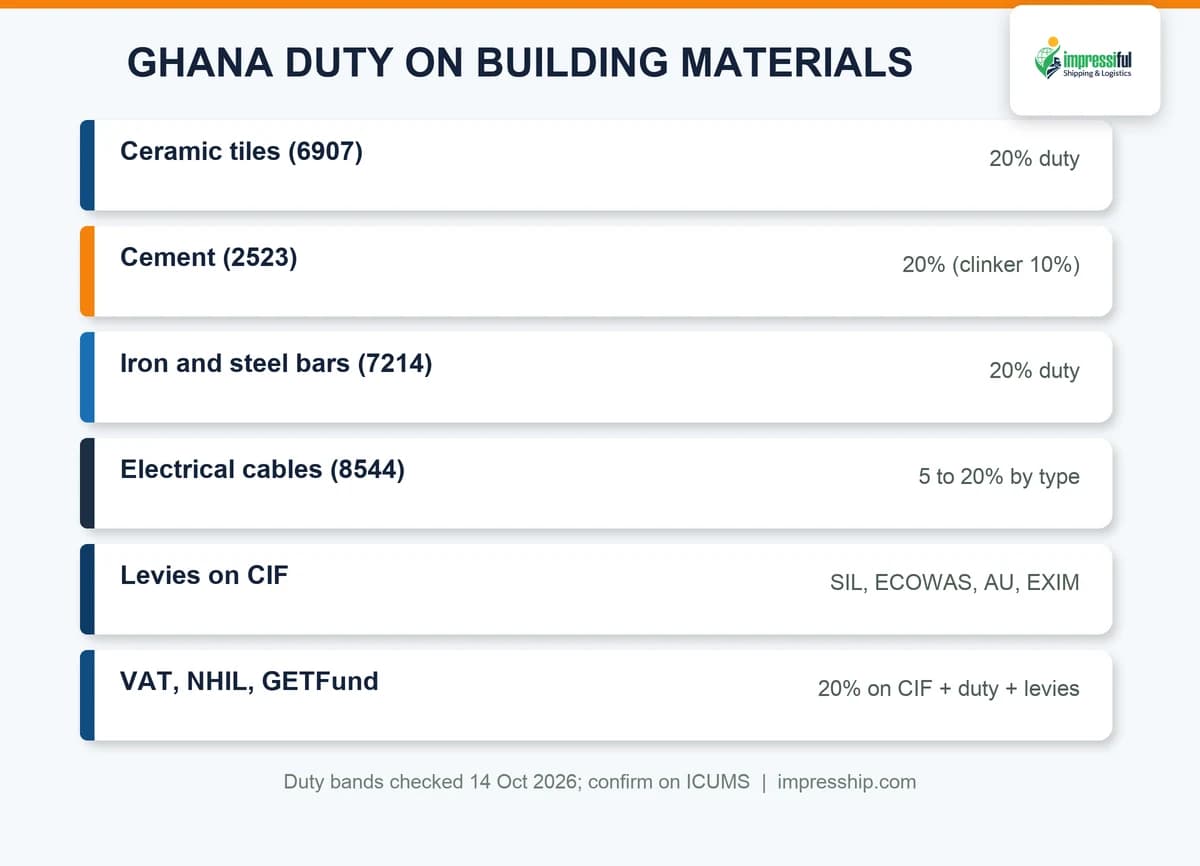
Dubai's trading markets sell a wide range of finishing and fit out materials, many made in China, Europe or the Gulf and consolidated in the UAE. The duty bands below are the ones in our import duty calculator, taken from Ghana's tariff schedule as reported to the World Bank's WITS tariff database and checked on 14 October 2026. Always confirm the exact HS line on ICUMS before you buy.
| Material | Example HS code | Ghana duty band | Freight is usually set by |
|---|---|---|---|
| Ceramic and porcelain tiles | 6907 | 20 percent | Weight |
| Cement | 2523 | 20 percent (clinker 10 percent) | Weight |
| Iron and steel bars (rods) | 7214 | 20 percent | Weight |
| Electrical cables | 8544 | 5 to 20 percent by type | Weight or volume |
| Sanitary ware, doors, fittings | Check on ICUMS | By HS line | Volume |
| Paints, adhesives, sealants | Check on ICUMS | By HS line | Volume, may be dangerous goods |
Sea freight estimates to Tema#
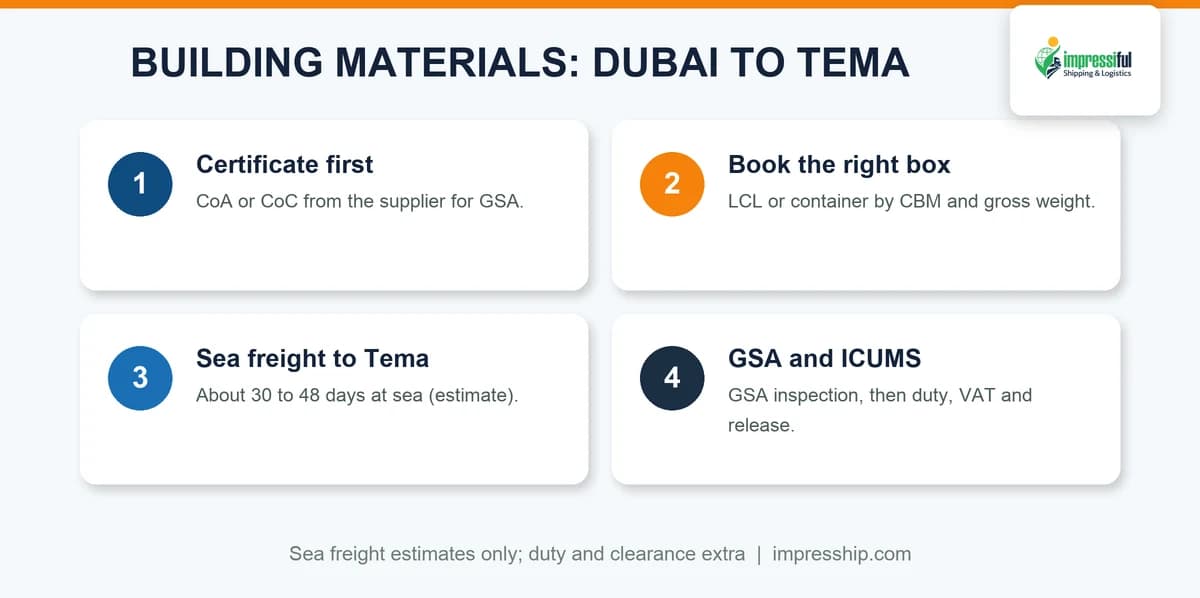
Our sea freight estimates from Dubai to Tema are about USD 337 per CBM for LCL, USD 10,500 to 12,500 for a 20ft container and USD 11,700 to 15,000 for a 40ft, with about 30 to 48 days at sea. These are estimates for sea freight only. They depend on the product, and Dubai pickup, destination charges, duty and clearance are extra. You can bring your cargo to us or ask for a pickup quote. For example, 8 CBM of sanitary ware and fittings by LCL would be about USD 2,695 in sea freight (an illustration, not a quote). Heavy cargo is charged per tonne when it weighs more than a tonne per CBM, and shipments up to 999 kg by weight band when that comes out higher.
For light, bulky materials the usual advice applies: LCL for most loads up to roughly 30 CBM, then a 40ft, which is the size our team recommends for full loads. Dense materials are different. LCL is billed per CBM or per tonne, whichever is greater, as our LCL vs FCL guide explains, and a cubic metre of steel, cement or stacked tiles weighs more than a tonne. Those loads reach a container's weight limit long before it is full, so send us the gross weight and we will confirm the right container. For urgent small parts, the shipping calculator shows air and sea estimates side by side.
Shipping building materials to Ghana?
Send the materials, HS codes if you have them, CBM and gross weight, and we will confirm the container and quote sea freight to Tema.
Ghana import duty and taxes on building materials#
The GRA customs tariffs and levies page lists the five ECOWAS bands Ghana applies, from 0 percent for essential social goods to 20 percent for finished goods and 35 percent for specific goods, along with the levies charged alongside duty. Duty is charged on the CIF value, then the levies, then VAT at 15 percent plus NHIL and GETFund at 2.5 percent each under the VAT Act, 2025 (Act 1151), effective 1 January 2026, as the GRA notice to VAT registered taxpayers sets out.
Here is an illustrative example for ceramic tiles with a CIF value of USD 15,000, using the rates in our duty calculator (checked 14 October 2026):
| Line | How it is worked out | USD |
|---|---|---|
| Import duty, 20 percent | 15,000 x 20% | 3,000 |
| Levies, 3.45 percent | Special Import Levy 2%, ECOWAS 0.5%, AU 0.2%, EXIM 0.75% on CIF | 518 |
| VAT, NHIL and GETFund, 20 percent | (15,000 + 3,000 + 518) x 20% | 3,704 |
| Taxes at Tema | about 7,221 |
That is close to half the CIF value, before the ICUMS fee, withholding tax and port charges. Our Ghana customs duty calculation guide explains each line, and your clearing agent's assessment on ICUMS is the final figure.
Ghana Standards Authority rules for building materials#
Because building materials and electrical cables are High Risk Goods, GSA checks them at the point of entry before Customs releases them. According to the GSA import inspection page:
- Register with GSA as an importer of High Risk Goods and buy the applicable Ghana Standard.
- Get a certificate before loading. Each consignment should carry a Certificate of Analysis or Certificate of Conformance against the applicable standard, issued by a competent laboratory, preferably in the exporting country.
- Expect an inspection. GSA checks labels and quality on arrival and may take samples. Without a certificate, the goods cannot be cleared until samples have been tested.
- Plan for release. Customs clears the consignment after GSA's satisfactory inspection and electronic release.
GSA also notes that second hand sanitary ware may not be imported for commercial purposes or in commercial quantities under L.I. 1586, so buy new stock only.
Documents for clearing building materials at Tema#
The GRA import procedures page lists what a clearing agent needs before or when the goods arrive:
- original bill of lading (or a telex release, which we provide)
- attested commercial invoice and packing list
- Import Declaration Form from the Ministry of Trade
- Taxpayer Identification Number or Ghana Card PIN
- permits from the regulators that cover the goods, such as GSA for building materials
The agent then lodges the declaration on ICUMS for classification, valuation and approval. Our customs clearance documents guide explains how to fill in each document so the HS code holds up.
Packing building materials for the sea leg#
- Palletise and strap heavy goods. Tiles, steel and bagged materials need strong pallets and even weight distribution in the container.
- Crate glass, mirrors and sanitary ware. Wooden crates with padding stop breakage when LCL cargo is handled at each end.
- Keep moisture out. Cement, gypsum and timber products should be wrapped and kept off the container floor.
- Declare chemicals. Some paints, adhesives, solvents and sealants ship as dangerous goods, and every dangerous goods shipment is subject to approval; our dangerous goods guide explains the declarations.
- Consolidate suppliers. Materials from several Dubai shops can be received, checked and loaded together through our consolidation and warehousing service.
Frequently asked questions#
How much does it cost to ship something from Dubai to Ghana?#
By sea, our estimates to Tema are about USD 337 per CBM for LCL, USD 10,500 to 12,500 for a 20ft and USD 11,700 to 15,000 for a 40ft, for sea freight only and depending on the product. Dubai pickup, destination charges, duty and clearance are extra. Our Dubai to Ghana shipping cost guide explains what each quote includes.
How much is import duty in Ghana?#
There is no single rate. Ghana applies five ECOWAS bands of 0, 5, 10, 20 and 35 percent on the CIF value, and most finished building materials such as tiles, cement and iron rods are in the 20 percent band. Levies and the 20 percent VAT stack are added on top, as the GRA tariffs and levies page shows.
What items are exempt from import duty?#
In the ECOWAS tariff that Ghana applies, only essential social goods sit in the 0 percent band, and building materials are not among them. Any other relief needs a specific legal basis and approval before shipping, so confirm it with GRA or your clearing agent rather than assuming it at the port.
How to calculate import duty charges?#
Multiply the CIF value by the duty rate for the HS code, add the levies on CIF, then apply VAT, NHIL and GETFund at 20 percent in total on the CIF value plus duty and levies. Our import duty calculator runs the same steps for building materials and other categories.
What container do I need to ship building materials?#
It depends on weight as much as volume. Light, bulky materials usually go LCL up to roughly 30 CBM, then in a 40ft container, but heavy loads such as tiles, cement and steel reach a container's weight limit long before it is full. Send the gross weight with your quote request and we will confirm the right container.
Send your cargo details for a same-day quote#
Tell us which materials you are buying in Dubai, the HS codes if you have them, the CBM and gross weight, and the delivery town in Ghana. We will confirm the right container, quote the sea freight to Tema with the destination charges spelled out and provide a telex release bill of lading. We ship general cargo and dangerous goods, with every dangerous goods shipment subject to approval.
Request a same-day quote or message us on WhatsApp with your cargo details. See our ocean freight service for how we handle full and shared containers.