Customs Clearance in Nigeria Explained: Form M, PAAR and Import Duty
Customs clearance in Nigeria explained for importers shipping from the UAE: how to open a Form M, when you need SONCAP or NAFDAC approval, how the PAAR works, how import duty is calculated and what delays cargo in Lagos.
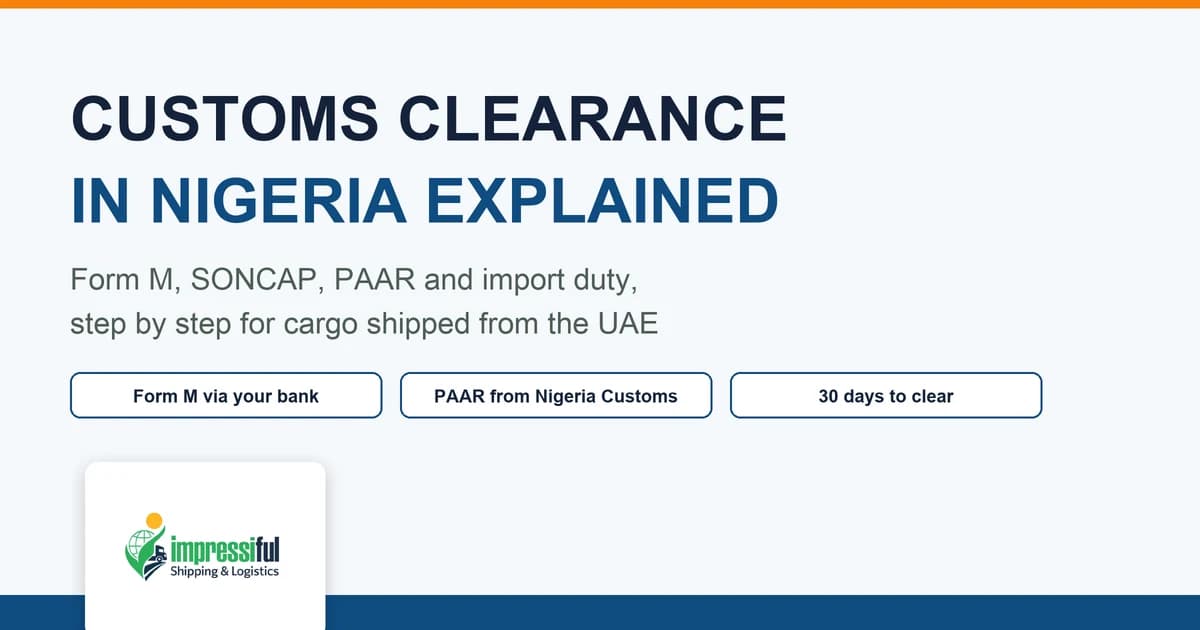
Under the Nigeria Customs Service Act 2023, imports must be cleared within 30 days of discharge before they become overtime cargo, down from 90 days under the old law. That clock makes the paperwork you finish before your goods leave Dubai more important than anything you do in Lagos. This guide explains customs clearance in Nigeria step by step: Form M, product certificates, the Pre-Arrival Assessment Report (PAAR), how duty is worked out, and the mistakes that keep containers at Apapa and Tin Can.
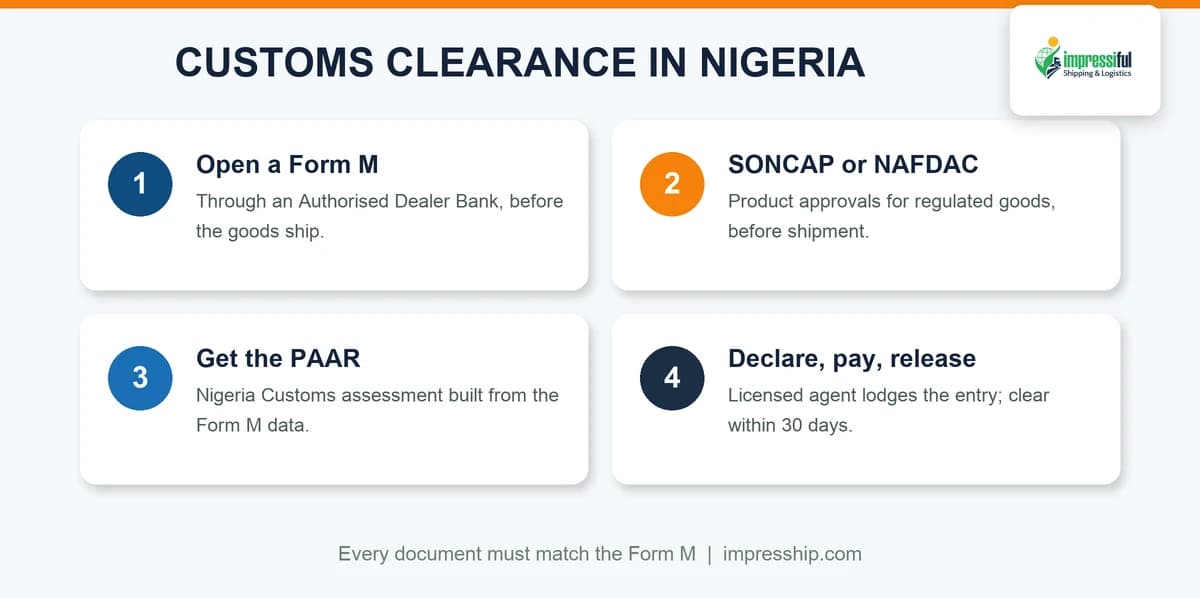
In practice, customs clearance in Nigeria starts weeks before arrival. You open a Form M through a Nigerian bank before the goods ship, add a SONCAP or NAFDAC approval where your product needs one, and obtain a PAAR from Nigeria Customs. A licensed customs agent then lodges the declaration (we handle this through our partner agents, or you can use your own agent), you pay duty, and the cargo is examined and released.
Documents for customs clearance in Nigeria#
Nigeria clears cargo against data that was filed before shipment, so every document has to match. The table shows the core set for a sea freight import from the UAE.
| Document | Issued by | When | What to check |
|---|---|---|---|
| Form M | Your Authorised Dealer Bank in Nigeria, registered with Nigeria Customs | Before shipment | Goods description, HS code, value and port of discharge |
| Product Certificate and SONCAP Certificate | Standards Organisation of Nigeria (SON) | Before Form M and before shipment | Needed for most regulated products |
| NAFDAC permit | NAFDAC | Before shipment | Food, drugs, cosmetics, chemicals and similar products |
| Commercial invoice and packing list | Your supplier | At shipment | Same values and descriptions as the Form M |
| Bill of lading | The carrier or forwarder | After loading | Consignee, port and cargo description |
| PAAR | Nigeria Customs Service | Before arrival | Built from the Form M data |
Our customs clearance documents guide covers the commercial invoice, packing list and certificate rules that apply across African markets, and our bill of lading guide explains the transport document Nigeria will check.
Step 1: open a Form M through your bank#
Form M is Nigeria's import declaration. The Central Bank of Nigeria's Foreign Exchange Manual requires anyone importing physical goods to process a Form M through an Authorised Dealer Bank, whatever the value and whether or not payment is involved. The Form M only becomes valid for importation once Nigeria Customs has registered it.
Three points catch importers out:
- Open it before the goods ship. The Form M number should appear on the shipping documents, so ask your supplier to wait for it.
- Choose the right type. A Form M "valid for forex" is used when the bank will pay the supplier in foreign currency; "not valid for forex" is used when you pay another way.
- Watch the validity and tolerance. Each Form M has a validity period and a value tolerance set by the CBN manual. Your bank confirms both and handles any extension.
Since July 2024 the CBN has validated Form M applications without the old price verification report, which removed one step for importers.
Step 2: SONCAP or NAFDAC approval for your product#
Most manufactured goods are regulated products in Nigeria. Under the SONCAP programme you need a Product Certificate to open the Form M, then a SONCAP Certificate for each shipment after the goods are checked in the exporting country. Food, drugs and some chemicals are excluded from SONCAP because NAFDAC regulates them instead.
Since 27 March 2026, import permits and certificates from SON and NAFDAC are processed on Nigeria's National Single Window, which is being rolled out in phases toward full customs integration. Start these approvals as soon as you agree the order: they take longer than the ocean voyage.
Shipping from Dubai to Lagos?
Send your cargo details, HS codes and Form M status, and we will plan the booking and shipping documents around your Nigerian paperwork.
Step 3: get the PAAR from Nigeria Customs#
The Pre-Arrival Assessment Report (PAAR) is Nigeria Customs' assessment of your consignment, created from the registered Form M before the cargo arrives. It confirms the classification and value that customs will use, and your agent cannot complete the declaration without it.
Nigeria Customs moved Form M and PAAR processing from its old NICIS II system to B'Odogwu, its new trade platform, during 2025. In a statement published by the Federal Ministry of Information, the Nigeria Customs Service explained that a PAAR is now created from the Form M record on the B'Odogwu dashboard and that there is no fee for migrating an older Form M.
Step 4: declaration, duty payment and release#
When the vessel arrives, the licensed customs agent lodges the declaration against the PAAR, the duty is paid through the approved channel, and customs examines the cargo by scanner or physical inspection. Once released, you pay terminal and shipping line charges and arrange delivery.
Speed matters here. Cargo that is not cleared within 30 days becomes overtime cargo; it can still be cleared later only with approval, and consignments left for 90 days face disposal. Demurrage and storage run the whole time, which is why our Dubai to Nigeria shipping guide treats the Lagos side as the real cost risk.
How import duty is calculated in Nigeria#
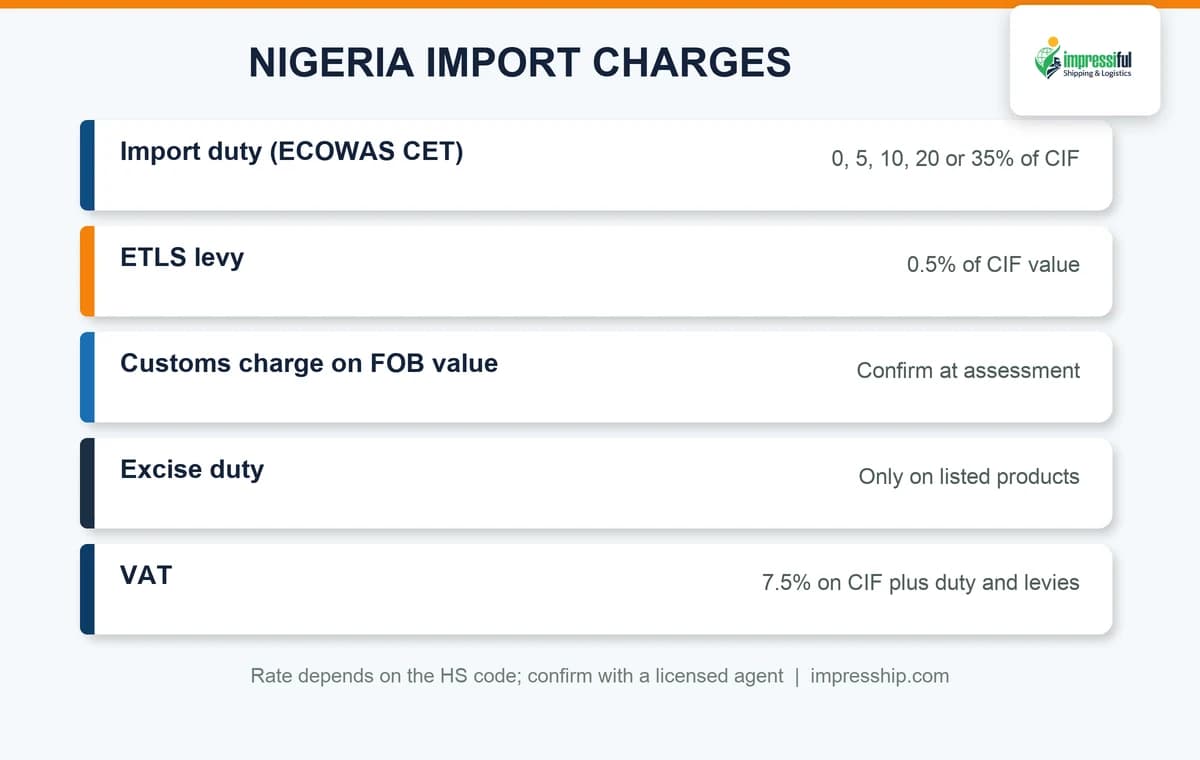
Duty depends on the HS code of your goods and their customs value, normally the CIF value (cost, insurance and freight). Nigeria applies the ECOWAS Common External Tariff, so the rate is set by the tariff line, with a few levies on top.
| Charge | Basis | Typical rate |
|---|---|---|
| Import duty (ECOWAS CET) | CIF value | 0, 5, 10, 20 or 35 percent by HS code |
| ECOWAS Trade Liberalisation Scheme levy | CIF value | 0.5 percent |
| Customs charge on FOB value | FOB value | Set by Nigeria Customs; changed in 2025, confirm at assessment |
| Excise duty | Value of excisable goods | Only on listed products |
| VAT | CIF value plus duty and levies | 7.5 percent |
Because the duty base is CIF, the Incoterm you agree changes the figure; our FOB vs CIF guide shows how. The same method appears in our Ghana customs duty guide, and Nigeria works the same way once you know the HS code. Treat these rates as a guide and confirm the tariff line with your customs agent before you buy.
Common mistakes that delay clearance#
- Data that does not match. The goods description, HS code, quantity and value must agree across the Form M, invoice, packing list and bill of lading.
- Wrong port on the Form M. If the cargo discharges at a different Lagos terminal from the one on the Form M, it has to be amended.
- Certificates started too late. A missing SONCAP certificate or NAFDAC permit stops the PAAR.
- Restricted or prohibited items. Check the Nigeria Customs import prohibition list before you buy, not after you ship.
- Undeclared dangerous goods. Perfume, batteries and aerosols must be declared; read our dangerous goods guide first.
Frequently asked questions#
What is a Pre-Arrival Assessment Report (PAAR)?#
A PAAR is the assessment Nigeria Customs issues before your cargo arrives, based on the registered Form M. It confirms the classification and value customs will use for duty, and it is needed before your agent can lodge the declaration. It is now created on the Nigeria Customs Service B'Odogwu platform.
What are the requirements for Form M in Nigeria?#
You need an account with an Authorised Dealer Bank, a proforma invoice from your supplier, the HS code and description of the goods, and a Product Certificate or other permit where the product is regulated. The bank submits the Form M and Nigeria Customs registers it before it can be used. Our customs documents guide lists the supporting papers.
How to get CBN Form M?#
You apply through any Authorised Dealer Bank in Nigeria, which processes the Form M electronically under the rules in the CBN Foreign Exchange Manual. There is no separate application to the Central Bank itself. Start before your supplier ships, because the Form M number should appear on the shipping documents.
How much does it cost to clear customs in Nigeria?#
Duties and taxes depend on the HS code and CIF value: import duty of 0 to 35 percent, a 0.5 percent ETLS levy, other customs charges and 7.5 percent VAT. On top come agent fees, terminal handling and trucking, which vary with the cargo and the terminal, so ask for them in writing with your quote; our Dubai to Nigeria guide covers the Lagos side.
How long does it take for custom clearance in Nigeria?#
There is no fixed clearing time, so we do not quote one: it depends on the cargo, the examination and the documents, which is why a valid Form M, PAAR and product approvals before arrival matter most. The legal window is 30 days from discharge before cargo becomes overtime, so plan the paperwork before the vessel sails.
How to check custom duty in Nigeria?#
Find the HS code of your goods, then check the rate for that tariff line in the Nigeria Customs tariff or with a licensed customs agent, and apply it to the CIF value. Add the levies and VAT shown in the table above. Our FOB vs CIF guide explains how the Incoterm changes the value customs uses.
Send your cargo details for a same-day quote#
Tell us what you are shipping, the HS codes if you have them, your Form M status and the destination in Nigeria. We ship general cargo and dangerous goods to Lagos (sea cargo currently loads at one of our partner ports: Sohar, the one we use most, or Salalah in Oman, Jeddah in Saudi Arabia, or Khor Fakkan or Fujairah in the UAE), with every dangerous goods shipment subject to approval, by ocean freight or air, and we provide telex release bills of lading so your agent is not waiting for original documents. Nigeria is one of the 54 African countries on our destinations list.
Request a same-day quote or message us on WhatsApp with your cargo details.