Freight Forwarder vs Shipping Line vs NVOCC: Who Does What When You Ship from Dubai to Africa
Freight forwarder vs shipping line vs NVOCC explained for importers shipping from Dubai to Africa: who operates the ships, who issues the master and house bill of lading, the 5 key differences and which one to book with.
Freight forwarder vs shipping line is the first question many importers ask when they start shipping from Dubai to Africa: who actually moves the container, who do you pay, and whose name is on the bill of lading? This guide explains freight forwarder vs shipping line vs NVOCC in plain terms, what each one does on a shipment from the UAE to ports such as Tema, Lagos, Mombasa or Durban, and which one a small or mid sized importer should deal with.
The short answer: a shipping line owns or operates the ships, an NVOCC sells space on those ships under its own bill of lading without operating any vessel, and a freight forwarder organises the whole shipment for you, booking with lines or NVOCCs and handling the paperwork around the sea leg.
Freight forwarder vs shipping line vs NVOCC at a glance#
| Shipping line | NVOCC | Freight forwarder | |
|---|---|---|---|
| Operates ships | Yes | No | No |
| Who it sells to | Mainly forwarders, NVOCCs and large shippers on contract | Forwarders and shippers who need space or LCL | Importers and exporters of any size |
| Bill of lading | Master bill of lading (MBL) | Its own house bill of lading (HBL) | Arranges the B/L; may issue a house bill when it also acts as carrier |
| Shared containers (LCL) | Rarely sold direct | Often consolidates LCL | Consolidates or books LCL for you |
| Pickup, documents, clearance | Port to port only | Port to port, sometimes more | Coordinates the whole chain |
| Best for | Large, regular FCL volumes | Space and LCL at scale | Most small and mid sized importers |
What a shipping line does#
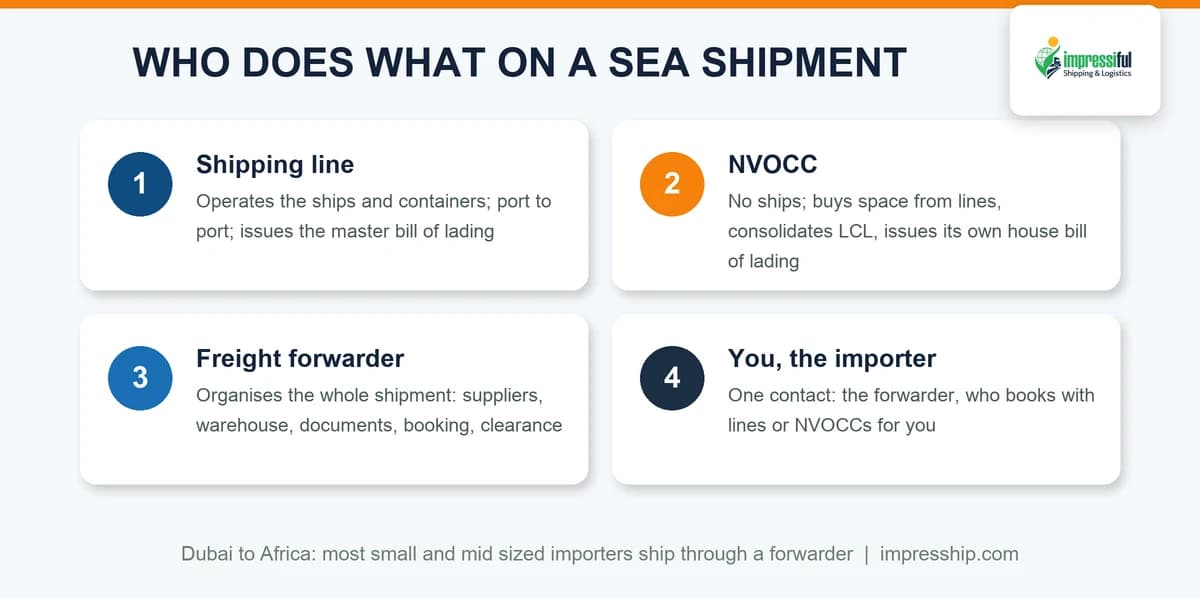
A shipping line, also called an ocean carrier or vessel operating common carrier (VOCC), owns or charters the ships and the containers and runs scheduled services between ports. It sells space on those ships, publishes its sailings, and issues a master bill of lading for each container it carries.
Shipping lines work port to port. They move the container from the loading port to the discharge port and release it to the party named on their bill of lading. They do not normally collect cartons from your suppliers, pack a shared container, prepare your commercial invoice or clear the goods at destination. Most of them also prefer to deal with high volume customers on contract, which is why a trader shipping a few CBM a month rarely books with a line directly.
Shipping lines also set the free days at destination. Once those run out, demurrage and detention start; our guide to demurrage and detention charges in Tema and Lagos explains how they build up.
What an NVOCC does#
NVOCC stands for non-vessel operating common carrier. US shipping law, which coined the term, defines an NVOCC as a common carrier that does not operate the vessels that carry the goods and is itself a shipper in its relationship with the ocean carrier (46 U.S.C. 40102). In practice, an NVOCC buys container space from shipping lines in bulk and resells it under its own name and terms.
Two things make an NVOCC different from a plain booking agent:
- It acts as the carrier to you. It issues its own house bill of lading and takes on carrier responsibility for your goods, while the shipping line issues a master bill of lading to the NVOCC.
- It consolidates. Many NVOCCs fill containers with cargo from several shippers and sell the space by the CBM. That is how LCL, or shared container shipping, usually works.
So an NVOCC sits between the shipping line and the shipper. It has no ships, but legally it is a carrier.
What a freight forwarder does#
A freight forwarder organises the movement of your goods from origin to destination on your behalf. It chooses the carrier, books the space, receives or collects the cargo, prepares and checks the shipping documents, arranges the bill of lading and coordinates with an agent at the destination port. Forwarders also handle air freight, and many arrange customs clearance through licensed agents.
Many forwarders also act as an NVOCC on some or all of their sea shipments, issuing their own house bill of lading. Others book directly with the line or through an NVOCC partner. For the importer, the practical point is the same: the forwarder is your single contact for the whole shipment, and it deals with the carriers for you.
Before you choose one, our checklist for finding a freight forwarder in Dubai shows how to verify the licence, memberships and track record.
Freight forwarder vs shipping line: the key differences#
The freight forwarder vs shipping line choice comes down to five differences:
- Ships. The shipping line operates them; the forwarder does not.
- Scope. The line covers port to port. The forwarder covers the whole chain: suppliers in Dubai, warehouse, documents, the sea or air leg and the handover at destination.
- Volume. Lines want regular full containers. A forwarder takes one pallet, a few cartons or a full container.
- Choice. A line can only sell its own services. A forwarder compares lines, routings and sailings and picks the one that fits your cargo and dates.
- Point of contact. With a line you manage suppliers, documents, insurance and clearance yourself. With a forwarder, one team handles it and answers your questions.
The comparison of a freight forwarder vs NVOCC is narrower: both arrange carriage, but the NVOCC always acts as a carrier and issues its own bill of lading, while a forwarder may act as the shipper's agent, as an NVOCC, or both.
Not sure who should handle your shipment?
Tell us what you are shipping from Dubai, the volume and the destination port, and we will quote the sea or air freight and explain who issues your bill of lading.
Master and house bills of lading: who issues which#
The roles show up clearly on the bills of lading:
- Master bill of lading (MBL): issued by the shipping line for the whole container. The shipper on it is usually the forwarder or NVOCC that booked the space, and the consignee is often its agent at the destination port.
- House bill of lading (HBL): issued by the NVOCC or the forwarder acting as carrier to you, the actual shipper. It names you or your buyer and lists your goods, even when they share the container with other shippers.
At the destination, the forwarder's agent collects the container from the line with the master bill, unpacks the shared cargo and releases each shipment against its house bill. If you ship a full container under your own name with a line, you may receive the master bill directly.
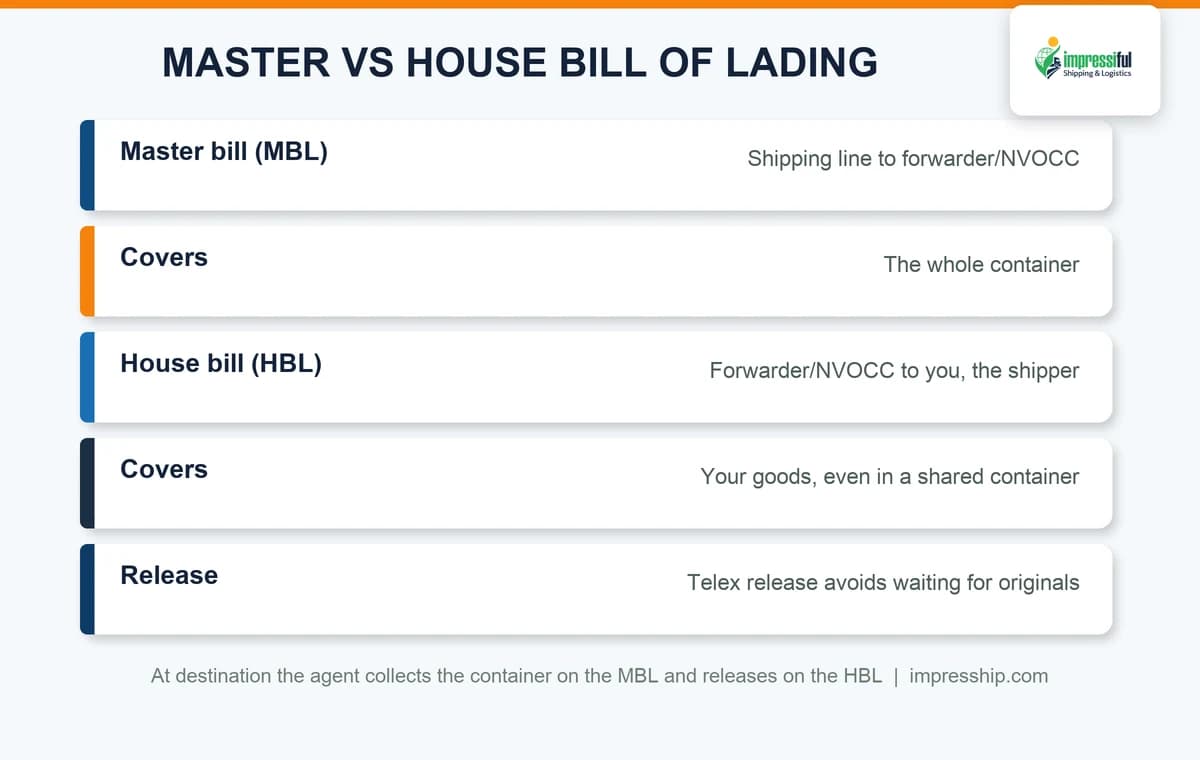
Whichever bill you hold, check the release type. A telex release, where the originals are surrendered at the loading port, usually avoids waiting for paper documents to arrive; we provide telex release bills of lading. Our guide to the bill of lading explained covers the types, the release options and the fields to check before the vessel sails.
Which one should you use when shipping from Dubai to Africa?#
For most importers buying in the UAE, a freight forwarder is the practical choice:
- You buy from several suppliers. A forwarder receives cartons from each one, checks them and ships them together. Our consolidation and warehousing guide shows how that works.
- Your volume is below a full container. Shared container space is sold by the CBM through forwarders and NVOCCs, not usually by the lines. Our LCL vs FCL guide explains where the switch point is.
- You need documents and clearance handled. Commercial invoice, packing list, certificate of origin where needed, the bill of lading and customs clearance at destination all have to match.
- Routing changes. With the Strait of Hormuz closed to most container traffic, the loading port and routing matter more than they used to. A forwarder works them out for you.
Booking directly with a shipping line makes sense for large importers who ship full containers every week, already have their own clearing agents and documentation staff, and can negotiate a service contract. Even then, many keep a forwarder for LCL, air freight and urgent cargo.
How Impressiful Shipping and Logistics fits in#
Impressiful Shipping and Logistics is a freight forwarder based in the UAE. We book space with shipping lines for sea freight to all 54 African destinations on our list, and air freight from the UAE to destinations worldwide. Our sea cargo currently loads at one of our partner ports: Sohar (most used) or Salalah in Oman, Jeddah, Khor Fakkan or Fujairah.
On a typical shipment we:
- Receive your goods from suppliers at our shared warehouse in Dubai, or quote a pickup, and confirm every delivery with photos and counts.
- Consolidate LCL cargo, or book a 20ft or 40ft container for larger loads. Shared space is priced by CBM, and heavy, small loads are charged by weight.
- Prepare the booking and shipping documents and provide a telex release bill of lading.
- Handle customs clearance at destination through our partner agents, or hand over to your own clearing agent if you prefer.
Every shipment we handle is insured, and we ship general cargo and dangerous goods, with every dangerous goods shipment subject to approval.
As a guide to cost, LCL sea freight estimates are about USD 337 per CBM to Tema and about USD 372 per CBM to Lagos. Our team recommends LCL up to roughly 30 CBM and a 40ft container beyond that; the shipping calculator gives the estimate for your port. These are sea freight estimates only: Dubai pickup, destination charges, duty and clearance are extra. Our guide on how to get an accurate freight quote lists what to send so the quote matches the final invoice.
Frequently asked questions#
What is the difference between a shipping line and a freight forwarder?#
A shipping line owns or operates the ships and moves containers from port to port under its master bill of lading. A freight forwarder does not operate ships: it organises the whole shipment for the shipper, choosing and booking the carrier, receiving the goods, preparing documents and coordinating delivery and clearance. Most small and mid sized importers book through a forwarder rather than directly with a line.
What is the main difference between a freight forwarder and an NVOCC?#
An NVOCC is a carrier without ships: it buys space from shipping lines, issues its own house bill of lading and takes carrier responsibility for the goods. A freight forwarder arranges shipments, often as the shipper's agent. Many companies are both, acting as forwarder and NVOCC on different shipments, so ask which role the company plays on yours and whose bill of lading you will receive.
Can NVOCC issue bill of lading?#
Yes. An NVOCC issues its own house bill of lading to the shipper and takes carrier responsibility for the goods, while the shipping line issues the master bill of lading to the NVOCC. When you book, ask whose bill of lading you will receive, because that shows who is the carrier on your shipment.
Is Maersk a freight forwarder?#
Maersk is first a shipping line: it operates container ships and issues master bills of lading. Like several large carriers, it also sells logistics and forwarding services, so it can act in both roles. For a small importer the question is the role on your booking: are you dealing with the vessel operator, an NVOCC or a forwarder, and who issues your bill of lading?
Is a freight forwarder the same as a shipping company?#
No. A shipping company in the usual sense is a shipping line, which operates the ships. A freight forwarder does not operate ships: it books space with the lines or with NVOCCs, receives the goods, prepares the documents and coordinates the whole move. A forwarder also works with clearing agents; we handle customs clearance at destination through our partner agents, or you can use your own clearing agent.
Send your cargo details for a same-day quote#
Tell us what you are shipping, the number of cartons or the CBM and weight, and the destination port. We will confirm LCL or a container, quote sea freight with the destination charges spelled out and tell you who issues your bill of lading, with telex release. We handle customs clearance at destination through our partner agents, or you can use your own clearing agent.
Request a same-day quote or message us on WhatsApp with your cargo details.