
How to Ship a Container from Dubai to Africa: Step by Step
How to ship a container from Dubai to Africa in 9 steps: full or shared space, booking, loading, VGM, the UAE export declaration, bill of lading, clearance at destination, and 20ft and 40ft sea freight estimates to Tema, Lagos and Mombasa.
Shipping a full container from Dubai to Africa takes nine steps and two sets of paperwork, one for the UAE export and one for the import at the other end. With the Strait of Hormuz closed, our sea cargo currently loads at one of our partner ports: Sohar (most used) or Salalah in Oman, Jeddah in Saudi Arabia, or Khor Fakkan or Fujairah in the UAE, so ask for the loading port and the sailing date when you book. The delays come from bookings made too late, missing documents and cargo that arrives at destination before the paperwork does. This guide explains how to ship a container from Dubai step by step, who does each part, and what it costs.
For most importers, the job splits into three parts: book the container and load it in the UAE, let the forwarder handle the export and the sailing, then have the import cleared before the free days at the port run out. Our freight forwarding services team can manage all three, or only the sea leg if you already have an agent at destination.
How to ship a container from Dubai: the 9 steps#
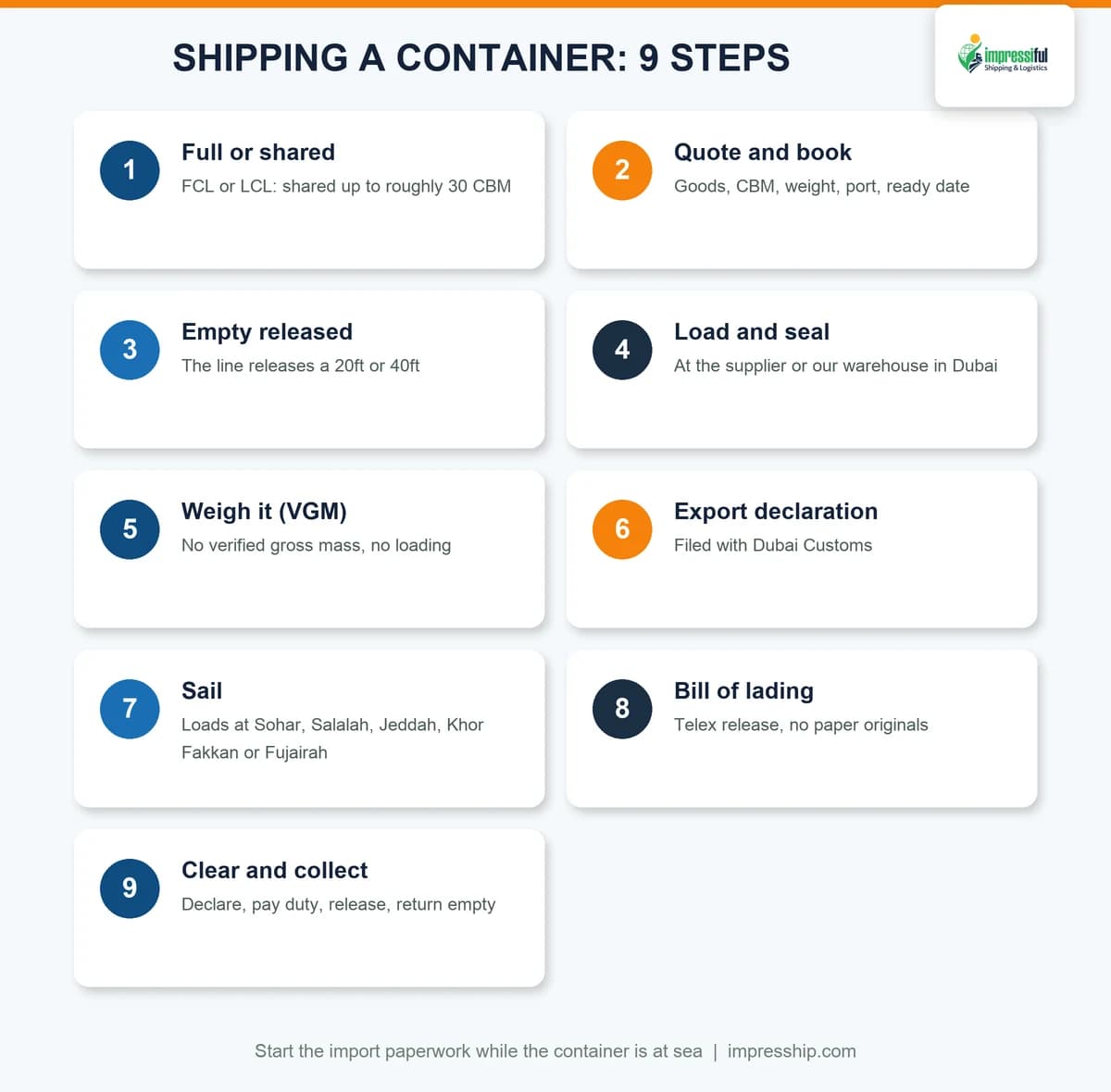
The table shows each step, who usually handles it and what you need to provide. The steps are the same whether the container goes to Tema, Lagos, Mombasa or another African port.
| Step | What happens | Who does it | What you provide |
|---|---|---|---|
| 1. Choose full or shared | Decide between a full container (FCL) and shared space (LCL) | You, with the forwarder | Total CBM and weight |
| 2. Get a quote and book | The forwarder books space with a shipping line | Forwarder | Goods, destination port, ready date |
| 3. Empty container released | The line releases an empty 20ft or 40ft | Forwarder, shipping line | Loading address and date |
| 4. Load the container | Goods are loaded, braced and sealed | Supplier, warehouse or forwarder | Packing list per carton |
| 5. Weigh it (VGM) | The packed container gets a verified gross mass | Shipper or forwarder | Cargo weight |
| 6. UAE export declaration | Export filed with Dubai Customs | Forwarder | Commercial invoice, packing list |
| 7. Sail | Gate in at the loading port (currently Sohar, Salalah, Jeddah, Khor Fakkan or Fujairah), loading, sailing | Shipping line | Nothing, track the vessel |
| 8. Bill of lading and release | The line issues the bill; telex release when paid | Forwarder, shipping line | Consignee details, payment |
| 9. Clear and collect | Import declaration, duty, release, empty return | Clearing agent at destination | Import documents, duty payment |
Need this handled end to end?
Tell us your lane and cargo profile and we'll come back with a routing plan and an all-in rate.
Step 1: decide if a full container makes sense#
A full container is yours alone, sealed in the UAE and opened at destination. Shared LCL space is charged per CBM and suits smaller loads. As a rule of thumb, shared space suits shipments up to roughly 30 CBM, and above that we recommend booking a 40ft. Our LCL vs FCL guide works through the break-even, and the container sizes guide shows what fits in a 20ft, a 40ft and a high cube.
If you are not sure of your volume, add up the cartons with our CBM calculator first. A 20ft holds about 25 to 28 CBM of cartons in practice and suits heavy, dense goods; a 40ft holds roughly twice the volume for light, bulky goods.
Steps 2 and 3: quote, booking and the empty container#
Send the forwarder what the goods are, the total CBM and weight, the destination port and the date the cargo will be ready. The forwarder books space on a sailing and the shipping line releases an empty container for loading. Book early in busy seasons, because a ready container with no space on a vessel costs time.
Declare anything that might be dangerous goods at this point, such as batteries, paints, perfume or aerosols, with the Safety Data Sheet. We ship dangerous goods as well as general cargo, and every dangerous goods shipment is subject to approval.
Step 4: loading the container in the UAE#
A full container is loaded where the goods are, at the supplier's site or at a warehouse. If you are buying from several suppliers, bring the goods to our shared warehouse in Dubai first: goods come in once your shipping is confirmed within the next two weeks, and there is no storage charge if they are loaded within those two weeks; storage is AED 20 per sq ft per month if shipping is not confirmed. We repack and relabel before loading. Trucking the container in the UAE is quoted separately, and many clients bring their cargo to us themselves.
Load heavy items on the floor, spread the weight along the length of the box and brace the load so nothing shifts at sea. Keep a packing list that matches what goes in, carton by carton, because the destination customs will check it.
Steps 5 and 6: the VGM and the UAE export declaration#
The verified gross mass (VGM) is the total weight of the packed container. The International Maritime Organization makes it a condition for loading, and the shipper named on the bill of lading is responsible for it.
The forwarder then files the export declaration with Dubai Customs, using your commercial invoice and packing list. The goods description and HS code on the invoice should match what the importer will declare at destination, so agree them with your buyer before loading.
Steps 7 and 8: sailing and the bill of lading#
Once the container is gated in at the loading port and loaded, the shipping line issues the bill of lading. We provide telex release bills of lading, so the consignee can collect the cargo without waiting for paper originals to arrive by post. Our bill of lading guide explains original, telex and sea waybill releases.
Typical time at sea is 30 to 48 days to West African ports such as Tema and Lagos, and 22 to 40 days to Mombasa. These times depend on the sailing and any transshipment, so plan around a range, not a single date.
Step 9: clearance and collection at destination#
The import side starts while the container is at sea. The clearing agent lodges the declaration, the duty is paid and the shipping line issues a delivery order. We handle destination customs clearance, or you can use your own agent. Delivery beyond the port is arranged on request, so ask when you book.
Free days at the port are short. Our guide to demurrage and detention at Tema and Lagos explains the daily charges that start once they run out, and why the empty container has to go back on time.
What a container from Dubai to Africa costs#
Container freight is charged per box, not per CBM. These are our sea freight estimates, and they depend on the product and the country.
| Destination port | 20ft estimate | 40ft estimate | Time at sea |
|---|---|---|---|
| Tema, Ghana | about USD 10,500 to 12,500 | about USD 11,700 to 15,000 | 30 to 48 days |
| Lagos, Nigeria | about USD 11,300 to 13,500 | about USD 12,600 to 16,200 | 30 to 48 days |
| Mombasa, Kenya | about USD 8,900 to 10,600 | about USD 9,900 to 12,800 | 22 to 40 days |
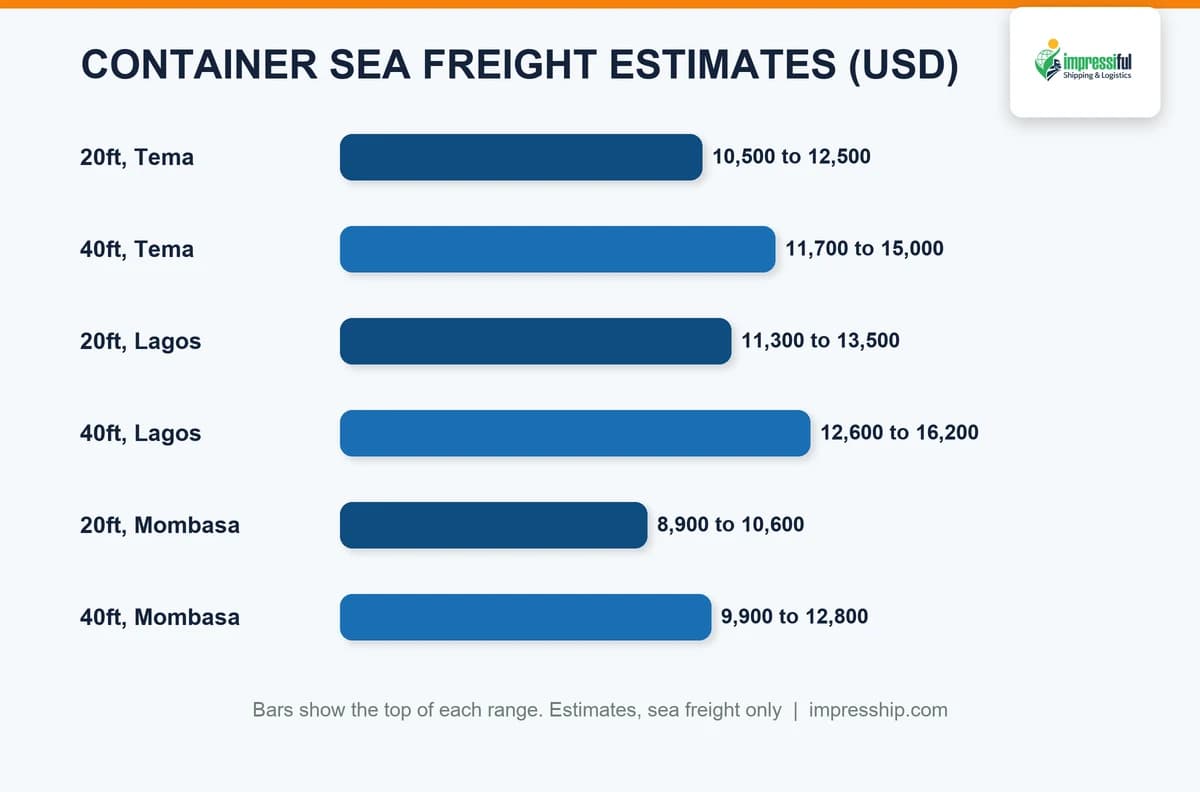
A 40ft costs only a little more than a 20ft for twice the space, which is why a well filled 40ft usually gives the lowest cost per carton. These are estimates for sea freight only; Dubai pickup, destination charges, duty and clearance are extra. Our shipping calculator gives estimates for every lane we serve.
Frequently asked questions#
What is the process of shipping a container?#
You choose between a full and a shared container, book space through a forwarder, load and weigh the container, and the forwarder files the export declaration before it sails. At destination, a clearing agent declares the goods, the duty is paid and the shipping line releases the container. Our container sizes guide helps with the first decision.
How much does it cost to ship a 40 foot container to Africa?#
As sea freight estimates, a 40ft runs from about USD 11,700 to 15,000 to Tema, USD 12,600 to 16,200 to Lagos and USD 9,900 to 12,800 to Mombasa, depending on the product and the country. Dubai pickup, destination charges, duty and clearance are extra, and the shipping calculator covers other ports.
How much does it cost to ship a 20ft container to Nigeria?#
Our sea freight estimate for a 20ft to Lagos is about USD 11,300 to 13,500, depending on the product. For about USD 1,300 to 2,700 more, a 40ft doubles the space, so compare both before you book. Clearance, duty and port charges at Lagos are separate lines on the quote.
What is the cheapest way to ship a container?#
Fill it. A full 40ft gives the lowest cost per CBM, while a half empty box pays for space you do not use, so loads under roughly 30 CBM usually go cheaper as shared LCL. Book early, have documents ready before arrival to avoid demurrage, and see our LCL vs FCL guide for the break-even.
How much is a shipping container in Dubai?#
To ship goods you do not need to buy a container: the shipping line provides one and you pay freight for its use, plus return of the empty at destination. Buying a container outright is a different purchase, made from container traders. For freight, send us your cargo details and we will quote the box that fits.
Send your cargo details for a same-day quote#
Send the packing list (or total CBM and weight), what the goods are, where they are in the UAE and the destination port. We will confirm whether a 20ft, a 40ft or shared space suits the load and send a dated, itemised quote.
Request a same-day quote or message us on WhatsApp with your cargo details. See the UAE to Africa shipping guide for every lane we serve.