
How to Calculate Import Duty in Kenya: EAC Rates, IDF, RDL and VAT with a Worked Example
How to calculate import duty in Kenya for goods shipped from Dubai: the customs value, EAC CET duty bands and the July 2026 changes, the 2.5 percent IDF, 2 percent RDL, excise and 16 percent VAT, the formula step by step and a worked example in four duty bands.
Knowing how to calculate import duty in Kenya before you pay your supplier is what separates a profitable shipment from one that sits at Mombasa while you look for money. Kenya charges four things on most imports: import duty under the East African Community Common External Tariff (EAC CET), the Import Declaration Fee (IDF), the Railway Development Levy (RDL) and VAT, with excise duty on top for a short list of goods. This guide shows the formula step by step, the current rates and a worked example for goods shipped by sea from Dubai.
All four are worked out from one number, the customs value of your goods, so that is where the calculation starts.
Step 1: work out the customs value (CIF)#
Kenya values imports on a CIF basis: the cost of the goods, plus the insurance, plus the freight to Kenya. In practice:
- Cost: the price on your commercial invoice. If you buy FOB or ex works in Dubai, the freight still has to be added. Our FOB vs CIF guide explains why the Incoterm changes your duty bill.
- Freight: the sea or air freight to Mombasa or Nairobi. Our sea estimate to Mombasa is about USD 372 per CBM in shared container space, from the same rates as our shipping calculator; estimates only, confirmed at booking.
- Insurance: the insurance cost for the shipment. All our shipments are insured.
Because freight sits inside the customs value, every dollar of freight is also taxed. That is one reason heavy, low value goods usually go by sea rather than air.
Need this handled end to end?
Tell us your lane and cargo profile and we'll come back with a routing plan and an all-in rate.
Step 2: find the import duty rate for your HS code#
The import duty rate depends on the HS code of each product, which you look up in the EAC CET. According to PwC's Kenya tax summary, the CET 2022 has a minimum rate of 0 percent, middle rates of 10 and 25 percent and a maximum of 35 percent, with much higher rates for sensitive products. The full schedule is the EAC CET 2022 published by KRA.
| CET band | Typical goods | Duty rate |
|---|---|---|
| Raw materials, capital goods, medicines | Most industrial machinery, packaged medicines, laptops | 0 percent |
| Intermediate goods | Many inputs and parts, for example most vehicle parts | 10 percent |
| Finished goods | Most consumer products | 25 percent |
| Fourth band of finished goods | Selected finished products the EAC wants to protect | 35 percent |
| Sensitive items | Rice, sugar, milk, edible oils and some steel lines | Higher rates, sometimes a USD amount per tonne |
The rates are not fixed for good. The EAC Gazette of 30 June 2026 changed several rates for Kenya from 1 July 2026: PwC reports that mobile phones moved from 0 to 25 percent for one year, and that higher rates now apply to furniture, iron and steel products, LPG stoves and some wood products, while lithium-ion batteries got a lower rate. Check the rate for your exact HS code before you order. Our guide to HS codes for importers shows how to find it.
Step 3: add the IDF, RDL, excise and VAT#
On top of import duty, Kenya charges:
- Import Declaration Fee (IDF): 2.5 percent of the customs value.
- Railway Development Levy (RDL): 2 percent of the customs value.
- Excise duty: only on excisable goods. PwC lists bottled water, soft drinks, cigarettes, alcohol, fuels and motor vehicles among them.
- VAT: 16 percent, the general rate. The Kenya Revenue Authority confirms that VAT on imported goods is paid by the importer, and PwC lists 0 percent for zero rated and exempt supplies and 8 percent for fuel.
Both the IDF and RDL rates come from the PwC summary last reviewed in July 2026, after the Finance Act 2026. Some calculators online still show the older 3.5 percent IDF, which no longer applies. Our duty calculator uses the current rates and charges VAT on the customs value plus import duty.
Kenya import duty calculator: the formula step by step#
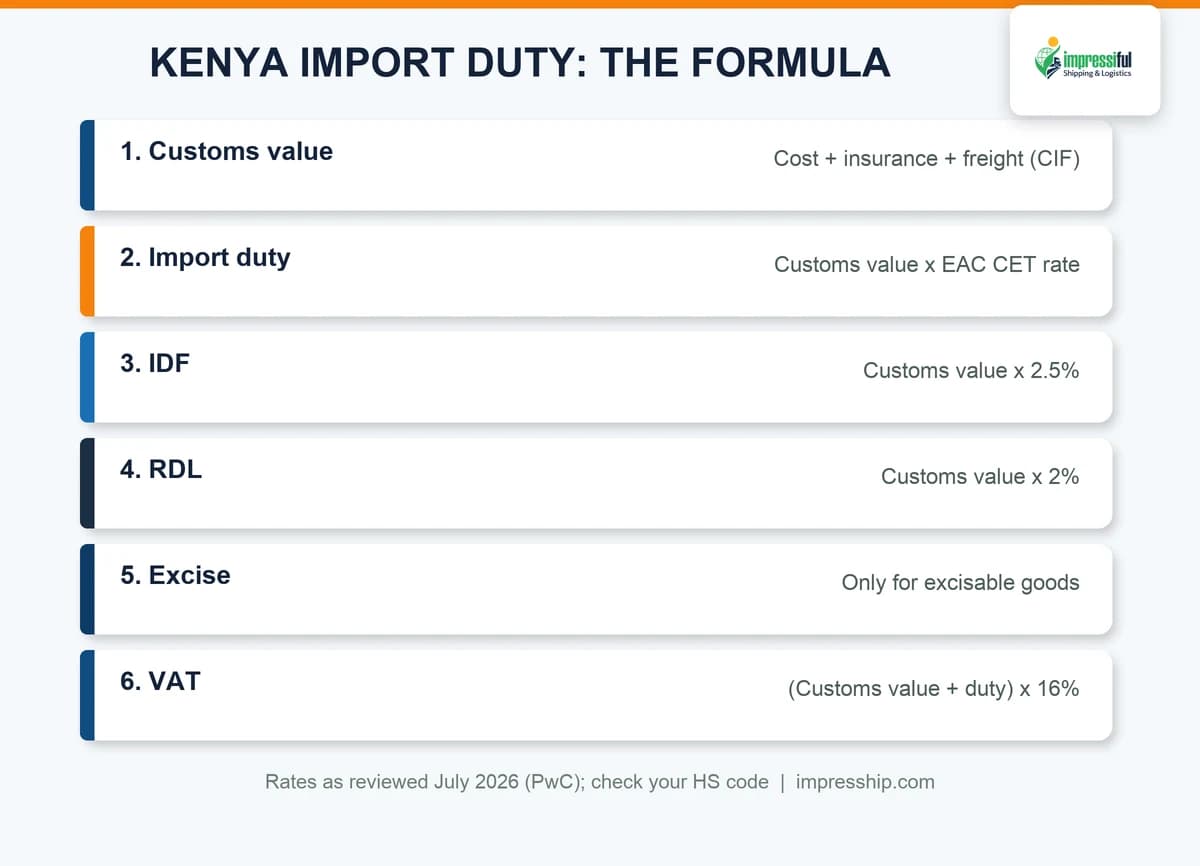
Put together, the calculation for general goods looks like this:
- Customs value (CIF) = cost + insurance + freight
- Import duty = customs value x CET rate
- IDF = customs value x 2.5 percent
- RDL = customs value x 2 percent
- Excise duty = only if the goods are excisable, at the rate for that product
- VAT = (customs value + import duty) x 16 percent
- Total taxes = import duty + IDF + RDL + excise + VAT
Customs works in Kenya shillings, so your clearing agent converts the values at the customs exchange rate on the entry.
How to calculate import duty in Kenya: a worked example from Dubai#
Say you buy goods in Dubai for USD 20,000 and ship 10 CBM weighing 1,500 kg to Mombasa in shared container space. At about USD 372 per CBM, the sea freight comes to about USD 3,720 (an estimate, not a quote). With insurance of USD 80 used here only to show the method, the customs value is USD 23,800.
| Line | 0 percent band | 10 percent band | 25 percent band | 35 percent band |
|---|---|---|---|---|
| Customs value (CIF) | 23,800 | 23,800 | 23,800 | 23,800 |
| Import duty | 0 | 2,380 | 5,950 | 8,330 |
| IDF (2.5 percent) | 595 | 595 | 595 | 595 |
| RDL (2 percent) | 476 | 476 | 476 | 476 |
| VAT (16 percent) | 3,808 | 4,189 | 4,760 | 5,141 |
| Total taxes (USD) | 4,879 | 7,640 | 11,781 | 14,542 |
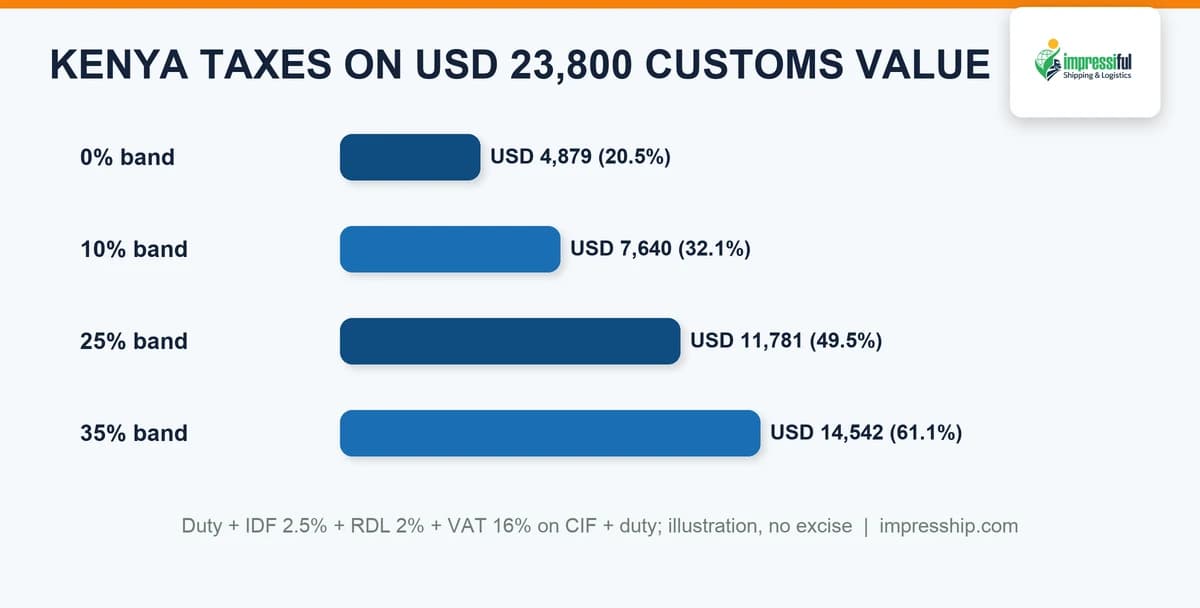
The same shipment costs about USD 4,900 in taxes if the goods are in the 0 percent band and about USD 14,500 in the 35 percent band, nearly three times as much. The HS code matters far more than the freight. Port charges, clearing fees and inland delivery come on top of these taxes, so treat the total as the tax part of your landed cost, not the whole of it.
Shipping goods from Dubai to Kenya?
Send the goods, HS codes if you have them, CBM, gross weight and the delivery city, and we will quote sea freight to Mombasa or air cargo to Nairobi and give you the freight figure your duty is worked out on.
What changes the duty bill#
- The HS code. A product that fits two headings can sit in two bands. Agree the code with your clearing agent before you buy, not after the goods land.
- The invoice value. Customs can question a value that looks too low and assess the goods at a higher one. Keep the real invoice and proof of payment.
- Freight and insurance. Because they are part of the customs value, a cheaper and better planned shipment also lowers the duty. Our guide to shipping from Dubai to Mombasa covers the sea lane, and our guide to air cargo from Dubai to Nairobi covers the air option.
- Exemptions and remissions. Some inputs for manufacturers and approved projects qualify for remission or exemption, which the importer must apply for. Personal effects of returning residents and new arrivals on contract follow separate rules on the KRA site.
- Vehicles. Cars are valued differently, on KRA's current retail selling price, with excise by engine size; see KRA's motor vehicle import procedures. This guide covers general goods.
Documents KRA expects#
According to KRA's page on how to import, imports must be cleared through a customs clearing agent, and you should have:
- An Import Declaration Form (IDF) and the customs declaration (entry)
- A Certificate of Conformity from the PVoC agent for regulated products; the UAE is in Zone 8 of the current pre-export verification contracts, as SGS sets out in its PVoC announcement
- An import standards mark when it applies
- A valid commercial invoice and pro forma invoice from the exporter
The importer also needs a KRA PIN. We handle customs clearance at destination through our partner agents, or you can clear with your own agent. Our customs clearance documents guide explains how to prepare each paper, and we provide telex release bills of lading for sea shipments.
How Kenya compares with West Africa#
Kenya's taxes follow the same pattern as West Africa, a duty band on the customs value plus levies and VAT, but the numbers differ. Ghana and Nigeria use the ECOWAS tariff, with their own levies and VAT rates. If you trade on more than one lane, our guides to Ghana customs duty and Nigeria import duty work through the same method for those countries.
Frequently asked questions#
How to calculate import duty in Kenya?#
Start with the customs value, which is the cost of the goods plus insurance and freight (CIF). Multiply it by the EAC CET rate for your HS code to get the import duty, then add the IDF at 2.5 percent and the RDL at 2 percent of the customs value. VAT at 16 percent is charged on the customs value plus duty, and excisable goods pay excise duty as well.
How much is customs duty in Kenya?#
Import duty follows the EAC Common External Tariff: 0 percent for raw materials and capital goods, 10 percent for intermediate goods, 25 percent for most finished goods and 35 percent for a fourth band, with higher rates for sensitive items. Some rates for Kenya changed on 1 July 2026, for example mobile phones moved to 25 percent for one year, so check your HS code.
What is the IDF rate in Kenya?#
The Import Declaration Fee is 2.5 percent of the customs value of the goods, according to PwC's Kenya tax summary reviewed in July 2026. The Railway Development Levy of 2 percent is charged on the same value. Some online calculators still show an IDF of 3.5 percent, which is out of date.
What is the formula for calculating customs duty?#
Customs duty = customs value x duty rate. In Kenya the customs value is the CIF value of the goods (cost, insurance and freight) and the duty rate comes from the EAC CET for the HS code. For example, goods with a customs value of USD 23,800 in the 25 percent band pay USD 5,950 in duty, before the IDF, RDL and VAT.
What are the current VAT rates in Kenya?#
The general VAT rate is 16 percent, applied to imported goods as well as local sales. Fuel is charged at 8 percent, and zero rated and exempt supplies at 0 percent. On imports, the importer pays the VAT at clearance, together with the duty and levies.
Send your cargo details for a same-day quote#
Tell us what you are shipping from Dubai to Kenya, the HS codes if you have them, the CBM and gross weight and the delivery city. We will confirm LCL or a container, quote the freight with the destination charges spelled out and give you the freight figure to put into your duty calculation. All our shipments are insured, sea cargo currently loads at one of our partner ports: Sohar (most used) or Salalah in Oman, Jeddah in Saudi Arabia, or Khor Fakkan or Fujairah in the UAE, and we handle customs clearance at destination through our partner agents, or your importer can use their own agent.
Request a same-day quote or message us on WhatsApp with your cargo details.