
HS Codes Explained for Importers: How to Classify Goods Shipped to Africa
HS codes explained for importers shipping from Dubai to Africa: how the six digits and national tariff lines work, the UAE 12 digit and ECOWAS codes, the classification rules, how to find the right code, what a wrong code costs and HS 2028.
More than 98 percent of the merchandise in international trade is classified under the Harmonized System, according to the World Customs Organization, and more than 200 countries and economies use it as the base of their customs tariffs. That makes HS codes the one number every importer shipping from Dubai to Africa has to get right. This guide explains how HS codes are built, why the code on your invoice decides your duty bill, how to find the right one, and what changes when HS 2028 arrives.
For most importers, the HS code matters long before the cargo reaches the port. It sets the duty rate, decides whether a permit or conformity certificate is needed, and has to match across the invoice, packing list and customs declaration. Agree it with your supplier and your clearing agent before you pay, and the duty bill becomes a number you can plan for.
HS codes explained: how the digits work#
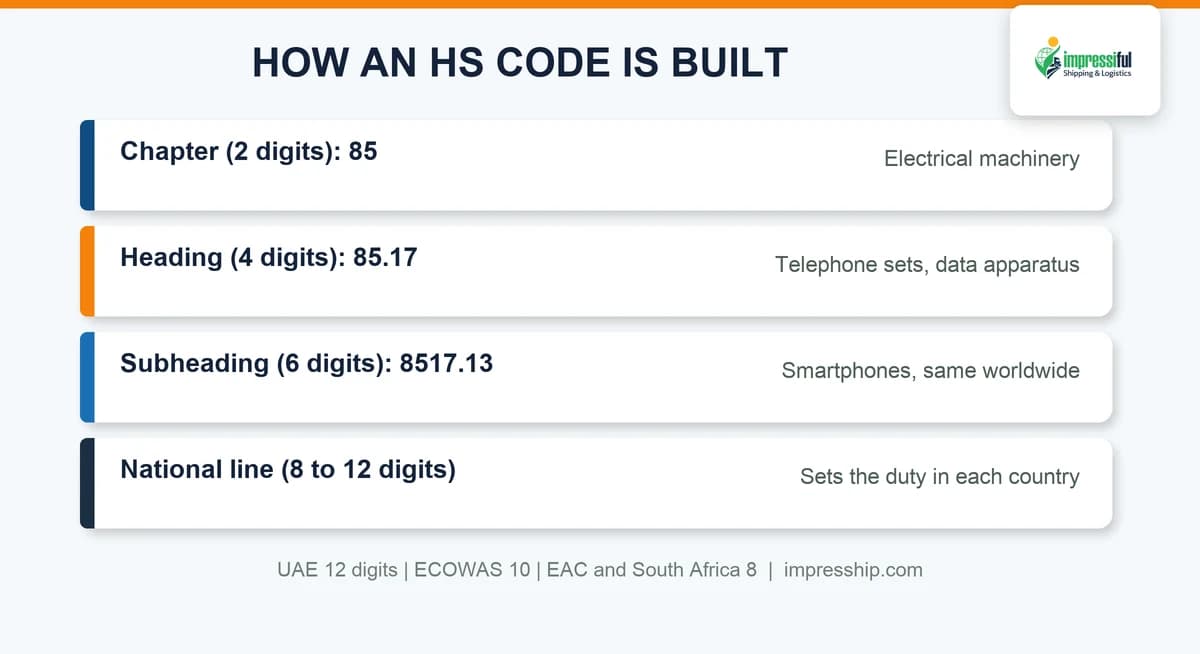
The Harmonized System is maintained by the WCO and groups goods into more than 5,000 commodity groups, each identified by a six digit code. The first six digits are the same in every country that uses the system; countries then add their own digits for national duty rates and statistics.
| Level | Digits | Example | What it tells customs |
|---|---|---|---|
| Chapter | 2 | 85 | Electrical machinery and equipment |
| Heading | 4 | 85.17 | Telephone sets and other apparatus for transmitting voice or data |
| Subheading | 6 | 8517.13 | Smartphones (the international HS level) |
| National tariff line | 8 to 12 | 8517.13 plus local digits | The duty rate and rules in the importing country |
The international part stops at six digits. A smartphone is 8517.13 in Dubai, Accra, Lagos and Durban alike, but the full tariff line that sets the duty rate is longer and differs by country. When a supplier says "the HS code", always ask which country's tariff it comes from.
Need this handled end to end?
Tell us your lane and cargo profile and we'll come back with a routing plan and an all-in rate.
How long is an HS code in the UAE and in Africa?#
National tariffs extend the six digit HS code in different ways, which is why the code on a UAE export declaration is not always the code your broker will declare at destination.
- UAE. The GCC countries now use a 12 digit Integrated Customs Tariff based on HS 2022. Dubai Customs set a six month transition from 1 August 2025, with 8 and 12 digit codes running in parallel; its Integrated Customs Tariff guide explains the structure.
- ECOWAS countries. Ghana, Nigeria, Togo and the other ECOWAS members apply the ECOWAS Common External Tariff, with national lines that run to 10 digits and five duty bands of 0, 5, 10, 20 and 35 percent, as the US trade guide to Ghana summarises.
- East Africa. Kenya, Tanzania, Uganda and the other EAC members use the EAC Common External Tariff at 8 digits.
- South Africa. The SARS tariff book uses 8 digit tariff subheadings, shared across the Southern African Customs Union.
The practical rule: your Dubai supplier's export code is a useful start, but the code that counts for duty is the one in the destination country's tariff. Our Ghana customs duty calculation guide shows how that code feeds straight into the duty band at Tema.
How customs classifies goods: the six interpretation rules#
Classification is not a keyword search. The HS comes with six General Rules for the Interpretation (GRIs), and customs officers apply them in order.
- Rule 1 comes first. Goods are classified by the wording of the headings and the section and chapter notes, not by the titles alone.
- Unfinished and mixed goods. Rule 2 covers incomplete or unassembled articles and mixtures of materials.
- Two possible headings. Rule 3 picks the most specific description, then the material or component that gives the goods their essential character (common with sets and kits), then the heading that comes last in numerical order.
- Nothing fits. Rule 4 classifies goods under the heading for the most similar goods.
- Cases and packing. Rule 5 deals with cases, boxes and packing that travel with the goods.
- Subheadings. Rule 6 applies the same logic at the subheading level.
This is why "machine parts" or "general goods" on an invoice causes trouble. Customs needs enough detail (material, function, power source, what the item is part of) to apply the rules, and vague wording invites a query or a reclassification. Our customs clearance documents guide shows how the description, HS code and value need to agree across every document.
How to find the right HS code for your product#
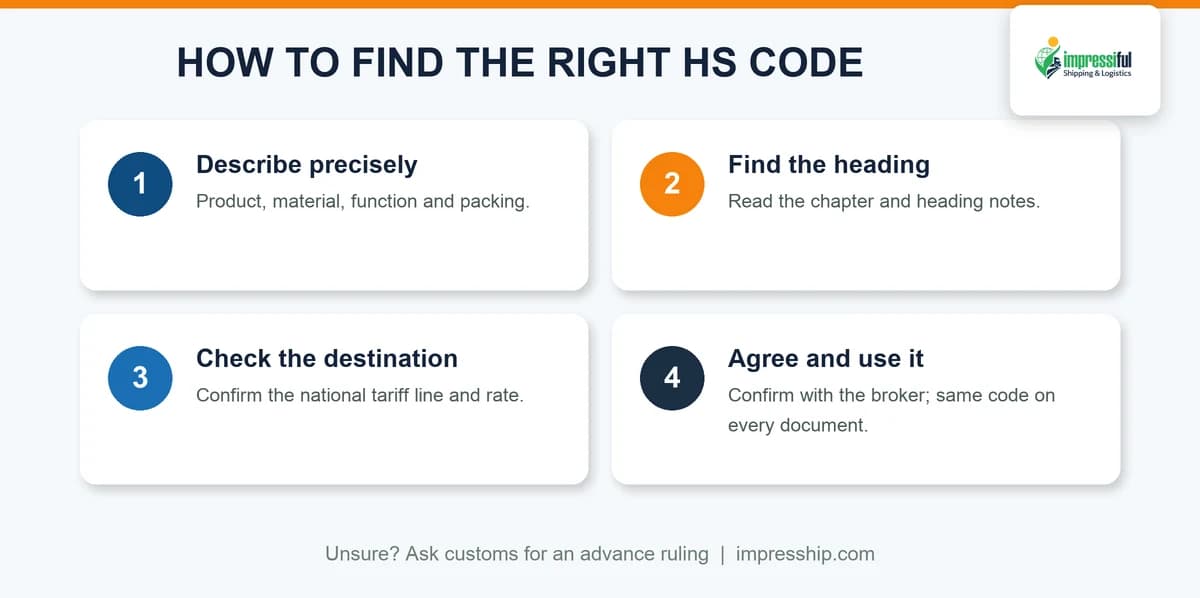
- Write a precise description. Name the product, the material, what it does and how it is packed.
- Find the chapter and heading. Use the HS nomenclature or the destination country's tariff to narrow it down, and read the chapter notes.
- Check the destination tariff line. Confirm the full national code and duty rate in the importing country's tariff.
- Agree it with your clearing agent. Ask the licensed broker at destination to confirm the code before you ship.
- Use it everywhere. Put the same code and description on the commercial invoice, packing list and bill of lading description, so nothing conflicts at clearance.
If the classification is uncertain or the duty at stake is large, ask the destination customs authority for an advance ruling. The WTO Trade Facilitation Agreement, in force since February 2017, requires member countries to provide advance rulings on tariff classification, although the procedure differs from country to country.
Not sure which HS code applies?
Send us the product description, a photo or spec sheet and the destination country, and we will check the documents and quote the shipment from Dubai.
What happens if you use the wrong HS code#
A wrong code is rarely just a typing error in the eyes of customs. Depending on the country, it can lead to:
- Extra duty and penalties when customs reclassifies the goods into a higher band.
- Delays and storage costs while the declaration is queried, amended or the cargo is examined.
- Missing permits. A code that hides a regulated product can mean the right licence or conformity certificate was never arranged.
- Refused preferences. Trade agreement rates depend on the code and origin rules lining up.
Some product groups deserve extra care. Perfume (3303.00), aerosols and lithium batteries (8507.60) are common in Dubai shipments and are also dangerous goods; every dangerous goods shipment is subject to approval, and our dangerous goods guide explains the declarations they need.
Our FOB vs CIF guide explains how that value is worked out.
HS 2028: what changes from 1 January 2028#
The HS is updated every five to six years. The next version, HS 2028, is the eighth edition and enters into force on 1 January 2028, according to the WCO's HS 2028 page. It contains 299 sets of amendments, giving 1,229 headings and 5,852 subheadings, including a new heading 21.07 for dietary supplements and new headings 30.07 and 30.08 for vaccines.
If you import the same products every year, plan a review of your codes before January 2028. National tariffs will be updated to the new edition, and an old code on a supplier's template can cause a mismatch at clearance.
Frequently asked questions#
How do I understand HS codes?#
Read an HS code from left to right: the first two digits are the chapter, the first four the heading and the first six the subheading, which is the same worldwide under the WCO Harmonized System. Any digits after the sixth belong to the importing country's tariff and set the duty rate there.
How can I find my HS code?#
Start with a precise description of the product and its material, then find the chapter and heading in the HS or in the destination country's tariff and read the chapter notes. Confirm the full national code with your clearing agent before you ship, and if the duty at stake is large, ask customs for an advance ruling.
How to find HS code in UAE?#
UAE codes follow the GCC 12 digit Integrated Customs Tariff, which Dubai Customs publishes along with its tariff guidance. Your Dubai supplier or forwarder will use it on the export declaration, but remember that the destination country may classify the same goods under its own national digits.
What is the format of a 12-digit HS code?#
The first six digits are the international HS code (chapter, heading and subheading). In the GCC tariff, the seventh and eighth digits add the GCC level of detail and the last four give a finer national breakdown. Only the first six digits will match the code used in an African country's tariff.
What is the HS code used for in Ghana customs?#
In Ghana the HS code decides which ECOWAS CET band applies (0, 5, 10, 20 or 35 percent) and whether extra levies, permits or exemptions apply. Our Ghana customs duty calculation guide walks through a worked example, and our customs clearance service can check the code before loading.
What are HS codes for imports?#
For imports, the HS code is the product number customs uses to apply the duty rate, collect trade statistics and check whether the goods are restricted. It appears on the commercial invoice and the customs declaration, and it should be agreed before shipping, not after the cargo arrives.
Send your cargo details for a same-day quote#
Tell us what you are shipping, the HS codes if you have them, the volume and weight, and the destination port. We ship general cargo and dangerous goods from the UAE to all 54 African countries on our destinations list, with every dangerous goods shipment subject to approval, by ocean freight or air, and we provide telex release bills of lading (see our bill of lading guide).
Request a same-day quote or message us on WhatsApp with your cargo details.