Shipping to Landlocked African Countries: Gateway Ports, Transit and Customs Explained
Shipping to landlocked African countries from Dubai: the gateway ports for all 16 landlocked markets, how bonded transit works, the EAC Single Customs Territory and COMESA transit guarantee, and how to choose the right port.
Sixteen of Africa's 54 countries have no coastline, from Mali and Niger in the west to Ethiopia, Uganda and Zambia in the east and south, according to the UN list of landlocked developing countries. Their trade costs are about 30 percent higher than those of coastal states, UN News reported, because every import crosses at least one neighbour before it arrives. Shipping to landlocked African countries from Dubai is still routine if you plan it well. This guide lists the gateway port for each country, explains how transit cargo moves under customs control, and shows how to choose a route and keep the paperwork clean.
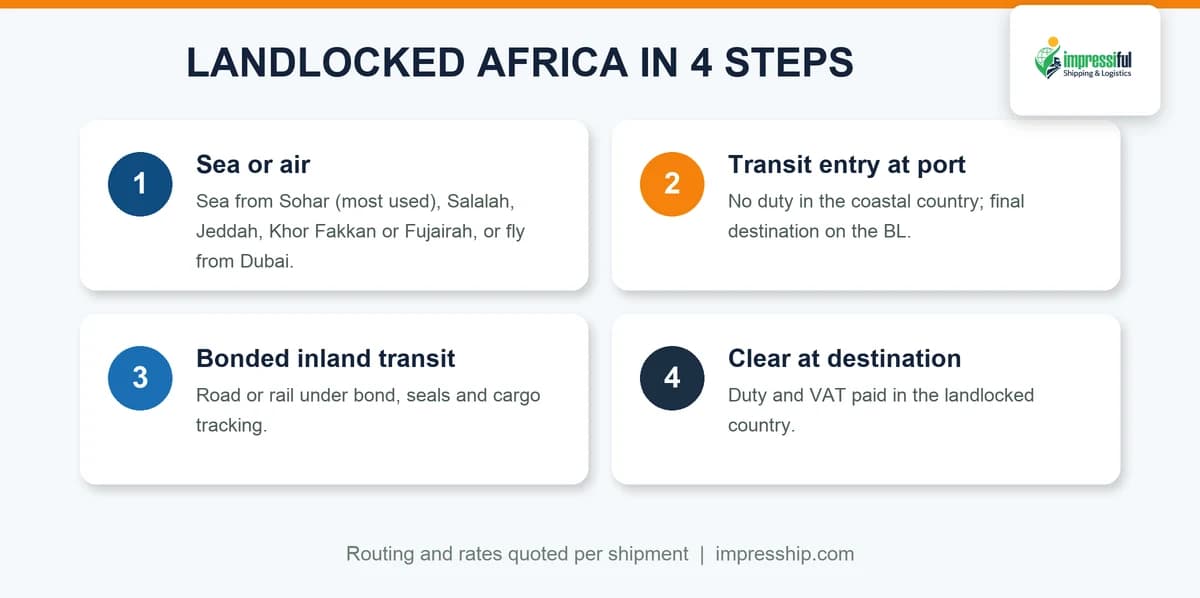
For most importers, the answer is a two part journey. The cargo goes by sea (sea cargo currently loads at one of our partner ports: Sohar, the one we use most, or Salalah in Oman, Jeddah in Saudi Arabia, or Khor Fakkan or Fujairah in the UAE) to a coastal gateway port such as Tema, Dar es Salaam, Mombasa, Djibouti or Durban, then travels inland by road or rail under a customs transit bond, and duty is paid only in the country of final destination. Air freight into the capital is the alternative for urgent goods.
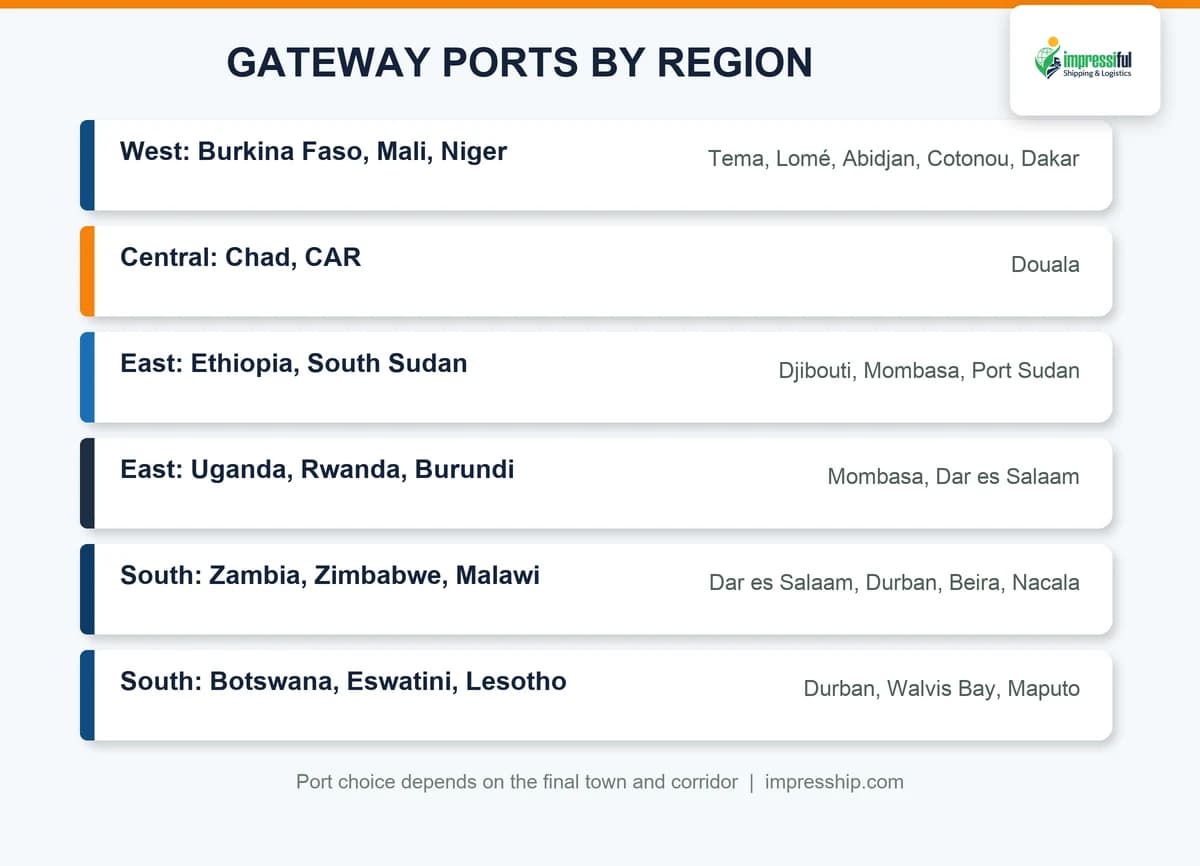
The 16 landlocked African countries and their gateway ports#
The table below follows our destinations list, which shows the common maritime gateways for each landlocked market. Port choice can still vary with the carrier, the cargo, the customs corridor and the final town.
| Country | Region | Common gateway ports |
|---|---|---|
| Burkina Faso | West | Tema (Ghana), Lomé (Togo), Abidjan (Côte d'Ivoire) |
| Mali | West | Dakar (Senegal), Abidjan (Côte d'Ivoire) |
| Niger | West | Cotonou (Benin), Lomé (Togo) |
| Chad | Central | Douala (Cameroon) |
| Central African Republic | Central | Douala (Cameroon) |
| Ethiopia | East | Djibouti |
| South Sudan | East | Mombasa (Kenya), Port Sudan (Sudan) |
| Uganda | East | Mombasa (Kenya), Dar es Salaam (Tanzania) |
| Rwanda | East | Dar es Salaam (Tanzania), Mombasa (Kenya) |
| Burundi | East | Dar es Salaam (Tanzania) |
| Zambia | Southern | Dar es Salaam (Tanzania), Durban (South Africa) |
| Zimbabwe | Southern | Durban (South Africa), Beira (Mozambique) |
| Malawi | Southern | Beira, Nacala (Mozambique) |
| Botswana | Southern | Durban (South Africa), Walvis Bay (Namibia) |
| Eswatini | Southern | Maputo (Mozambique), Durban (South Africa) |
| Lesotho | Southern | Durban (South Africa) |
Shipping to a landlocked African country?
Send your cargo details, HS codes and the final town or city, and we will come back with the gateway port, routing and an all in rate.
How shipping to landlocked African countries works#
Every landlocked shipment has the same four stages, whichever corridor it uses. Getting each one right decides how long the cargo sits at the gateway port and how much it costs to reach the final town.
- Sea or air from Dubai. The cargo sails to the gateway port by ocean freight, in a full container or consolidated with other shippers' goods. Urgent goods can fly directly into the destination country instead.
- Discharge at the gateway port. The cargo is entered as transit, not as an import into the coastal country, so no duty is paid there. This only works if the bill of lading names the final destination.
- Inland transit under customs control. The goods move by road or rail under a customs bond, seals and, on many corridors, electronic cargo tracking. Our inland transportation service covers ground moves from ports to final destinations; ask for the inland leg in your quote.
- Clearance in the destination country. Duty and VAT are paid at the inland border or the destination dry port, under that country's tariff and rules.
Transit rules: bonds, seals and single declarations#
Transit cargo crosses a country without paying its duty, so customs needs a guarantee that the goods will leave. That is the role of the transit bond, and regional schemes have made it simpler.
East Africa: the Single Customs Territory. For Rwanda, Burundi and Uganda, the Tanzania Revenue Authority explains that goods from outside the EAC are no longer treated as transit followed by a second import entry. One declaration is lodged and processed in the destination country, and the goods then move under electronic cargo tracking or a regional bond guarantee. The scheme started on the Northern Corridor through Mombasa and now also runs on the Central Corridor through Dar es Salaam.
COMESA: one guarantee across borders. The COMESA Regional Customs Transit Guarantee lets a single customs bond cover goods under seal across the member and participating states that have signed it, including Ethiopia, Malawi, Rwanda, Tanzania, Uganda and Zimbabwe, instead of a new bond at every border.
Southern and West Africa. Botswana, Lesotho and Eswatini share a customs union with South Africa, so agree with the clearing agents at both ends where the goods will be entered. Sahel routes from Tema, Lomé, Abidjan, Cotonou and Dakar run under each coastal country's transit procedures, and your clearing agent at the port arranges the bond.
Choosing the right gateway port#
Several landlocked markets have two or three possible gateways, and the best one changes with the season and the cargo. Compare these points for each routing you are offered:
| Factor | What to ask |
|---|---|
| Final town | Which port is closest by road or rail to the delivery address, not just to the capital? |
| Corridor rules | Is a single declaration or a regional bond available, or does each border need its own entry? |
| Container use | Can the container travel inland, or will the cargo be unloaded at the port and trucked? |
| Documents | Does the destination need a certificate of conformity, permit or pre-arrival declaration? |
| Port conditions | How long is cargo currently waiting at the gateway port, and how many free days apply? |
Our customs clearance documents guide explains the core set (commercial invoice, packing list, bill of lading and certificate of origin), and our bill of lading guide covers the bill itself. We provide telex release bills of lading, so the agent at the gateway port is not waiting for paper originals.
How to keep landlocked shipments on budget#
- Quote door to door, not port to port. The inland leg, border charges and container return can cost more than the sea freight, so ask for every leg in one quote.
- Consolidate before you ship. Several suppliers in Dubai can deliver to one warehouse and travel as a single shipment with one set of transit documents.
- Declare dangerous goods upfront. Perfume, aerosols and batteries ship as dangerous goods, and every dangerous goods shipment is subject to approval; our dangerous goods guide explains the declarations.
- Fix the HS codes and values early. The destination country's customs will check the same invoice as the transit country, so a wrong code or value causes delays twice. Our customs clearance service can check the paperwork from Dubai.
Frequently asked questions#
What are the 16 landlocked countries in Africa?#
They are Botswana, Burkina Faso, Burundi, the Central African Republic, Chad, Eswatini, Ethiopia, Lesotho, Malawi, Mali, Niger, Rwanda, South Sudan, Uganda, Zambia and Zimbabwe, as listed by the UN Office for landlocked developing countries. All 16 are on our destinations list, each with its common gateway ports.
How do landlocked countries trade?#
They import and export through the seaports of their neighbours, using road and rail corridors and customs transit regimes that let goods cross the coastal country without paying its duty. Regional schemes such as the EAC Single Customs Territory and the COMESA transit guarantee reduce the number of declarations and bonds along the way, and air freight serves urgent and high value goods.
How does being landlocked affect a country's economy?#
Longer routes, border crossings and transit bonds make imports and exports more expensive and slower. UN News puts the trade costs of landlocked developing countries at about 30 percent above those of coastal states, which is why efficient corridors and clean paperwork matter so much for importers.
How much does it cost to ship to Africa?#
It depends on the destination, volume, weight, cargo type and mode, and for landlocked countries also on the inland leg, so sea and air freight are quoted per shipment. Our air freight vs ocean freight guide explains how to choose the mode, and you can send the CBM, weight and final town through our contact page for an all in rate.
Which port is best for shipping to Uganda or Rwanda?#
Both Mombasa and Dar es Salaam serve Uganda and Rwanda on our destinations list, and the better choice depends on the final town, the sailing and current conditions at each port. Ask for both routings when you request a quote, with the final destination on the bill of lading from the start.
Send your cargo details for a same-day quote#
Tell us what you are shipping, the HS codes if you have them, the volume and weight, and the final town or city in the landlocked country. We ship general cargo and dangerous goods from the UAE to all 54 African countries on our list, including the 16 landlocked markets through their gateway ports, with every dangerous goods shipment subject to approval, and we provide telex release bills of lading.
Request a same-day quote or message us on WhatsApp with your cargo details.