
Strait of Hormuz Shipping: How Cargo from Dubai Reaches Africa Now (2026)
Strait of Hormuz shipping explained for importers in Africa: whether cargo from Dubai can still ship with the strait closed, the five partner ports our sea cargo loads at, how a shipment runs step by step, current sea estimates and what to do differently.
Short answer: Yes. Cargo from Dubai still ships to Africa while the Strait of Hormuz is closed: it travels by road to a port outside the strait and loads there. Our sea cargo currently loads at one of our partner ports: Sohar (most used) or Salalah in Oman, Jeddah, Khor Fakkan or Fujairah. Our sea freight figures remain estimates, confirmed at booking.
Strait of Hormuz shipping has been close to a standstill for most of 2026, and importers in Ghana, Nigeria, Kenya and the rest of Africa want to know two things: can they still buy in Dubai and ship home, and which ports carry the cargo now. This guide answers both with dated sources, lists the five partner ports our sea cargo currently loads at, shows how a shipment runs step by step, and sets out what has and has not changed in our estimates.
Is the Strait of Hormuz open for shipping?#
Not for normal commercial traffic. The live tracker straits.live reported on 18 November 2026 that the strait was closed to commercial shipping on day 263 of the closure, citing the IMF PortWatch count of 2 vessels on 15 November, about 2% of a typical day (around 85 transits a day before the crisis). UN Trade and Development (UNCTAD) explains in its rapid assessment of the Hormuz disruptions that the strait normally carries around a quarter of global seaborne oil trade, along with large volumes of liquefied natural gas and fertilisers.
For exporters, the key point is geography. Dubai's main container port sits inside the Gulf, so a ship leaving it has to pass through the strait. Ports on the Gulf of Oman, the Arabian Sea and the Red Sea do not. Since the closure, shipping lines and forwarders have moved UAE export cargo by road to those ports, often called a land bridge.
Strait of Hormuz shipping: the ports used now#
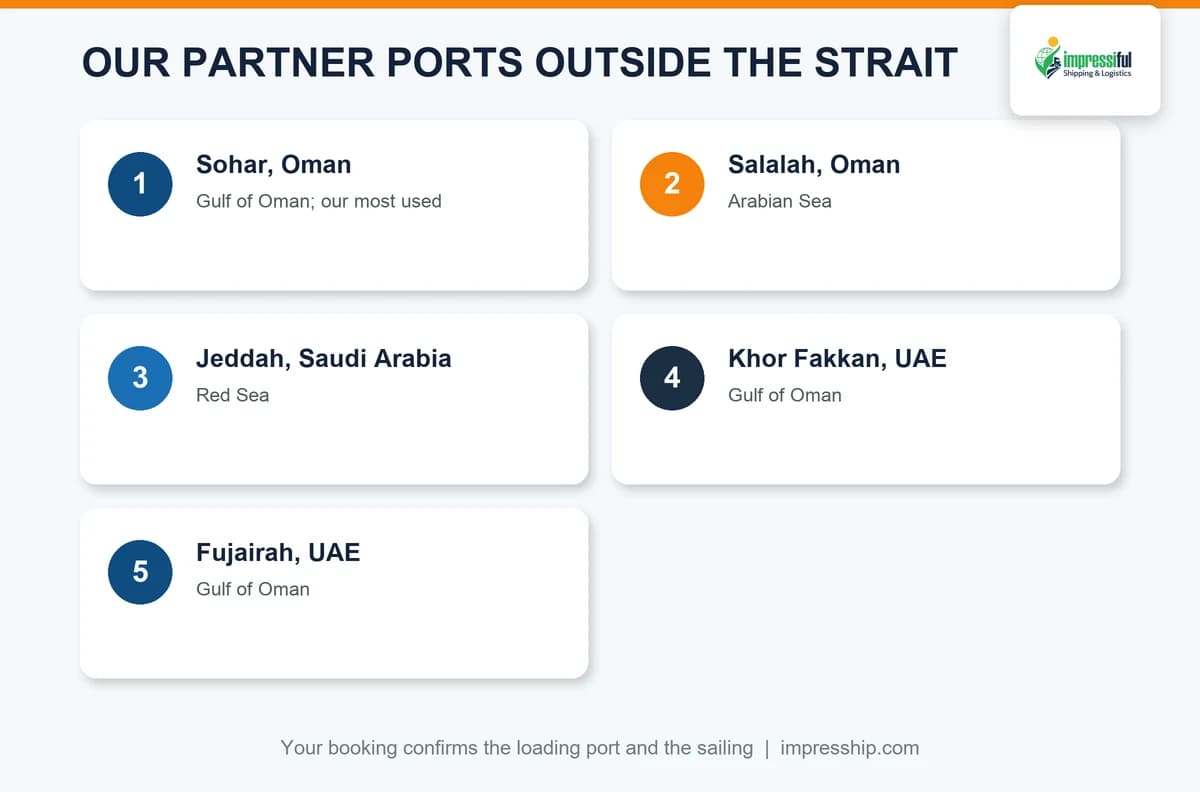
These are the five partner ports our sea cargo currently loads at. All five are outside the Strait of Hormuz.
| Partner port | Country | Coast | Outside the strait? |
|---|---|---|---|
| Sohar (our most used) | Oman | Gulf of Oman | Yes |
| Salalah | Oman | Arabian Sea | Yes |
| Jeddah | Saudi Arabia | Red Sea | Yes |
| Khor Fakkan | UAE | Gulf of Oman | Yes |
| Fujairah | UAE | Gulf of Oman | Yes |
Which port a shipment uses depends on the sailing, the space available and the destination, and your booking confirms the loading port and the sailing. Most cargo to Africa is also transshipped at a regional hub on the way, so the vessel that loads your goods is not always the one that discharges them.
Shipping lines publish their own Gulf rules, and they change often. Maersk's Middle East operational update of 18 November 2026, for example, lists export land bridge solutions from the UAE via Salalah and Khor Fakkan, accepts dry cargo bookings to and from Sohar and Salalah, and keeps dangerous goods bookings from the UAE and Oman suspended. Read those notices as a snapshot of one carrier on one date.
How a shipment from Dubai to Africa runs now#
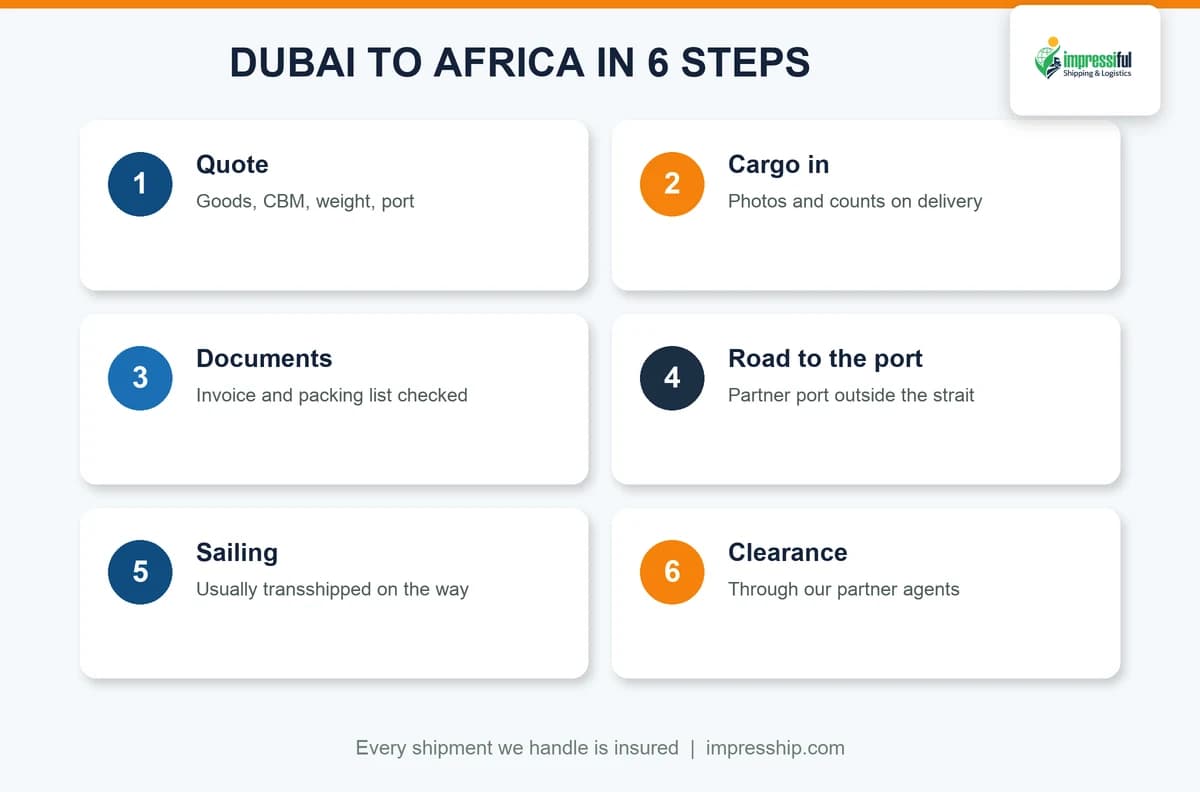
- Quote. You send the goods, the CBM and weight, and the destination port. We confirm LCL (shared space) or a container, using the same estimates as the shipping calculator.
- Cargo in. Your supplier delivers to our shared warehouse in Dubai, or we quote a pickup. We confirm every delivery with photos and counts.
- Documents. We check the commercial invoice and packing list in Dubai before the cargo leaves. Our guide to the commercial invoice for export shows what it needs.
- To the partner port. The cargo moves by road to the partner port named in your booking.
- Sailing. The cargo loads and sails, usually with a transshipment on the way to Africa.
- Arrival and clearance. We handle customs clearance at destination through our partner agents, or you can use your own clearing agent. We provide telex release bills of lading, so nobody waits for paper originals.
Shipping from Dubai to Africa during the closure?
Send the goods, the CBM and weight and the destination port, and we will confirm the sailing from one of our partner ports and quote the sea freight.
What our estimates look like now#
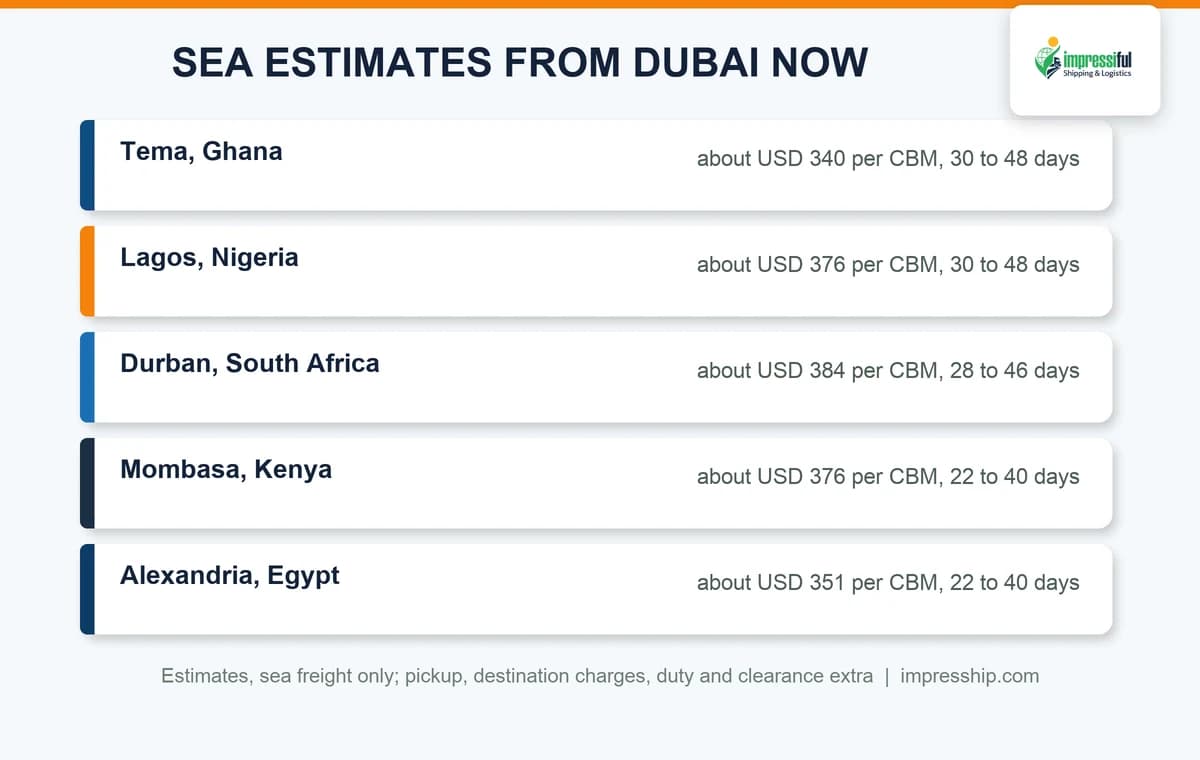
Our sea freight figures are estimates from the CEO's rate card and the shipping calculator. They depend on the product and the country, and they cover sea freight only: Dubai pickup, destination charges, duty and clearance are extra.
| Region | Example port | LCL estimate | Days at sea |
|---|---|---|---|
| West Africa | Tema, Ghana | about USD 340 per CBM | about 30 to 48 |
| West Africa | Lagos, Nigeria | about USD 376 per CBM | about 30 to 48 |
| Central and Southern Africa | Durban, South Africa | about USD 384 per CBM | about 28 to 46 |
| East Africa | Mombasa, Kenya | about USD 376 per CBM | about 22 to 40 |
| North Africa | Alexandria / Port Said, Egypt | about USD 351 per CBM | about 22 to 40 |
| Landlocked countries | via a gateway port | confirmed with each quote | confirmed with each quote |
Shipments under 1,000 kg pay a weight band when it is higher than the CBM charge, starting at about USD 177 to Tema for 25 to 49 kg. Every coastal lane is in the shipping calculator, and the LCL vs FCL guide explains when a container makes sense. We recommend LCL up to roughly 30 CBM, then a 40ft.
Your booking confirms the price, the loading port and the sailing.
What importers should do differently during the closure#
- Get the routing in writing. Ask any forwarder which port your cargo will load at and whether the sailing is direct or transshipped.
- Ask what the quote covers. A fair quote separates sea freight, pickup, origin handling, destination charges, duty and clearance, so you can compare like with like.
- Have the documents ready early. An accurate invoice, packing list and HS codes keep the cargo moving at the partner port and at destination. Our guide to an accurate freight quote lists what to send.
- Plan with the full transit range. Use the whole range of days at sea, not the lowest figure, when you promise stock to your customers.
- Declare dangerous goods. Perfumes, batteries, paints and chemicals face extra carrier rules during the closure. We ship dangerous goods, and every dangerous goods shipment is subject to approval.
- Consider air for the urgent part. Our air freight runs worldwide from the UAE and is quoted per shipment.
Every shipment we handle is insured. Our guide to West Africa vs East Africa shipping routes explains how the two coasts are served.
What has not changed for importers in Africa#
The closure changed how cargo leaves the UAE, not what happens when it arrives. Duty and taxes are still worked out by the customs authority of the destination country on the value of the goods, with the same documents: a commercial invoice, a packing list, a bill of lading and any permits or certificates your product needs. We still handle customs clearance at destination through our partner agents, and you can still use your own clearing agent if you prefer.
Our sea freight still covers the 54 African destinations on our destinations list, including gateway ports for landlocked countries such as Uganda, Rwanda and Burkina Faso, whose sea price is confirmed with each quote. Our ocean freight service page explains what we handle from the UAE.
Frequently asked questions#
Has shipping stopped in the Strait of Hormuz?#
Almost. On 18 November 2026, the straits.live tracker reported the strait closed to commercial shipping on day 263 of the closure, with 2 vessels counted on 15 November against about 85 a day before the crisis. Cargo from Dubai still moves by road to ports outside the strait, such as Sohar, Salalah, Jeddah, Khor Fakkan and Fujairah, and sails from there.
Can countries bypass the Strait of Hormuz?#
Yes, partly. The UAE and Oman have ports outside the strait, on the Gulf of Oman and the Arabian Sea, and Saudi Arabia has Jeddah on the Red Sea. Container cargo reaches them by road, which is how exporters keep shipping to Africa during the closure. Our sea cargo currently loads at Sohar (most used), Salalah, Jeddah, Khor Fakkan or Fujairah; see our shipping from the UAE to Africa page for the lanes.
Send your cargo details for a same-day quote#
Tell us what you are shipping from Dubai, the CBM and weight and the destination port in Africa. We will confirm LCL or a container, the partner port and the sailing, and handle customs clearance at destination through our partner agents, or hand over to your own clearing agent.
Request a same-day quote or message us on WhatsApp with your cargo details.