
Commercial Invoice for Export: What African Customs Check on the Invoice and Packing List
Commercial invoice for export from Dubai: the fields African customs check, what the packing list must show, the matching rules behind most queried entries, what Ghana, Nigeria, Kenya, Egypt and Morocco add, and a checklist before the cargo loads.
A commercial invoice for export is the first document African customs read: it says what the goods are, what they cost, who sold them and who is buying, and the duty is worked out from it. The packing list sits beside it and says what is physically inside each carton. When the commercial invoice and packing list agree with each other and with the bill of lading, the entry moves; when they do not, the entry gets queried. This guide covers the fields a commercial invoice for export needs, what the packing list must show, the matching rules customs officers check at Tema, Lagos, Mombasa and other African ports, and what each main market adds.
The short version: one set of facts, written the same way on every document, before the cargo leaves Dubai.
What is a commercial invoice for export?#
A commercial invoice is the bill of sale for an international shipment. The seller (the exporter) issues it to the buyer (the importer), and customs at both ends use it: in the UAE it supports the export declaration, and at destination it is the basis for the import declaration and the duty assessment.
Three documents are often confused:
- Proforma invoice. A quote issued before the sale is final. Importers use it to open a Form M in Nigeria or to apply for import permits, and some markets accept it at the start of the process. It is not a substitute for the final invoice.
- Commercial invoice. Issued at shipment, for the goods and quantities actually shipped, at the price actually paid.
- Packing list. Describes the physical cargo: packages, contents, sizes and weights. It does not need prices.
Our guide to customs clearance documents in Africa explains how these papers fit with the bill of lading, certificates and permits. This guide goes one level deeper, into the invoice and packing list themselves.
Need this handled end to end?
Tell us your lane and cargo profile and we'll come back with a routing plan and an all-in rate.
Commercial invoice for export: the fields customs check#
There is no single legal form; most suppliers use their own letterhead. What matters is that these fields are present and correct:
| Field | What to write | Why customs cares |
|---|---|---|
| Seller (exporter) | Full legal name, address, phone and trade licence or tax number | Identifies who sold and exported the goods |
| Buyer (consignee) | Legal name exactly as on the importer's tax registration, with address and tax number | Must match the bill of lading and the importer's records |
| Invoice number and date | A unique number, plus the order or contract number if there is one | Quoted on the declarations |
| Description of goods | What each item is, what it is made of and what it is used for | Drives the HS classification; "parts" or "samples" is not a description |
| HS code | At least six digits, and the national tariff line if known | Sets the duty rate |
| Quantity and unit | Per line, in pieces, sets, kg or metres | Checked against the packing list and the physical count |
| Unit price and line total | The real transaction price | Customs values the goods on it |
| Currency | USD, AED or the agreed currency | Converted at the customs rate |
| Incoterm and named place | For example FOB Dubai or CIF Lagos | Shows what the price includes |
| Freight and insurance | Shown separately when the price is CIF or CFR | Duty in most African markets is on the CIF value |
| Country of origin | Where each item was made, not where it was bought | Preferential duty, restrictions and certificates |
| Packages and weights | Number of packages, net and gross weight | Matched to the packing list and the bill of lading |
| Destination references | Form M number (Nigeria), ACID (Egypt) or other reference the importer gives you | The entry cannot be linked to the goods without it |
| Signature and stamp | The supplier's authorised signature and company stamp | Confirms the invoice is genuine |
Two fields cause more trouble than the rest. The first is origin: goods made in China and bought from a trader in Deira are Chinese origin, and writing "UAE" on the invoice does not change that. Our certificate of origin guide explains how origin is proved. The second is the Incoterm: the ICC Incoterms rules define what FOB, CFR and CIF include, and our FOB vs CIF guide shows why West African duty is charged on the CIF value whichever term you buy on.
The packing list: what it must show#
The packing list tells the officer, and everyone who handles the cargo, what is in each package. A good one shows:
- Package numbers and marks, matching the labels on the cartons or pallets
- Contents per package, using the same descriptions and quantities as the invoice lines
- Package type, such as carton, pallet, crate or drum
- Dimensions per package, in centimetres
- Net and gross weight per package
- Totals: number of packages, total gross weight and total volume in CBM
- The same references as the invoice: invoice number, seller and consignee
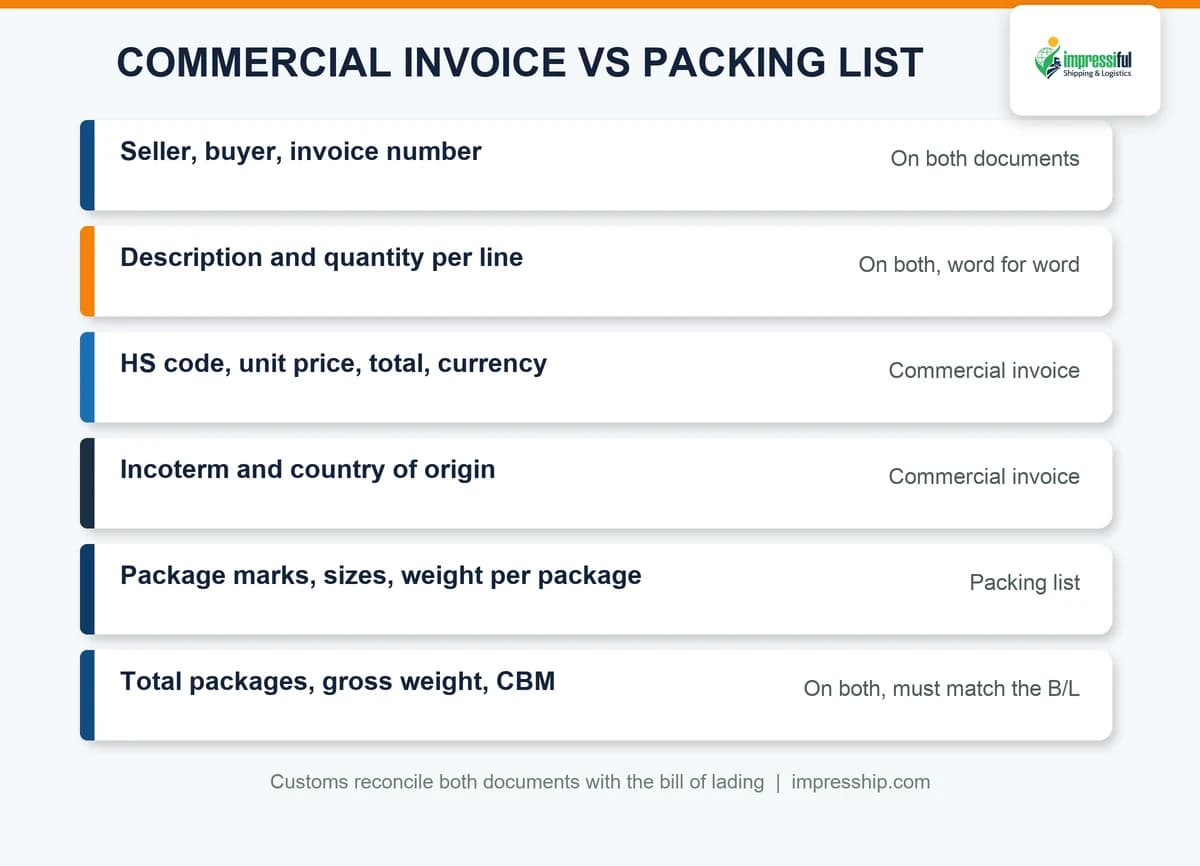
The totals on the packing list are also what a sea freight quote is built on, so measure carefully; our guide on how to calculate CBM shows the method. Some suppliers issue a combined "invoice and packing list". That is acceptable in many markets, as long as every field above is still there.
Why entries get queried: the matching rules#
Customs officers do not read each document on its own. They reconcile the invoice, packing list, bill of lading, certificates and the importer's declaration against each other and, when the cargo is examined, against the container. These are the mismatches we see most often:
- The consignee name differs. "ABC Trading" on the invoice, "ABC Trading Ltd" on the bill of lading and a third version on the importer's tax registration. Use the registered name everywhere.
- The totals do not agree. 412 cartons on the invoice, 410 on the packing list and 412 on the bill of lading, or gross weights that differ by a few hundred kilos.
- The descriptions do not agree. The invoice says "household items"; the packing list lists phones, perfume and kitchen appliances. Each line needs the same description on both.
- The value looks too low. Customs services across the continent compare declared values with reference values. An invoice below them invites an uplift and, increasingly, a penalty, so never split or under-invoice to save duty.
- The HS code does not fit the description. A code for "parts of machinery" next to a description of finished pumps is treated as a classification problem, not a typo. Our HS codes guide explains how to find the right code.
- The count is wrong. An examination finds more cartons, or different goods, than the documents show.
- Dangerous goods are missing from the documents. Perfume, aerosols and batteries hidden in a mixed load. We ship dangerous goods, but every dangerous goods shipment is subject to approval, and for products that contain chemicals or are dangerous goods we work with the supplier to get the safety data sheet (MSDS).
- A destination reference is missing. No Form M number on a Nigerian invoice, or no ACID on an Egyptian one.
What African customs add, market by market#
The core set is the same everywhere, but each market adds its own requirements:
- Ghana. The Ghana Revenue Authority lists the original bill of lading or waybill, an attested invoice, the packing list, the Import Declaration Form from the Ministry of Trade, the importer's TIN or Ghana Card PIN, and any permit from bodies such as the FDA or the Ghana Standards Authority. The clearing agent declares them in ICUMS. Our customs clearance in Ghana guide covers the steps.
- Nigeria. The importer opens a Form M through an Authorised Dealer Bank with a proforma invoice before the goods ship. The final invoice and packing list must carry the same descriptions and values as the Form M, and the Form M number should appear on them. Regulated products need a SONCAP product certificate. Our customs clearance in Nigeria guide explains each step.
- Kenya. The importer lodges an Import Declaration Form before shipment, and many regulated products need a certificate of conformity from a PVoC agent in the export country. Our guide on how to calculate import duty in Kenya shows how the invoice value becomes the duty.
- Egypt. The importer registers the shipment on Nafeza and receives an ACID, which must appear on the invoice, packing list and bill of lading. The US Commercial Service guide to Egypt's import documents also says the commercial invoice needs legalisation by the Egyptian consulate in most cases, so confirm with your importer. See our Dubai to Egypt guide.
- Morocco. According to the US Commercial Service guide to Morocco's import documents, the invoice should be on the supplier's letterhead, describe the goods fully in French, show the HS code, the value, the payment currency and the buyer's address, and use dates in the dd/mm/yyyy format. Our Dubai to Morocco guide covers that lane.
Rules change, so your importer or clearing agent should confirm the current list before the goods ship. We handle customs clearance at destination through our partner agents, or your importer can use their own agent.
Who prepares the commercial invoice and packing list?#
The seller prepares both. When you buy from one factory, that is simple. When you buy from five traders in Dubai and consolidate everything into one shipment, each supplier issues an invoice for their own goods, and the documents for the shipment must still add up to one consistent set.
That is where most of the matching problems start, so check the documents against the goods. Your suppliers deliver to our shared warehouse in Dubai, and we confirm every delivery with photos and counts, so you can compare each packing list with what actually arrived before the documents are finalised. If a supplier delivered 38 cartons instead of 40, the paperwork should say 38.
On the UAE side, the export declaration is filed with the commercial invoice and packing list as supporting documents, together with the bill of lading or air waybill and any permit the goods need. A clean invoice helps at both ends.
A checklist before the cargo loads#
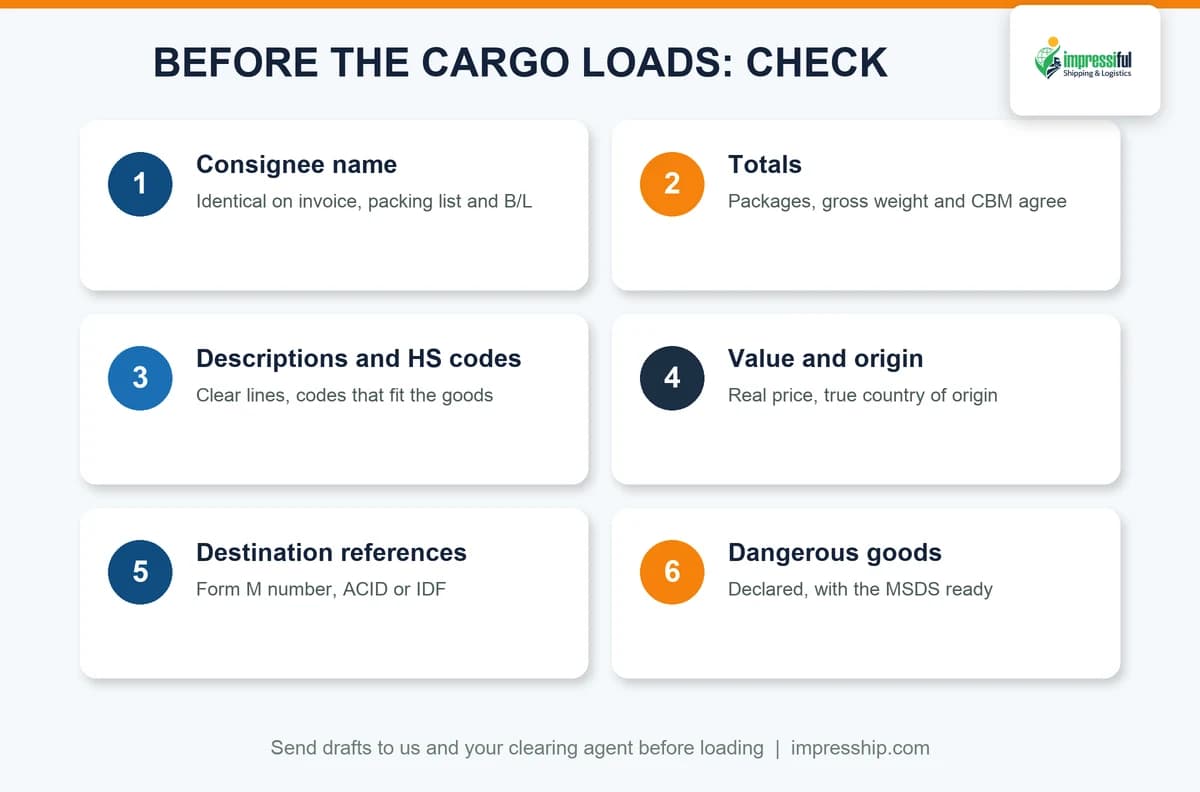
- The consignee name, address and tax number are identical on the invoice, packing list and bill of lading.
- Every invoice line has a clear description, an HS code, a quantity and a unit price.
- Package count, gross weight and CBM agree across all documents and with what was delivered.
- The Incoterm and named place are stated, with freight and insurance shown separately on a CIF or CFR price.
- Country of origin is correct for each item.
- Destination references (Form M number, ACID, IDF) are on the documents that need them.
- Dangerous goods are declared and the MSDS is ready.
- Drafts have gone to us and to the clearing agent before loading.
Our bill of lading guide lists the fields to check on the draft bill. Sea cargo currently loads at one of our partner ports: Sohar (most used) or Salalah in Oman, Jeddah in Saudi Arabia, or Khor Fakkan or Fujairah in the UAE, and the documents travel with the booking; we provide telex release bills of lading, so there are no originals to courier.
Want us to check your documents?
Send the draft commercial invoice, packing list, destination and your importer's details. We will flag anything that does not match before the cargo loads and quote the shipment.
Frequently asked questions#
How to make a commercial invoice for export?#
Use your company letterhead and include the seller and buyer details, a unique invoice number and date, a clear description, HS code, quantity, unit price and total for each line, the currency, the Incoterm with its named place, the country of origin, the number of packages and the net and gross weights. Add any reference the destination needs, then sign and stamp it.
What are the requirements for a commercial invoice for export?#
It must show the real transaction: who sold, who bought, what was shipped, how much of it and at what price. Customs at destination use it to classify and value the goods, so the descriptions, HS codes, values, origin and weights must be accurate and must match the packing list and bill of lading. Some markets add rules, such as French descriptions for Morocco or the ACID for Egypt.
Is a commercial invoice required for export?#
Yes. A commercial shipment from the UAE needs a commercial invoice to support the export declaration, and the importer needs it to clear the goods at destination; in Ghana, for example, an attested invoice is on the Ghana Revenue Authority's list of required documents. Without it customs cannot value the goods, so the shipment cannot be cleared.
Who prepares the commercial invoice?#
The seller, also called the exporter or shipper, prepares the commercial invoice and normally the packing list too. When you buy from several Dubai suppliers, each one issues an invoice for their own goods. As the buyer, you should check the consignee details, descriptions and totals before the cargo loads, because you will be the one answering customs questions at destination.
What is the difference between packing list and commercial invoice?#
The commercial invoice is the financial document: it records the sale, the prices and the total value, and customs use it to calculate duty. The packing list is the physical document: it shows what is in each package, with dimensions and weights, and normally no prices. Customs compare the two, so the descriptions, quantities and totals must agree.
Send your cargo details for a same-day quote#
Tell us what you are shipping from Dubai, the number of packages, the total CBM and gross weight, the destination port and your importer's details, and attach the draft invoice and packing list if you have them. We will check the documents for mismatches, confirm LCL or a container, and quote with the destination charges spelled out. The shipping calculator gives an estimate for sea and air, and our destinations page lists every African port we ship to. All our shipments are insured, and every dangerous goods shipment is subject to approval.
Request a same-day quote or message us on WhatsApp with your cargo details.