
Shipping from Dubai to Egypt: Alexandria and Port Said Sea Freight, ACID and Import Duty
Shipping from Dubai to Egypt by sea: LCL and container freight estimates to Alexandria and Port Said, the ACID and Nafeza steps before loading, GOEIC factory registration, how import duty and VAT are worked out, the documents and the goods you cannot import.
Shipping from Dubai to Egypt by sea runs to two Mediterranean gateways on our rates: Alexandria, the main port for Cairo and the Nile Delta, and Port Said, at the northern entrance of the Suez Canal. Both are listed for Egypt on our Africa destinations page. Egypt is also one of the few markets where a shipment cannot even be loaded without an advance customs number, the ACID. This guide covers our sea freight estimates, the ACID and Nafeza steps, how import duty and VAT are worked out, the documents to prepare and the goods you cannot import.
Most traders ship general cargo in shared container space (LCL) until the order gets close to filling a container, then switch to a 40ft.
Shipping from Dubai to Egypt: sea freight estimates#
These are our estimates for sea freight from the UAE to Alexandria or Port Said, from the same rates as our shipping calculator. They are estimates, confirmed at booking, and they depend on the product.
| Service | Estimate (sea freight only) | When it fits |
|---|---|---|
| LCL (shared container) | About USD 348 per CBM | Mixed or smaller orders up to roughly 30 CBM |
| 20ft container | USD 8,600 to 10,200 | Dense, heavy cargo that hits the weight limit first |
| 40ft container | USD 9,600 to 12,300 | Full loads; our recommended size above about 30 CBM |
| Time at sea | About 22 to 40 days, plus a few days for consolidation | Depends on the sailing and transshipment |
Dubai pickup, destination charges in Egypt, duty and clearance are extra. You can bring your cargo to our warehouse in Dubai or ask us for a pickup quote. Shared space is charged per CBM, or per tonne when the cargo is heavier than that, and shipments up to 999 kg are charged by weight band instead when that comes out higher.
As worked examples, 5 CBM of mixed goods weighing 500 kg comes to about USD 1,740 in sea freight, 12 CBM weighing 1,200 kg about USD 4,170, and 20 CBM weighing 2,000 kg about USD 6,950 (examples, not quotes). Volume drives the price, so measure the cartons first; our guide on how to calculate CBM shows how.
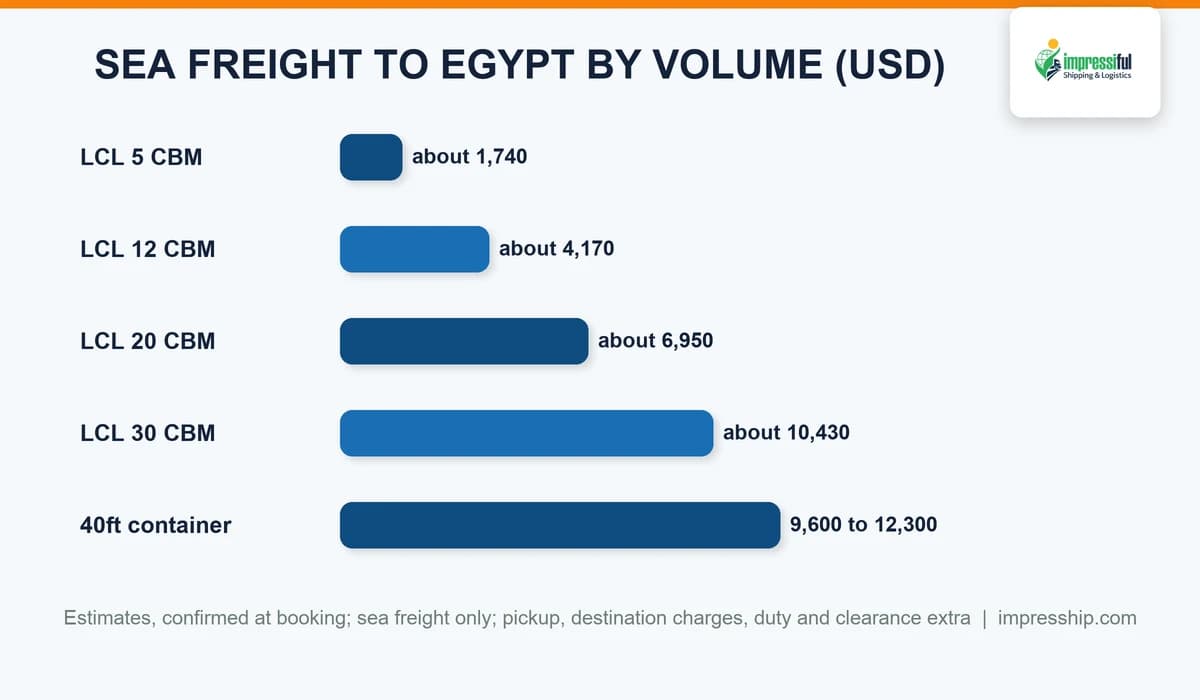
At 30 CBM, shared space comes to about USD 10,430, already inside the 40ft range. Our team recommends LCL up to roughly 30 CBM and a 40ft container beyond that, because a 40ft holds about 67 CBM and the goods are loaded once and opened once at the port. The LCL vs FCL guide explains the two pricing models.
With the Strait of Hormuz closed, our sea cargo currently loads at one of our partner ports: Sohar (most used) or Salalah in Oman, Jeddah in Saudi Arabia, or Khor Fakkan or Fujairah in the UAE, and your booking confirms the sailing. If your buyer prefers another Egyptian port, ask us when you request the quote.
Shipping from Dubai to Egypt?
Send the goods, HS codes if you have them, CBM, gross weight, the port and your importer's ACID if you already have it, and we will confirm LCL or a container and quote sea freight to Alexandria or Port Said.
ACID and Nafeza: the step you cannot skip#
Egypt's Advance Cargo Information system, set up by Ministry of Finance Decree 38/2021, has been mandatory since October 2021. According to the US Commercial Service guide to Egypt's import requirements, it works like this:
- The Egyptian importer registers the shipment on Nafeza, Egypt's single window for customs, either directly or through a customs broker.
- Customs issues an ACID (Advance Cargo Information Declaration number) for that shipment, normally within 48 hours.
- The exporter sends the shipment documents electronically, quoting the ACID on every document. Exporters do this through the CargoX platform linked to Nafeza.
- The importer confirms the data, and only then is the cargo loaded and shipped.
The ACID must appear on the invoice, packing list and bill of lading. The US guide to Egyptian customs regulations is blunt about the risk: shipments without an ACID are denied entry and must be re-exported at the shipper's cost. Shipping lines also refuse to load cargo for Egypt without a valid ACID. So ask your buyer for the ACID before the goods leave your supplier, and send it to us with the booking.
Factory registration for regulated products#
Some consumer goods can only be imported into Egypt from factories or brand owners registered with GOEIC, the General Organization for Export and Import Control, under Ministerial Decree 43 of 2016. The US guide to Egypt's trade barriers lists the products covered, which include perfumes and cosmetics, soap and detergents, household articles of plastic, ceramic and glass tableware, steel and aluminium kitchenware, domestic electrical appliances, carpets, clothing and many packaged foods.
If you buy these goods from a Dubai trader rather than the manufacturer, check with your importer that the factory or brand is on the GOEIC register before you pay. It is the most common reason a consumer goods shipment to Egypt gets stuck.
Import duty and VAT in Egypt#
Duty in Egypt is charged on the CIF value (goods, insurance and freight) at the rate set for the HS code. According to PwC's Egypt tax summary, rates generally range from 0 to 60 percent of CIF, with higher rates of up to 135 percent for passenger cars, alcohol and non-essential luxury goods, and 0 to 5 percent for machinery used for industrial purposes. VAT at the standard rate of 14 percent then applies to the duty-paid value, and some goods carry a schedule (excise) tax as well. Duties are paid in Egyptian pounds.
As an illustration of the method only, goods with a CIF value of USD 10,000 and a 20 percent duty rate would pay USD 2,000 in duty, and 14 percent VAT on USD 12,000 would add USD 1,680, a total of USD 3,680 before any fees. Your HS code sets the real rate; our guide to HS codes for importers explains how to find it.
Egypt and the UAE are both members of the Greater Arab Free Trade Area, so goods of genuine Arab origin can qualify for preferential duty with a valid certificate of origin. Goods made in China or elsewhere and simply bought in Dubai do not qualify. Our certificate of origin guide explains how origin is proved.
Documents for shipping from Dubai to Egypt#
- Commercial invoice and packing list, matching each other and quoting the ACID. The US guide says the commercial invoice needs legalisation by the Egyptian consulate in most cases, so confirm with your importer what customs will ask for.
- Certificate of origin. The US guide also lists consular authentication for the certificate. For products that contain chemicals or are dangerous goods, we work with the supplier to get the safety data sheet (MSDS) and the certificate of origin when applicable.
- Bill of lading, quoting the ACID. We provide telex release bills of lading.
- GOEIC registration for regulated products, and any product certificates the importer needs for inspection.
- Insurance certificate. All our shipments are insured.
Our customs clearance documents guide explains how to prepare each document.
What you cannot ship to Egypt#
The US guide to prohibited and restricted imports lists items offensive to religious beliefs, asbestos and asbestos brake pads, certain pesticides and chemicals, poultry parts and offal, and two-stroke motorcycles. Used vehicles are generally banned unless under one year old, used and refurbished medical equipment cannot be imported, and used goods in general are restricted; for example, used computers older than five years are banned.
Perfume, aerosols and anything with a lithium battery ship as dangerous goods. We ship them, but every dangerous goods shipment is subject to approval, so declare them when you ask for a quote; our guide to dangerous goods shipping lists the everyday items that count, and the rules apply on the Egypt route too.
How a Dubai to Egypt shipment runs#
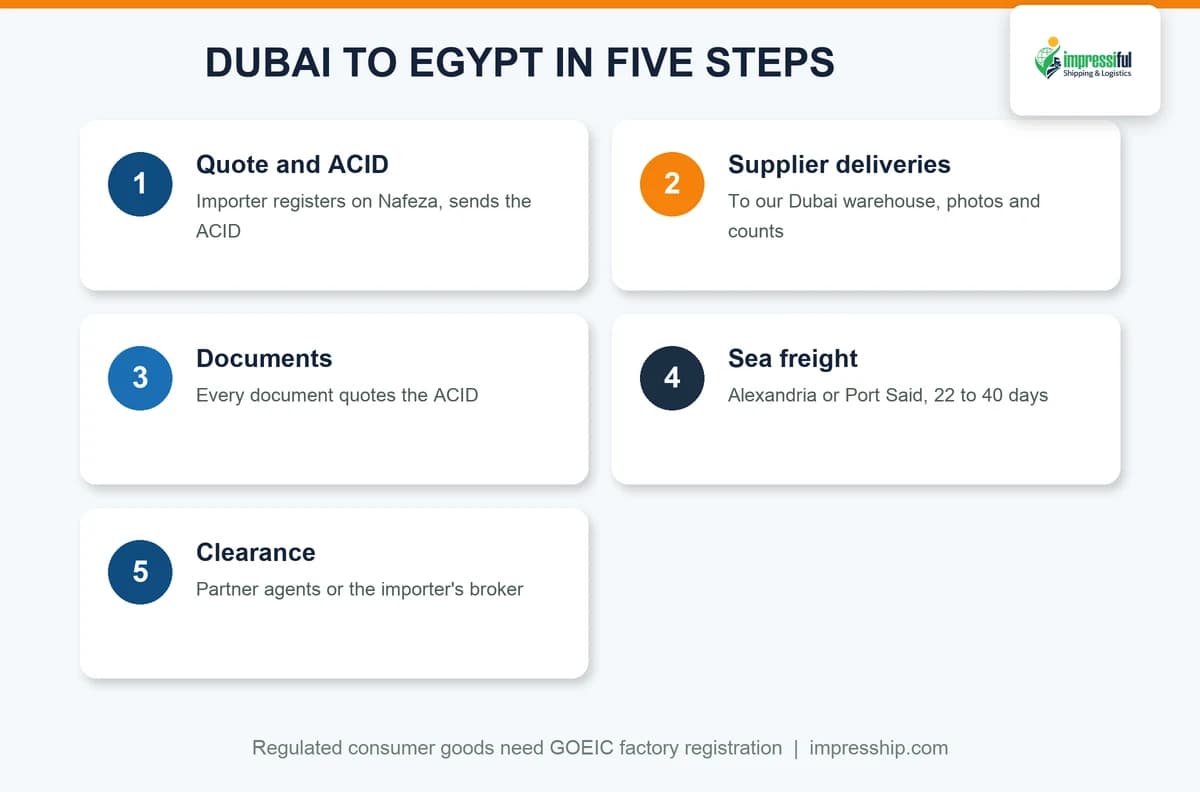
- Quote and ACID. Send the product list, CBM, weight and the port. Your importer registers the shipment on Nafeza and sends you the ACID.
- Supplier deliveries. Your suppliers deliver to our shared warehouse in Dubai, and we confirm every delivery with photos and counts. Storage is free when the cargo is loaded within two weeks of confirmed shipping; if shipping is not confirmed, storage is charged at AED 20 per sq ft per month.
- Documents. Invoice, packing list, certificate of origin and bill of lading all quote the ACID, and the documents are sent through the Nafeza channel before loading.
- Sea freight. The cargo sails to Alexandria or Port Said, about 22 to 40 days at sea.
- Clearance and delivery. We handle customs clearance at destination through our partner agents, or your importer can use their own broker. Delivery beyond the port is on request.
Traders who ship to Egypt often supply the Red Sea and Horn of Africa markets too. Our guides to shipping from Dubai to Djibouti and Ethiopia, shipping from Dubai to Somalia and shipping from Dubai to Mombasa cover those lanes.
Frequently asked questions#
How much does it cost to ship to Egypt?#
By sea, shared container space to Alexandria or Port Said is an estimated USD 348 per CBM, so 5 CBM weighing 500 kg comes to about USD 1,740 in sea freight. A 40ft container is an estimated USD 9,600 to 12,300. These are sea freight estimates; Dubai pickup, destination charges, duty and clearance are extra.
How much does it cost to ship 20 kg?#
A 20 kg parcel is usually simpler by air than by sea. On our air service, parcels up to 50 kg chargeable weight go with our express courier partner, and the shipping calculator gives an estimate for Egypt. Remember that a bulky parcel is charged on its volumetric weight if that is higher than 20 kg.
What are the import duties in Egypt?#
Import duty is charged on the CIF value at the rate for the HS code, generally between 0 and 60 percent, and higher for cars and luxury goods. VAT at 14 percent is then added on the duty-paid value, and some goods carry a schedule tax. Goods of Arab origin can qualify for preferential rates under the Greater Arab Free Trade Area.
What are the import requirements for Egypt?#
Every sea shipment needs an ACID registered by the importer on Nafeza before loading, quoted on all documents. You also need a commercial invoice, packing list, certificate of origin and bill of lading, plus GOEIC factory registration for regulated consumer goods. Your importer confirms any legalisation customs asks for.
How to get ACID number in Egypt?#
The Egyptian importer, or a customs broker acting for them, registers the shipment on the Nafeza portal, and customs issues the ACID, normally within 48 hours. The importer then sends the ACID to the exporter, who quotes it on every document and sends the documents electronically through the platform linked to Nafeza.
Send your cargo details for a same-day quote#
Tell us what you are shipping from Dubai to Egypt, the HS codes if you have them, the CBM and gross weight, the port and your importer's ACID if it is ready. We will confirm LCL or a container, quote the sea freight with the destination charges spelled out and provide a telex release bill of lading. All our shipments are insured, we ship general cargo and dangerous goods, with every dangerous goods shipment subject to approval, and we handle customs clearance through our partner agents, or your importer can use their own broker.
Request a same-day quote or message us on WhatsApp with your cargo details.