Shipping from Dubai to Ethiopia via Djibouti: Freight Estimates, Import Taxes and Documents
Shipping from Dubai to Ethiopia through the port of Djibouti: LCL sea freight estimates to Djibouti, how the inland leg works, Ethiopian duty, surtax and VAT, the import licence and bank approval to arrange first.
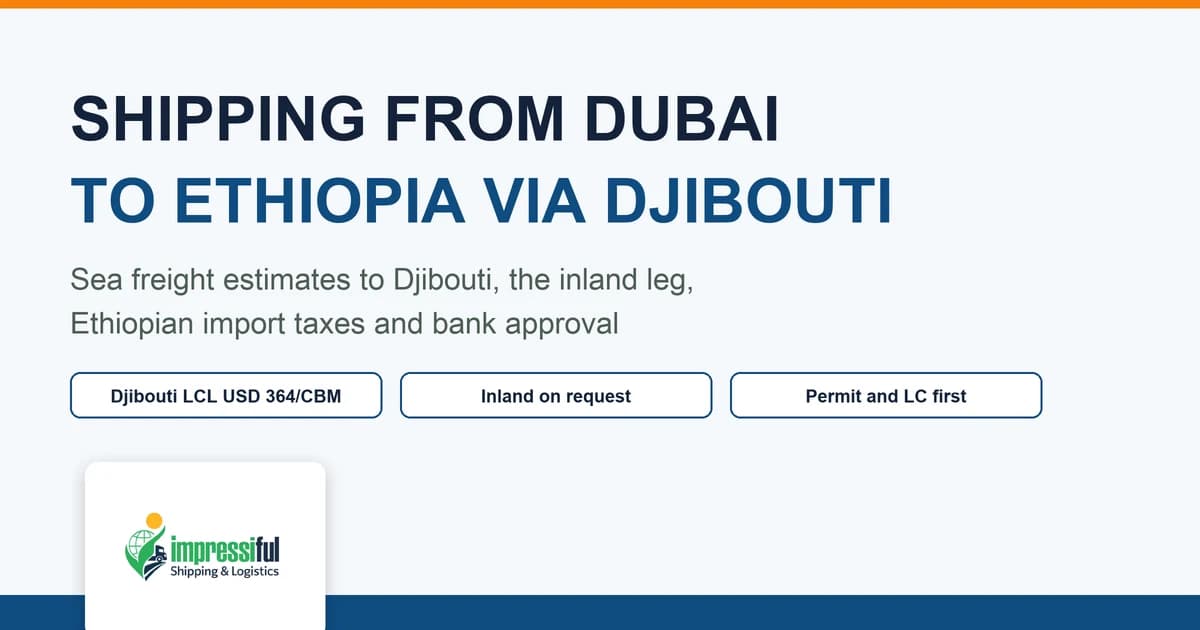
Shipping from Dubai to Ethiopia always runs through a neighbour's port, because Ethiopia has no coastline and almost all of its sea cargo is landed at Djibouti before it travels inland to Addis Ababa. The taxes at the end are significant: customs duty of 10 to 35 percent, a 10 percent surtax and 15 percent VAT, according to the PwC tax summary for Ethiopia (reviewed July 2026). This guide covers sea freight to Djibouti, how the inland leg to Ethiopia works, Ethiopian import taxes, the documents and the bank rules to sort out before you ship. Our inland transportation service explains what we can arrange beyond the port.
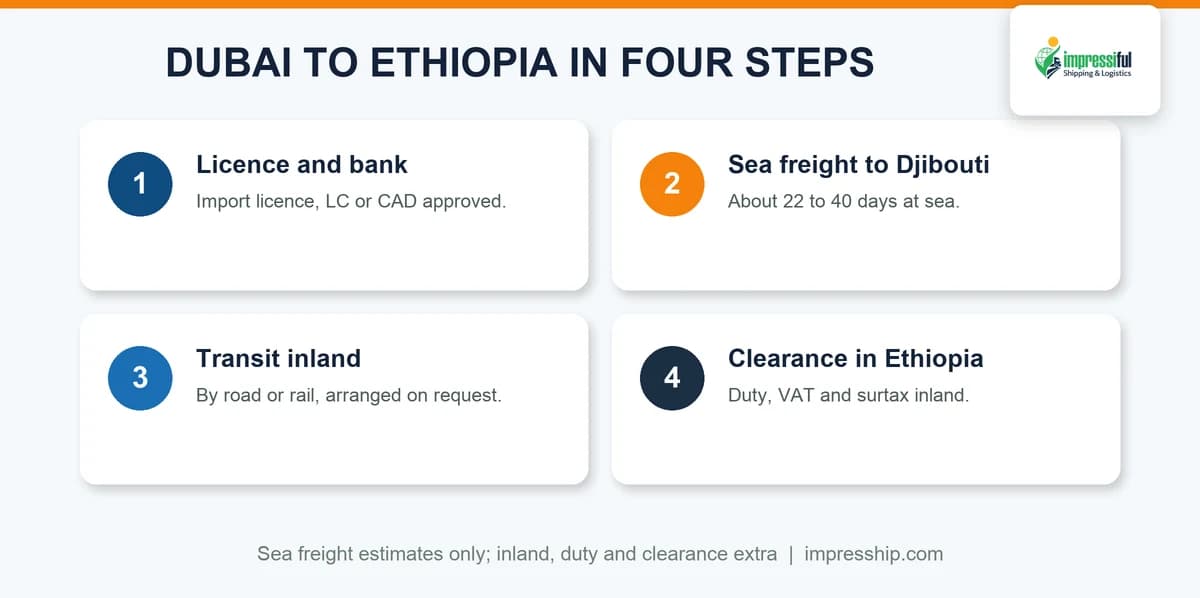
In practice, most buyers book sea freight to Djibouti (sea cargo currently loads at one of our partner ports: Sohar, the one we use most, or Salalah in Oman, Jeddah in Saudi Arabia, or Khor Fakkan or Fujairah in the UAE) and then move the cargo by road or rail to Ethiopia under a transit document. Getting the Ethiopian import permit and the bank's approval in place first matters more on this lane than the sailing itself.
Shipping from Dubai to Ethiopia via Djibouti: freight estimates#
Djibouti is both a destination in its own right and the gateway port for Ethiopia; both are listed on our Africa destinations page. These are our estimates for sea freight from Dubai by shared container (LCL), taken from the same rates as our shipping calculator.
| Destination | Route | LCL estimate (sea freight only) | Time |
|---|---|---|---|
| Djibouti | Port of Djibouti | About USD 364 per CBM | About 22 to 40 days at sea |
| Ethiopia (Addis Ababa and other cities) | Via Djibouti, then inland | To be confirmed | To be confirmed |
| 20ft or 40ft container | Either | Quoted per shipment | Depends on the sailing |
These are estimates for sea freight only, and they depend on the product. Dubai pickup, destination charges, duty and clearance are extra. You can bring your cargo to our warehouse or ask us for a pickup quote. As an illustration, 6 CBM of spare parts and household goods weighing 600 kg would be about USD 2,185 in sea freight to the port of Djibouti (not a quote). Shipments up to 999 kg are charged by weight band instead when that comes out higher, from about USD 191 for 25 to 49 kg. For Ethiopia, the full price to an inland city is still to be confirmed, so send us the details and we will quote the route.
LCL suits most loads up to roughly 30 CBM, and above that our team recommends booking a 40ft container.
Shipping from Dubai to Ethiopia or Djibouti?
Send the goods, HS codes if you have them, CBM and gross weight, and the final city. We will confirm LCL or a container and quote the sea freight to Djibouti.
How the Djibouti gateway works for Ethiopia#
The Djibouti Ports and Free Zones Authority runs the port complex, which includes the container terminal at Doraleh. Cargo for Ethiopia is discharged there and then moves inland in one of two ways:
- By road, on trucks along the Djibouti to Addis Ababa corridor, which still carries most of the cargo.
- By rail, on the electrified standard gauge line between Djibouti and Ethiopia that opened in 2018, mainly for containers.
The cargo travels in transit through Djibouti and is cleared by Ethiopian customs at an inland dry port or customs station, not at the Djibouti quay. That is why the paperwork for Ethiopia, not for Djibouti, decides how fast the shipment moves. The inland leg is arranged on request, and we do not offer tracking for inland legs, so ask us how the cargo will move after the port before you book. Our guide to shipping to Mombasa covers the other main East African gateway.
Ethiopia import duty and taxes#
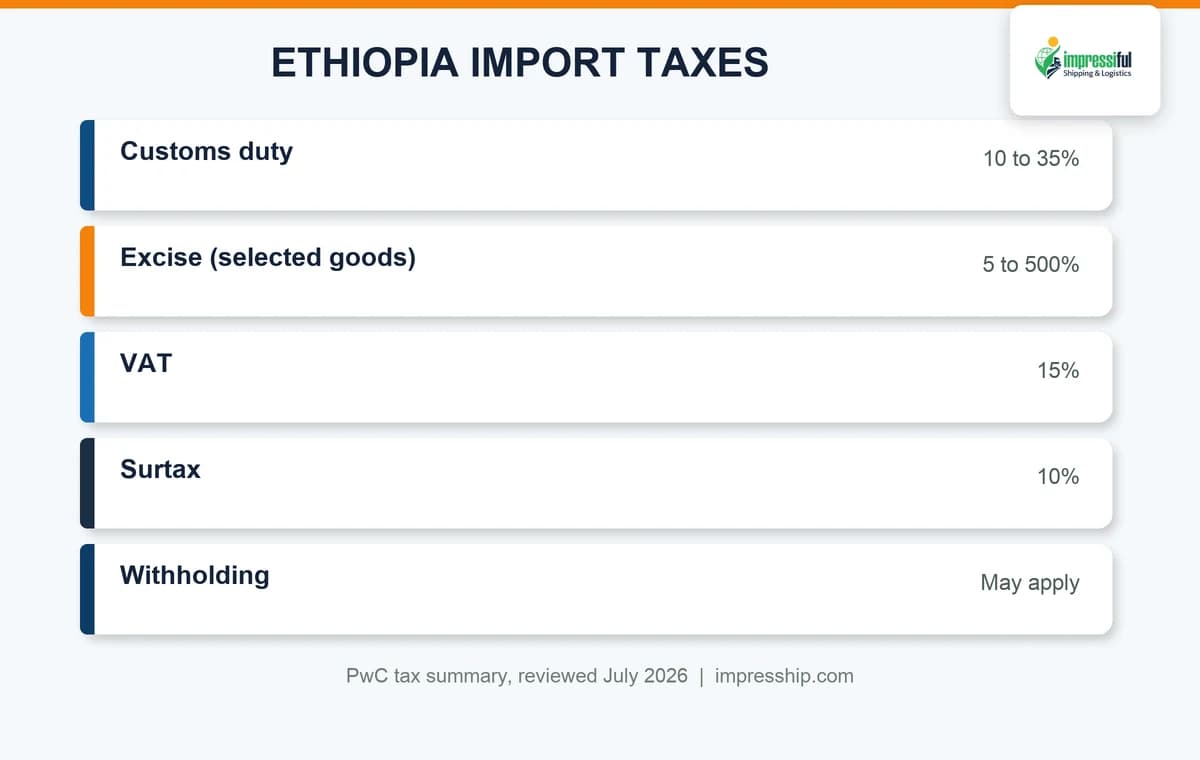
Ethiopian taxes on imports stack on top of each other, so the total is much higher than the duty rate alone.
| Charge | Rate | Notes |
|---|---|---|
| Customs duty | 10 to 35 percent by HS code | PwC, July 2026 (the 2024 US guide gives 0 to 35 percent) |
| Excise tax | 5 to 500 percent | Only on selected goods, such as vehicles, drinks and tobacco |
| VAT | 15 percent | Some basic goods and electric vehicles are exempt |
| Surtax | 10 percent | On most imports, with a few exceptions |
| Withholding | May apply | Collected at import; confirm with your clearing agent |
As an illustration, goods with a CIF value of USD 10,000 at a 20 percent duty rate and no excise would pay USD 2,000 in duty. If VAT is charged on CIF plus duty, 15 percent of USD 12,000 adds USD 1,800, and a 10 percent surtax on the running total of USD 13,800 adds about USD 1,380. That is about USD 5,180 in taxes before withholding, port, transit and clearing charges. The exact base for each tax depends on the tariff line, so confirm it with your clearing agent. Our import duty calculator shows the step by step method for the countries it covers.
Documents, permits and bank approval#
The US guide to Ethiopia's import requirements lists what an importer needs:
- an import licence, issued by regional state trade bureaus since July 2022, and an import registration number
- a tax identification certificate and a VAT certificate
- the commercial invoice, packing list, certificate of origin and transport documents
- extra approvals for regulated goods: the Ethiopian Food and Drug Administration for food, medicines and medical supplies, and the Ministry of Agriculture for plants, seeds and farm inputs
Payment is the other half of the paperwork. The National Bank of Ethiopia moved to a market based foreign exchange system under directive FXD/01/2024 in July 2024, and in May 2026 it allowed banks to approve letters of credit and cash against documents for holders of foreign currency and retention accounts without prior NBE approval. Ask your bank which route applies to you before the supplier ships. We provide telex release bills of lading, and our bill of lading guide explains how they work with a letter of credit.
How to keep the Dubai to Ethiopia lane running smoothly#
- Consolidate suppliers in Dubai. Goods from several shops can travel as one shipment through our consolidation and warehousing service. Goods come into our shared warehouse in Dubai once your shipping is confirmed within the next two weeks, and there is no storage charge if they are loaded within those two weeks.
- Match every document. The invoice, packing list, bank documents and bill of lading must show the same consignee, goods and values.
- Name the final destination early. Tell us whether the cargo stops in Djibouti or continues to Ethiopia, so the bill of lading and transit papers are issued correctly.
- Declare dangerous goods upfront. Perfume, aerosols and batteries ship as dangerous goods, and every dangerous goods shipment is subject to approval, so tell us before you book.
Frequently asked questions#
How long does shipping from Dubai to Djibouti take by sea?#
Our estimate is about 22 to 40 days at sea from Dubai to the port of Djibouti, depending on the sailing. Cargo for Ethiopia then needs extra time for transit and clearance inland, which is still to be confirmed for our route. The shipping calculator shows the current estimate.
How are goods shipped to Ethiopia?#
Almost all sea cargo for Ethiopia is landed at Djibouti and then moved inland by truck or on the Djibouti to Ethiopia railway. It is cleared by Ethiopian customs inland, so the import licence and bank documents must be ready before the cargo arrives. Our inland transportation service explains what we can arrange after the port.
Which port does Ethiopia use?#
Ethiopia mainly uses the port of Djibouti, including the container terminal at Doraleh, for its sea trade. The Djibouti Ports and Free Zones Authority runs the port complex.
How much is import tax in Ethiopia?#
PwC gives customs duty of 10 to 35 percent by tariff line, a 10 percent surtax on most imports and 15 percent VAT, with excise on selected goods. Because the taxes stack, the total is often well above the duty rate alone, so ask your clearing agent to work out the full amount before you buy.
Do I need a letter of credit to import into Ethiopia?#
Many imports are paid by letter of credit or cash against documents through an Ethiopian bank. Since May 2026, banks can approve these for holders of foreign currency and retention accounts without prior approval from the National Bank of Ethiopia, according to its notice on the FX directive. Check the current rules with your bank before you order.
Send your cargo details for a same-day quote#
Tell us what you are shipping from Dubai to Ethiopia or Djibouti, the HS codes if you have them, the CBM and gross weight, and the final city. We will confirm LCL or a container, quote the sea freight to Djibouti with the destination charges spelled out and provide a telex release bill of lading. We ship general cargo and dangerous goods, with every dangerous goods shipment subject to approval.
Request a same-day quote or message us on WhatsApp with your cargo details. See our ocean freight service for how we handle shared and full containers, and the UAE to Africa shipping guide for every lane we serve.