Dubai to West Africa Shipping Route vs East Africa: Transit Times, Costs and Transshipment Hubs
The Dubai to West Africa shipping route compared with East Africa: where cargo loads in 2026, time at sea, container and LCL estimates for Tema, Lagos, Mombasa and Dar es Salaam, the transshipment hubs on each route and what it means for stock planning.
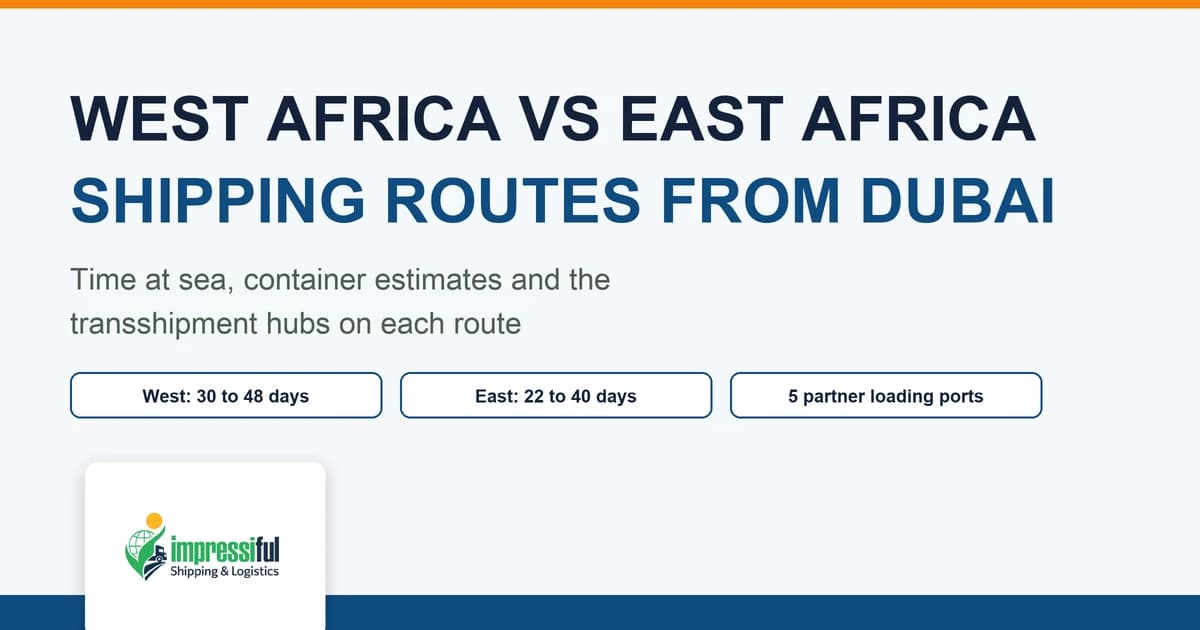
The Dubai to West Africa shipping route and the East Africa route look similar on a quote, but they behave very differently at sea. West African ports such as Tema, Lagos and Abidjan sit on the far side of the continent, so cargo travels further and usually changes ships at least once. East African ports such as Mombasa, Dar es Salaam and Djibouti are much closer to the Gulf. This guide compares the two routes, the time at sea we plan on, our freight estimates for the main ports and the transshipment hubs that shape every booking.
If you ship to both regions, the short answer is: East Africa is quicker and its containers cost less, while West Africa takes longer and needs more buffer in your stock plan.
The Dubai to West Africa shipping route in 2026#
With the Strait of Hormuz closed, our sea cargo currently loads at one of our partner ports: Sohar (most used) or Salalah in Oman, Jeddah in Saudi Arabia, or Khor Fakkan or Fujairah in the UAE. From there, a West Africa sailing has to reach the Atlantic side of the continent. Depending on the carrier's network, the routing goes either through the Red Sea and the Suez Canal into the Mediterranean, or around the Cape of Good Hope. Either way, almost no service runs direct: containers are usually moved onto a second vessel at a hub before the final call at Tema, Lagos, Abidjan, Lomé, Cotonou or Dakar.
That is why we plan on about 30 to 48 days at sea for West Africa, plus a few days for consolidation if you ship in shared container space (LCL). The range is wide because one missed connection at a hub can add a week. Our guide to ocean freight from the UAE to West Africa covers the cost lines and paperwork on this route in more detail.
The East Africa route#
East Africa is a shorter run down the Arabian Sea and the Indian Ocean coast. Salalah, one of our partner loading ports, describes itself as the region's fastest access point to East Africa, sitting next to the main East to West shipping lane and well away from the Strait of Hormuz (Asyad, Port of Salalah). Services to Mombasa, Dar es Salaam, Djibouti and Mogadishu or Berbera often have fewer connections than West Africa sailings.
We plan on about 22 to 40 days at sea to the East African and Horn of Africa ports. Some quick estimates you may see online count only the sailing itself; our figure allows for waiting for the right vessel and for any transshipment, which is what you should plan stock against. The lane guides for Mombasa, Dar es Salaam and Djibouti and Ethiopia cover each port.
West Africa vs East Africa: transit time and cost compared#
These are our estimates from the same rates as our shipping calculator. They are sea freight only and depend on the product: Dubai pickup, destination charges, duty and clearance are extra.
| Port | Shared space (LCL) | 20ft container | 40ft container | Time at sea |
|---|---|---|---|---|
| Tema, Ghana | About USD 337 per CBM | USD 10,500 to 12,500 | USD 11,700 to 15,000 | 30 to 48 days |
| Lagos, Nigeria | About USD 372 per CBM | USD 11,300 to 13,500 | USD 12,600 to 16,200 | 30 to 48 days |
| Abidjan, Côte d'Ivoire | About USD 348 per CBM | USD 10,800 to 12,900 | USD 12,100 to 15,400 | 30 to 48 days |
| Mombasa, Kenya | About USD 372 per CBM | USD 8,900 to 10,600 | USD 9,900 to 12,800 | 22 to 40 days |
| Dar es Salaam, Tanzania | About USD 372 per CBM | USD 9,200 to 11,000 | USD 10,300 to 13,200 | 22 to 40 days |
| Djibouti | About USD 364 per CBM | USD 8,300 to 9,900 | USD 9,200 to 11,800 | 22 to 40 days |
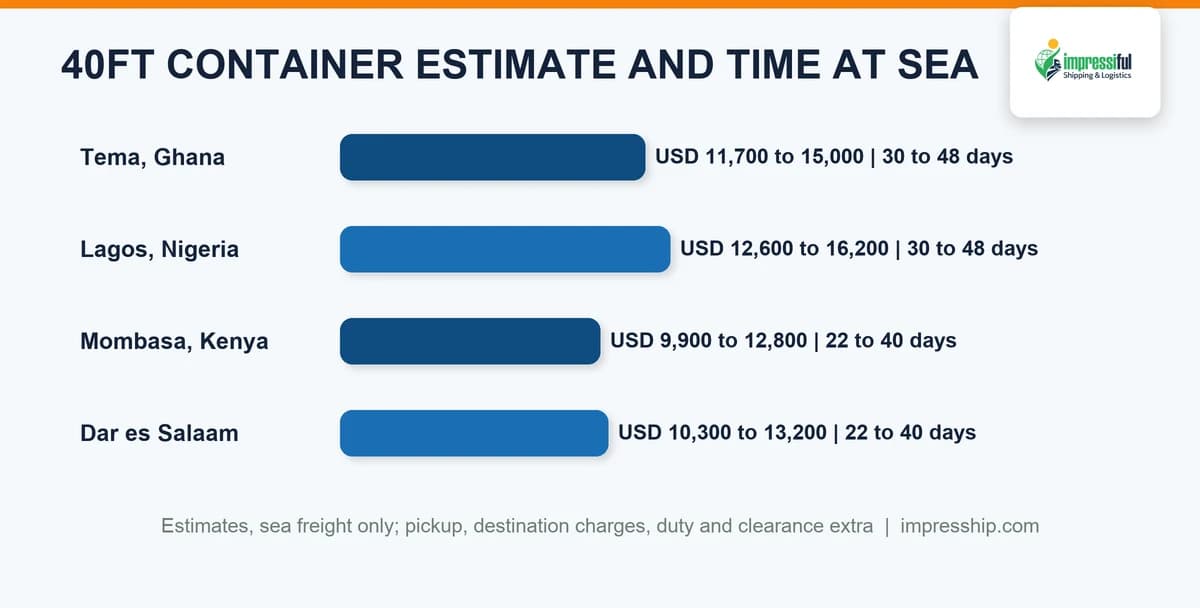
Two things stand out. First, the gap is mainly in containers: a 40ft to Mombasa is estimated at about USD 2,000 less than a 40ft to Tema. Second, shared space is priced much more evenly, so for small orders the region matters less than the volume. As a worked example, 10 CBM weighing 1,000 kg comes to about USD 3,370 in sea freight to Tema and about USD 3,720 to Lagos or Mombasa (examples, not quotes; shipments up to 999 kg can be charged by weight band instead when that comes out higher).
Our team recommends LCL up to roughly 30 CBM and a 40ft container beyond that, on both routes. The LCL vs FCL guide explains why.
Shipping to West or East Africa?
Send the goods, CBM, gross weight and the destination port, and we will confirm the route, LCL or a container, and quote the sea freight.
Transshipment hubs on Africa routes#
A transshipment hub is a port where large ocean vessels drop containers so that smaller feeder ships can carry them on to ports that the big ships do not call at. Hubs keep freight rates down, but every change of vessel is a point where cargo can wait for the next connection.
The hubs that matter most for cargo leaving our loading ports for Africa include:
- Salalah, Oman. A container transshipment port in its own right, which is one reason it works as a loading port for East Africa.
- Jeddah, Tanger Med and Algeciras. Red Sea and Mediterranean hubs where West Africa cargo routed through Suez commonly changes vessels.
- Lomé, Togo. A major West African hub: MSC has used it to transship cargo on its Asia to West Africa services (The Loadstar), feeding neighbouring ports such as Tema and Cotonou.
- Djibouti. The hub for the Horn of Africa and the main gateway for Ethiopia.
- Durban. The main hub for Southern Africa and for the landlocked countries served through it.
You do not choose the hub; the carrier's network does. What you can do is ask which service the booking is on and how many connections it has, because two quotes that look the same can differ by one transshipment. Shipments from China often go through the same hubs; our guide to shipping from China to Africa via Dubai explains when combining the two makes sense.
Southern Africa and landlocked countries#
Southern and Central African ports sit between the two routes in time: we plan on about 28 to 46 days at sea to Durban, Maputo, Luanda and Douala. For landlocked countries such as Uganda, Rwanda, Zambia, Mali and Burkina Faso, cargo goes to a gateway port and continues inland; those lanes are to be confirmed per shipment, and our guide to shipping to landlocked African countries explains how the gateways work. All 54 countries and their ports are on our Africa destinations page.
What the route means for planning#
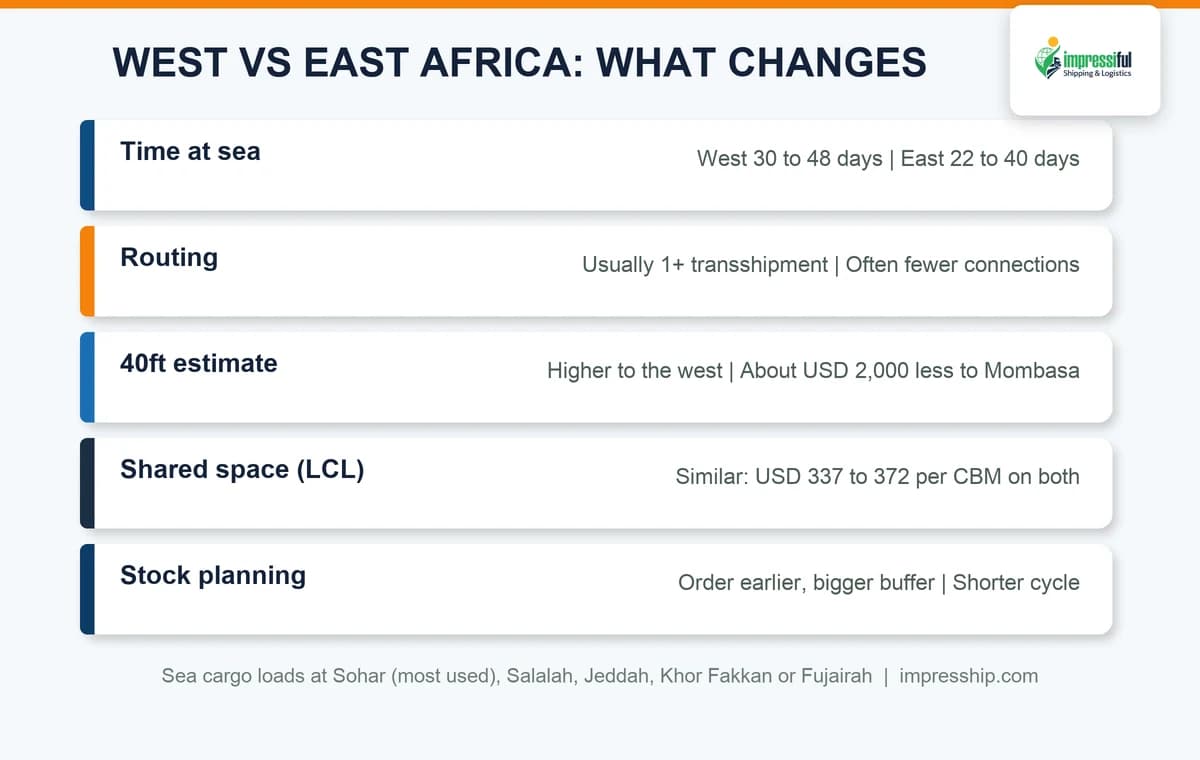
- Order earlier for West Africa. Add the 30 to 48 days at sea to supplier lead time, consolidation and clearance before you promise stock to customers.
- Keep a buffer for connections. On either route, a missed connection at a hub can add a week; plan stock so a late vessel does not empty your shelves.
- Get documents ready before loading. Matching invoices, packing lists and HS codes are what keep cargo moving at the destination; our customs clearance documents guide lists them.
- Watch free time at the port. Containers that wait for duty or paperwork run up charges; see our guide to demurrage and detention charges.
Frequently asked questions#
How long does shipping take from Dubai?#
By sea, we plan on about 30 to 48 days to West African ports such as Tema and Lagos, about 22 to 40 days to East African ports such as Mombasa and Dar es Salaam, and about 28 to 46 days to Southern and Central African ports. Shared space adds a few days for consolidation. Air is the faster option when time matters, quoted per shipment.
How long does a cargo ship take from Dubai to Kenya?#
We plan on about 22 to 40 days at sea to Mombasa. Quick figures of one to two weeks usually count only the sailing; our range also allows for waiting for the vessel and any transshipment. Customs clearance in Mombasa comes on top, so plan stock with some buffer.
What are the major shipping ports in Dubai?#
Dubai's main container port is operated by DP World, and Port Rashid now mainly handles cruise ships. Because the Strait of Hormuz is closed, our sea cargo currently loads at one of our partner ports: Sohar (most used) or Salalah in Oman, Jeddah in Saudi Arabia, or Khor Fakkan or Fujairah in the UAE, and your booking confirms the sailing. You can bring your cargo to our warehouse in Dubai or ask us for a pickup quote.
What does transhipment hub mean?#
A transshipment hub is a port where containers are moved from one vessel to another, usually from a large ocean ship to a smaller feeder ship that serves the final port. Lomé, Djibouti, Durban and Salalah are examples on Africa routes. Each change of vessel saves cost but adds a point where cargo can wait.
What is the biggest port in Nigeria?#
The Lagos port complex, Apapa and Tin Can Island, has long handled most of Nigeria's container traffic, and Lekki Deep Sea Port, opened in 2023, is the deepest. Our estimates for Nigeria are quoted to Lagos (Tin Can) at about USD 372 per CBM for shared space; see our guide to shipping from Dubai to Nigeria.
Send your cargo details for a same-day quote#
Tell us what you are shipping, the CBM and gross weight, and the port or country in West, East or Southern Africa. We will confirm the route, LCL or a container, and quote the sea freight with the destination charges spelled out. All our shipments are insured, we ship general cargo and dangerous goods, with every dangerous goods shipment subject to approval, and we handle customs clearance at destination through our partner agents, or you can use your own agent.
Request a same-day quote or message us on WhatsApp with your cargo details.