
Shipping from Dubai to Mombasa: Transit Times, Kenya Duties and Documents
Shipping from Dubai to Mombasa explained: sea transit times, Kenya import duty, the IDF and Railway Development Levy, the PVoC certificate for UAE goods, and transit cargo to Uganda, Rwanda and South Sudan.
The Port of Mombasa handled 2,005,076 TEUs in 2024, the first time in over a decade that its container traffic passed two million, according to Kenya Ports Authority figures reported by Logistics Business Africa. A steady share of that cargo starts in the UAE. This guide to shipping from Dubai to Mombasa covers transit times, the Kenyan duties and levies you will pay on arrival, the documents to prepare before loading, and how transit cargo moves on to Uganda, Rwanda and South Sudan.
In practice, the sea leg is the easy part of the lane. What decides your landed cost and clearance time is the paperwork around it: a Certificate of Conformity for regulated goods, an Import Declaration Form lodged in Kenya before arrival, and an HS code that lets you estimate the duty in advance.
Shipping from Dubai to Mombasa: transit times and options#
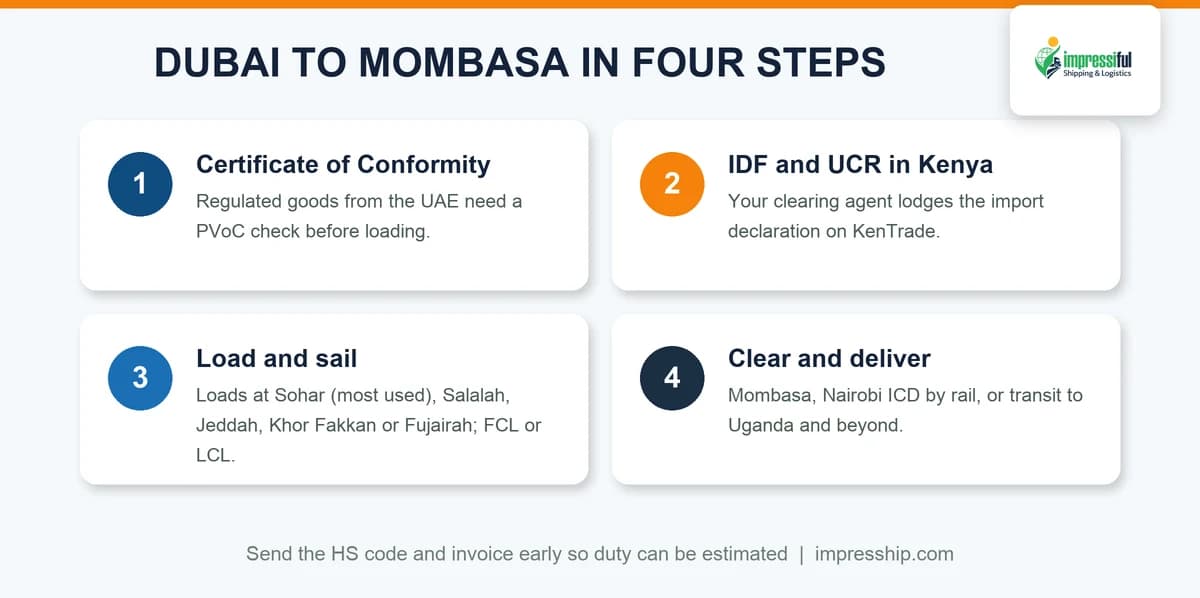
Mombasa is Kenya's main seaport and the start of the Northern Corridor, the road and rail route that also serves Uganda, Rwanda, South Sudan and the eastern DRC. From Dubai, most cargo goes by sea on direct or transshipped services; our sea cargo currently loads at one of our partner ports: Sohar (most used) or Salalah in Oman, Jeddah in Saudi Arabia, or Khor Fakkan or Fujairah in the UAE.
| Mode | Typical transit | Best for |
|---|---|---|
| FCL ocean freight to Mombasa | Typically 22 to 40 days by sea | Full loads, building materials, vehicle parts, stock for resale |
| LCL ocean freight (consolidated) | Typically 22 to 40 days by sea, plus consolidation time | Shipments from about 1 CBM up to roughly 30 CBM |
| Air freight, Dubai to Nairobi (JKIA) | Typically 1 to 3 days airport to airport | Urgent, light or high value goods |
| Onward rail, Mombasa to Nairobi ICD | Usually a short extra leg once cleared for rail | Containers consigned to Nairobi |
Transit times are market estimates for planning, not a schedule; the sailing you book, any transshipment and port congestion all move them. Ask for the routing with every quote. If you are not sure whether your cargo justifies a full box, our LCL vs FCL guide walks through the break even point, and our ocean freight service covers both.
Shipping from Dubai to Mombasa?
Send your cargo details, HS codes and final destination in Kenya or the region, and we will come back with routing and an all in rate.
Kenya import duties and levies at Mombasa#
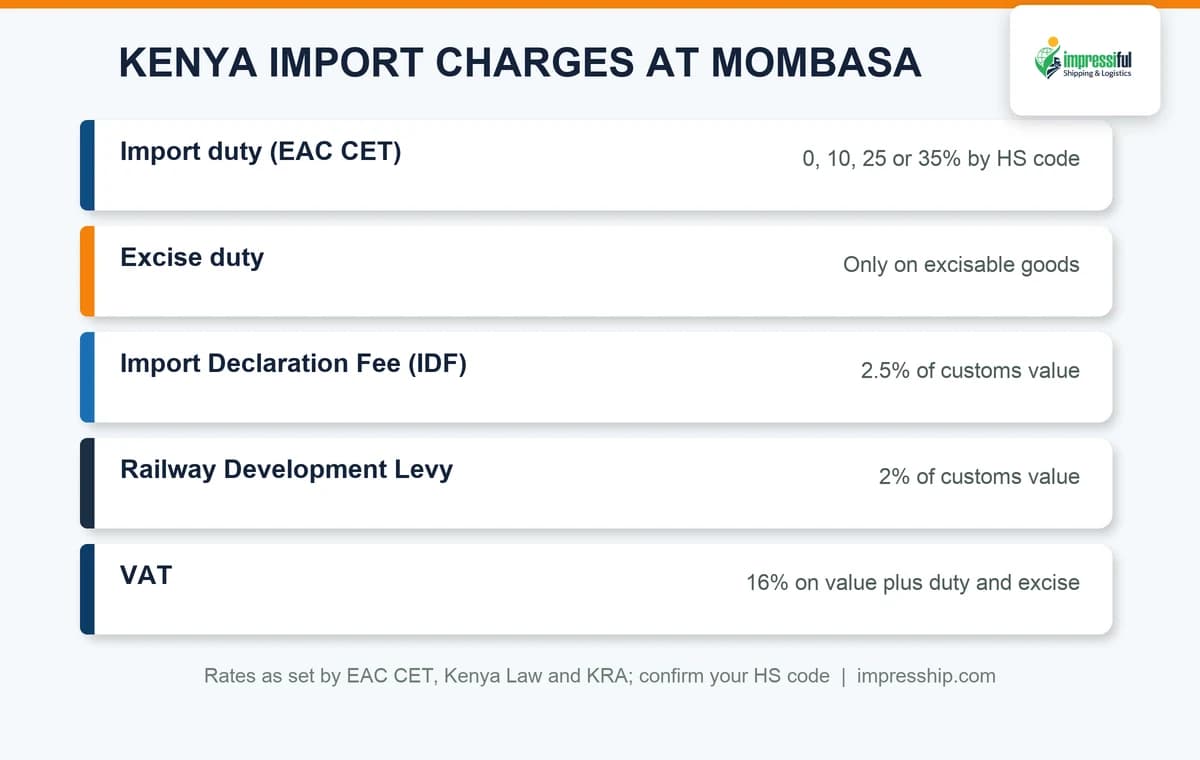
Kenya applies the East African Community Common External Tariff (CET), so import duty depends on the HS code of your goods. Since 1 July 2022 the CET has had four main bands, 0, 10, 25 and 35 percent, after EAC ministers adopted the 35 percent band for finished goods such as many textiles, dairy and steel products. A short list of sensitive items carries higher rates.
On top of duty, Kenya charges two levies on the customs value of goods entered for home use. Under the Miscellaneous Fees and Levies Act, the Import Declaration Fee (IDF) is 2.5 percent and the Railway Development Levy (RDL) is 2 percent. VAT is then charged at the general rate of 16 percent set out by the Kenya Revenue Authority, with excise duty added for excisable goods such as drinks and some cosmetics.
| Charge | Rate | Charged on |
|---|---|---|
| Import duty (EAC CET) | 0, 10, 25 or 35 percent by HS code | Customs value (CIF) |
| Excise duty | Varies, only for excisable goods | Customs value plus duty |
| Import Declaration Fee (IDF) | 2.5 percent | Customs value |
| Railway Development Levy (RDL) | 2 percent | Customs value |
| VAT | 16 percent (general rate) | Customs value plus duty and excise |
As a simple illustration, goods with a customs value of USD 10,000 in the 25 percent band attract USD 2,500 in duty, USD 250 IDF, USD 200 RDL and VAT of USD 2,000 (16 percent of USD 12,500), before port, clearing and delivery costs. Kenya's levy rates have changed several times in recent Finance Acts, so confirm them with your clearing agent before you price stock. Customs value is normally CIF, which is why the FOB vs CIF guide matters for your duty bill as well as your freight.
Documents for shipping from Dubai to Kenya#
Certificate of Conformity (PVoC). Kenya's Pre-Export Verification of Conformity programme checks regulated products in the country of export. The UAE sits in Zone 8 of the current contracts, which started on 9 February 2026, as SGS sets out in its PVoC announcement. Regulated goods shipped from the UAE therefore need inspection and a Certificate of Conformity before loading; without it, expect penalties and destination inspection at Mombasa.
Import Declaration Form and UCR. A licensed clearing agent (our partner agent, or your own if you prefer) creates a Unique Consignment Reference and lodges the IDF on the KenTrade single window before the goods arrive. The IDF number is then quoted on the commercial documents.
The core shipping set. Commercial invoice, packing list, bill of lading or air waybill, certificate of origin where relevant, and the importer's KRA PIN. Our customs clearance documents guide explains each one, and our bill of lading guide covers original, telex release and sea waybill options. We provide telex release bills of lading, which avoids waiting for paper originals to reach Mombasa.
Transit cargo to Uganda, Rwanda and South Sudan via Mombasa#
Landlocked East African markets rely on Mombasa as a gateway. Cargo for Uganda, Rwanda and South Sudan can be discharged at Mombasa and moved under customs transit by road or rail along the Northern Corridor, with duty paid in the country of final destination rather than in Kenya. Uganda and Rwanda can also be served through Dar es Salaam, so compare both routings when you ask for a quote.
For transit cargo, the bill of lading and invoice must show the final destination correctly from the start; changing a home use entry into a transit entry after arrival is slow and costly.
How to keep costs down on the Dubai to Mombasa lane#
- Consolidate small orders. Several suppliers in Dubai can deliver to one warehouse for a single LCL or FCL shipment; see our consolidation and warehousing guide.
- Book the inspection early. A late PVoC inspection is a common reason cargo misses a sailing.
- Declare dangerous goods upfront. Perfume, aerosols and batteries ship as dangerous goods, and every dangerous goods shipment is subject to approval; our dangerous goods guide explains the rules.
- Clear quickly on arrival. Storage and demurrage start once free days run out, so have the IDF, documents and duty funds ready before the vessel berths.
Frequently asked questions#
How long does it take to ship from Dubai to Mombasa?#
Sea freight to Mombasa typically takes about 22 to 40 days, depending on whether the service is direct or transshipped. LCL adds consolidation time, and air freight to Nairobi typically takes 1 to 3 days; our air freight service suits urgent cargo.
What documents are required to import goods into Kenya?#
You need a commercial invoice, packing list, bill of lading or air waybill, the importer's KRA PIN and an Import Declaration Form lodged on KenTrade. Regulated goods also need a PVoC Certificate of Conformity, which applies to shipments from the UAE under the current KEBS contracts.
How much is import duty in Kenya?#
Import duty follows the EAC Common External Tariff, with main bands of 0, 10, 25 and 35 percent depending on the HS code. On top of duty, Kenya charges a 2.5 percent IDF, a 2 percent Railway Development Levy and 16 percent VAT, as set out in the Miscellaneous Fees and Levies Act and KRA guidance.
Can I ship goods from Dubai to Uganda through Mombasa?#
Yes. Uganda bound cargo is commonly discharged at Mombasa and moved in transit along the Northern Corridor by road or rail, with duty paid in Uganda. The documents must show Uganda as the final destination from the start, and our customs clearance service can coordinate the handover.
How much does it cost to ship something to Kenya?#
As sea freight estimates to Mombasa, shared LCL space is about USD 372 per CBM, a 20ft container at USD 8,900 to 10,600 and a 40ft at USD 9,900 to 12,800, depending on the product. These are sea freight only; Dubai pickup, destination charges, duty and clearance are extra. Air suits urgent, light or high value goods and is priced on chargeable weight, so get an estimate from the shipping cost calculator.
Send your cargo details for a same-day quote#
Tell us what you are shipping, the CBM or weight, the HS codes if you have them and the final destination: Mombasa, Nairobi or a transit country such as Uganda, Rwanda or South Sudan. We ship to every African destination on our list, including the gateway ports for landlocked countries.
Request a same-day quote or message us on WhatsApp with your cargo details.