Certificate of Origin Dubai: When You Need One and How to Get It
Certificate of origin Dubai guide for importers shipping to Africa: what it shows, the three types, when Nigeria, Ghana, banks or buyers ask for one, the five Dubai Chambers steps, the AED 100 fee, documents and the mistakes that get it rejected.
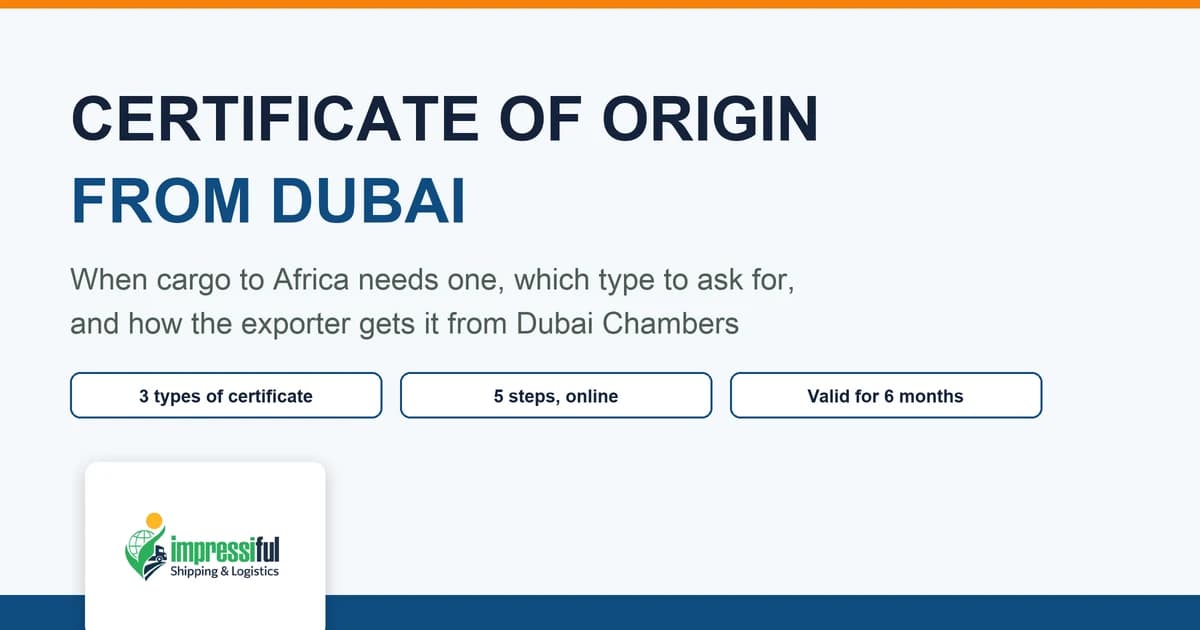
If you have searched "certificate of origin Dubai", you have probably been asked for one by a buyer, a bank or a clearing agent at the destination port. The good news is that in Dubai it is a fast online process: Dubai Chambers lists a fee of AED 100 per certificate and a processing time of two hours for members. This guide explains when a certificate of origin is needed for cargo going to Africa, which type to ask for, the documents behind it and the mistakes that get it rejected.
For most importers buying in the UAE, the question is not how to get the certificate but who applies for it. Only the exporter can apply, and only if it is a Dubai Chambers member whose invoice matches the shipment. So if your buyer, your bank or the destination customs needs one, agree it with your supplier before you pay, and tell your forwarder when you book so the invoice, packing list and destination customs clearance paperwork all line up.
What a certificate of origin shows#
A certificate of origin states the country where the goods were made, produced or processed. It is not about where you bought them. A blender bought in Dragon Mart and made in China is Chinese origin, even though it ships from the UAE. Our guide to shipping from China to Africa via Dubai explains why repacking in Dubai does not change that.
Customs at the destination uses origin for three things: applying the right duty rate, checking any trade agreement preference, and enforcing bans or extra controls on goods from certain origins. The duty itself is still worked out on the CIF value and the HS code, which our import duty calculator estimates for you.
Need this handled end to end?
Tell us your lane and cargo profile and we'll come back with a routing plan and an all-in rate.
Which certificate of origin do you need?#
There are three main types for goods leaving the UAE. Dubai Chambers issues the first two under its Resolution No. 7 of 2024, and the federal Ministry of Economy and Tourism issues preferential and non-preferential certificates for locally made products.
| Type | Use it for | Issued by | What it proves |
|---|---|---|---|
| Non-preferential, UAE origin | Goods made in the UAE | Dubai Chambers or the Ministry | The goods were produced in the UAE by a licensed manufacturer |
| Re-export certificate | Foreign goods bought in the UAE and shipped on | Dubai Chambers | The origin of foreign goods passing through Dubai |
| Preferential | Claiming a lower duty rate under a trade agreement | Ministry of Economy and Tourism | The goods meet that agreement's rules of origin |
Much of the cargo bought in Dubai for Africa is general merchandise made in China, India, Turkey or elsewhere and sold by UAE traders. That cargo needs the re-export type, if it needs a certificate at all.
A preferential certificate only helps where a trade agreement covers UAE goods in the destination country. West African preferences such as the ECOWAS tariff rules and the African Continental Free Trade Area apply to goods made in member states, so a Dubai re-export of Chinese goods does not qualify for them.
When cargo to Africa needs one#
There is no single rule for the whole continent. In practice, four situations decide it.
- Destination customs asks for it. In Nigeria, a certificate of origin replaced the old Combined Certificate of Value and Origin (CCVO) as an import document in 2017, as Nairametrics reported, and it sits alongside Form M. Our guide to customs clearance in Nigeria shows where it fits.
- The bank asks for it. A letter of credit often lists a certificate of origin among the documents the exporter must present to get paid. If it is in the credit terms, it is mandatory for that sale.
- Your buyer asks for it. Some distributors and government buyers want it for their own records or tenders.
- You claim a preference. Only relevant where an agreement covers the goods, as above.
For Ghana, the standard list of import requirements from the Ghana Revenue Authority does not include a certificate of origin, so it is usually asked for only in the cases above. Check with your clearing agent before the goods ship, because a missing certificate is far easier to fix in Dubai than at the destination port.
How we help. For products that contain chemicals or are dangerous goods, we work with your supplier to get the Material Safety Data Sheet (MSDS) and the certificate of origin when applicable. On our main routes, the certificate does not need embassy legalisation.
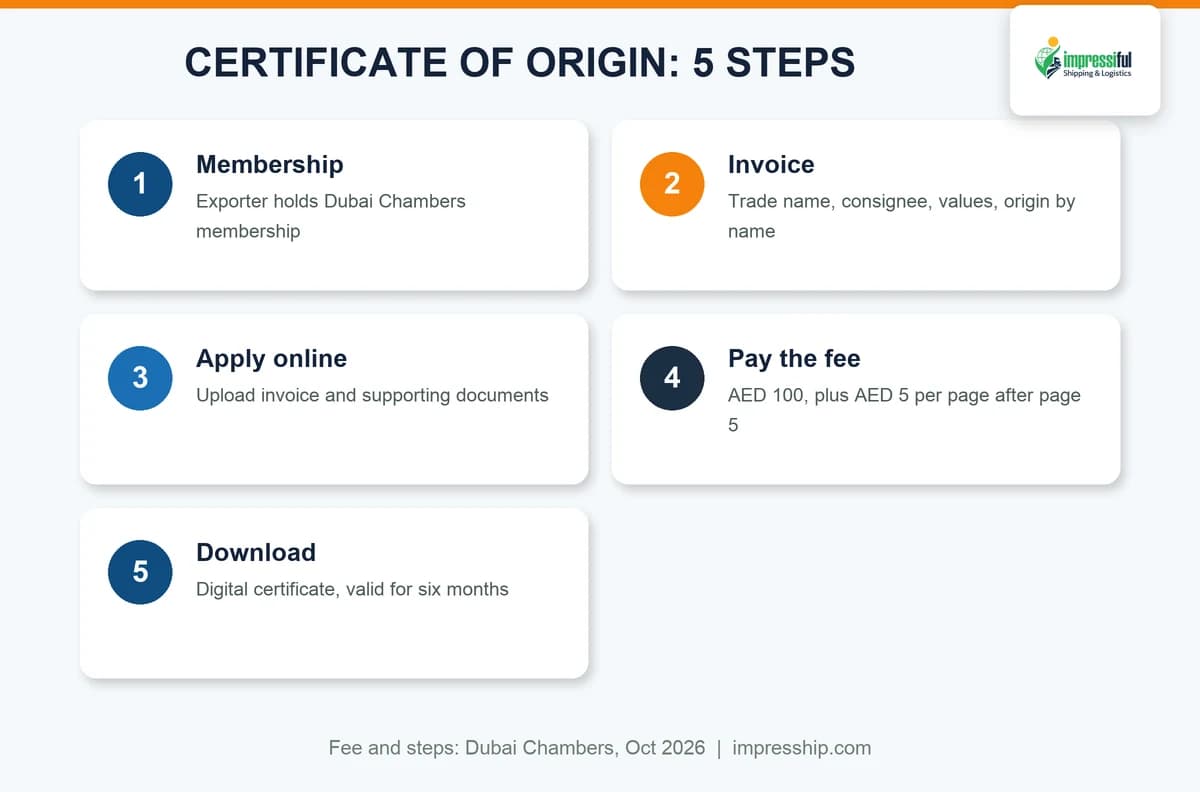
Certificate of origin Dubai: the five steps#
The Dubai Chambers process is fully online and moves quickly once the exporter's documents are right.
- Membership. The exporter must hold active Dubai Chambers membership. Ask your supplier early whether it is a member and has issued certificates before.
- Invoice. The commercial invoice must show the exporter's trade name, the consignee, the goods, the values and the country of origin by name.
- Application. The exporter applies on the Dubai Chambers portal and uploads the invoice and supporting documents.
- Payment. AED 100 per certificate, plus AED 5 for each invoice page after the fifth.
- Download. The certificate is issued digitally and is valid for six months from the date of issue.
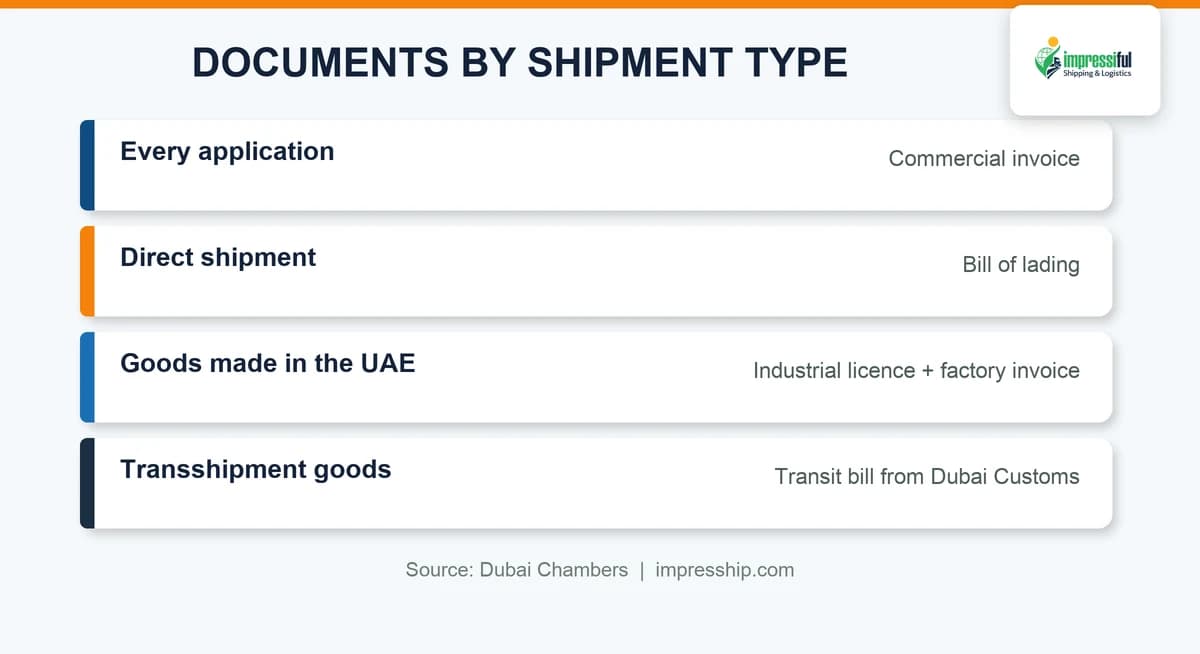
The supporting documents depend on the type of shipment. Dubai Chambers lists them as follows.
| Shipment | Documents to upload |
|---|---|
| Every application | Commercial invoice |
| Direct shipment | Bill of lading |
| Goods made in the UAE | Copy of the industrial licence and the factory's invoice |
| Transshipment goods | Transit bill from Dubai Customs |
Because a direct shipment needs the bill of lading, the certificate is often applied for after the cargo sails. Our bill of lading guide explains the draft and final versions, and why the details on it must match the invoice.
Mistakes that get a certificate rejected or questioned#
- "Made in Asia" or "EU" on the invoice. The resolution requires a named country of origin, not a region.
- Invoice and application that do not match. Values, quantities and the consignee must agree everywhere.
- Goods outside the exporter's licence. A trader can only certify goods within its licensed activities.
- An invoice dated after the application. The invoice date must be on or before the application date.
- A vague goods description. It causes questions at the destination too. Our HS codes guide shows how to describe goods properly.
- An expired certificate. After six months it is no longer valid.
The same mismatches cause most delays at African ports. Our customs clearance documents guide lists the full document set and the problems we see most often.
Frequently asked questions#
How do I get a Certificate of Origin in Dubai?#
The exporter applies online through Dubai Chambers, uploads the commercial invoice and supporting documents, pays the fee and downloads the certificate. The exporter must be a Dubai Chambers member. If you are the buyer, ask your supplier to apply, and agree it before you pay.
How much does it cost to get a Certificate of Origin?#
Dubai Chambers charges AED 100 per certificate, plus AED 5 for each page of the commercial invoice after the fifth. That is the official fee only. If a document clearing company applies for your supplier, it will add its own service charge.
Which countries require a Certificate of Origin?#
There is no single list, because each destination sets its own rules and banks and buyers add their own. In West Africa, Nigeria treats it as a standard import document alongside Form M, as our Nigeria customs clearance guide explains, while Ghana's standard list does not include it. Always check with the clearing agent at the destination before the goods ship.
Why is a Certificate of Origin needed?#
Customs uses it to apply the right duty rate, check trade agreement preferences and enforce restrictions on goods from certain origins. Banks use it to confirm a letter of credit has been met. The duty itself depends on the HS code and CIF value, which you can estimate with our import duty calculator.
How do I make a Certificate of Origin?#
You do not draw one up yourself; it is issued by an authorised body such as Dubai Chambers or the Ministry of Economy and Tourism. What you prepare is the commercial invoice, with the country of origin named, an accurate description and the right HS code, as our HS codes guide shows. The certificate is only as good as the invoice behind it.
Send your cargo details for a same-day quote#
Send the packing list (or total CBM and weight), what the goods are, where they are in the UAE and your destination port. Tell us if your buyer, bank or agent has asked for a certificate of origin, and we will tell you what the shipment needs before it is booked.
Request a same-day quote or message us on WhatsApp with your cargo details.