Customs Clearance in Ghana: Documents and Steps at Tema
Customs clearance in Ghana explained: the six documents GRA asks for, the ICUMS steps at Tema from declaration to the exit gate, red, yellow and green channels, what clearance costs and the mistakes that hold cargo at the port.
Customs clearance in Ghana runs on one system, ICUMS, and one rule that surprises first time importers: under section 43 of the Customs Act, 2015 (Act 891), every importer except a registered self-declarant must use a licensed customs house agent, as the Ghana Ports and Harbours Authority explains. The clock matters too: the law gives about seven free days after arrival before demurrage starts. This guide covers the documents for customs clearance in Ghana, the steps at Tema from declaration to the exit gate, and the mistakes that hold cargo at the port.
In practice, a smooth clearance at Tema is decided before the vessel arrives. If the bill of lading, attested invoice, packing list, Import Declaration Form and TIN are ready while the cargo is at sea, the agent can declare early, pay the duty on time and collect inside the free days. We handle destination customs clearance for cargo we ship to Ghana, or you can clear with your own agent.
Documents for customs clearance in Ghana#
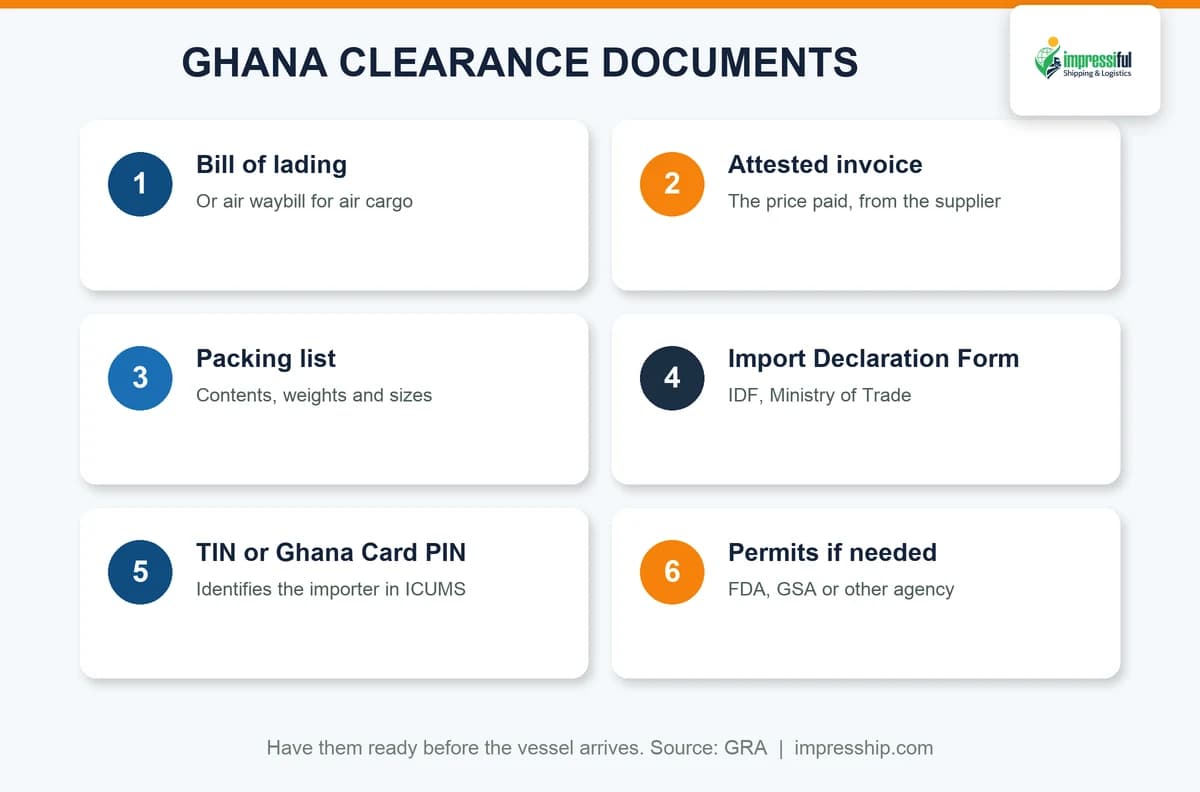
The Ghana Revenue Authority lists six requirements, which you need before or at the time the goods arrive at the port.
| Document | What it is | Where it comes from |
|---|---|---|
| Bill of lading (air waybill for air cargo) | Proof of shipment and title to the cargo | Shipping line, through the forwarder |
| Attested invoice | Commercial invoice showing the price paid | Supplier in Dubai |
| Packing list | Contents, weights and sizes per package | Supplier or forwarder |
| Import Declaration Form (IDF) | Registers the import in advance | Ministry of Trade, via the agent |
| TIN or Ghana Card PIN | Identifies the importer in ICUMS | Ghana Revenue Authority |
| Regulatory permits, if needed | Approval for controlled goods | FDA, GSA or other agency |
The invoice description and HS code decide the duty band, so a vague line such as "general goods" invites a reclassification. Our HS codes guide shows how to find the right code, and the customs documents guide covers the paperwork problems we see most often across African ports.
Some goods need a permit before they can be cleared: food, drugs and cosmetics from the Food and Drugs Authority, and many products from the Ghana Standards Authority. A few goods are banned or restricted outright, and GRA keeps the current import prohibitions and restrictions list. Check it before you buy, not after the cargo lands.
Need this handled end to end?
Tell us your lane and cargo profile and we'll come back with a routing plan and an all-in rate.
Customs clearance in Ghana: the steps at Tema#
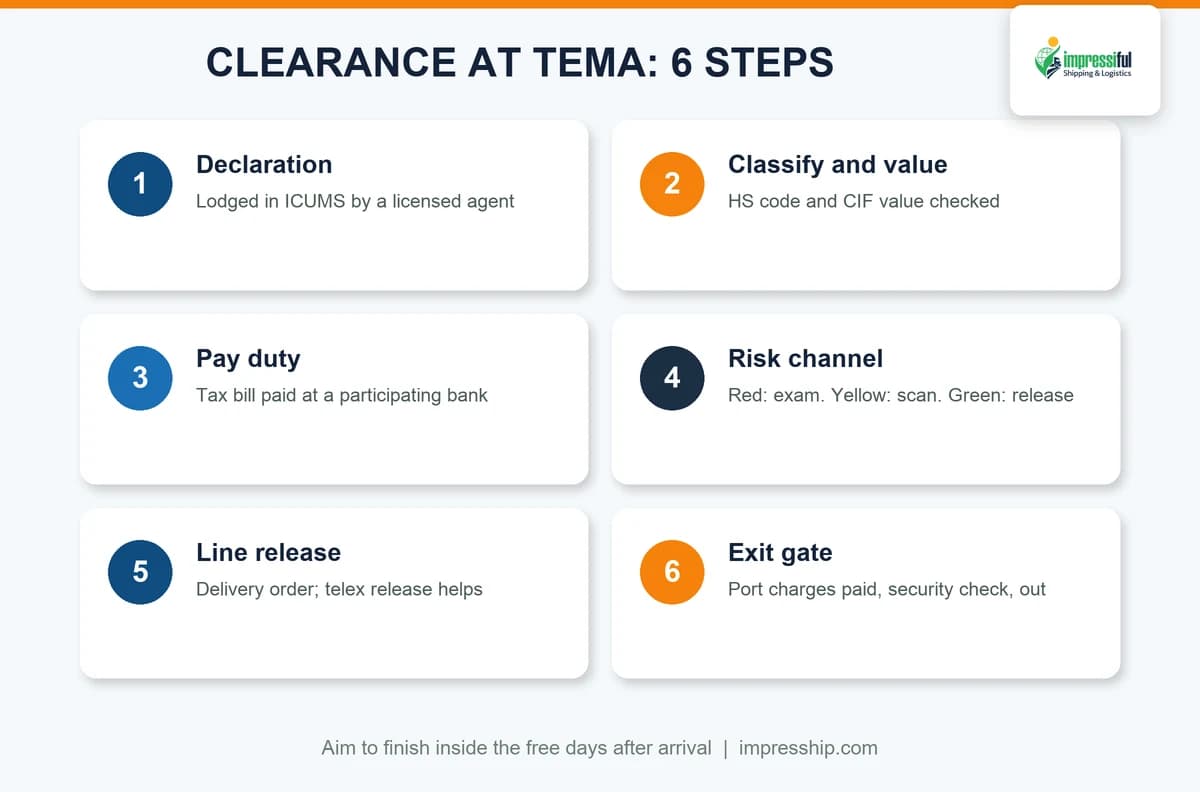
Every general cargo clearance follows the same order in ICUMS, the Integrated Customs Management System, which runs on the UNIPASS platform.
- Declaration. The agent submits the declaration in ICUMS with all the documents, before or after the vessel arrives. Before is better.
- Classification, valuation and approval. Customs checks the HS code and the value. Duty is charged on the CIF value, the cost of the goods plus insurance and freight.
- Duty payment. ICUMS generates a tax bill, and the agent pays the duties and taxes at a participating bank.
- Risk channel. The declaration is routed to one of three channels.
- Shipping line release. The line issues the delivery order once its charges are settled. With a telex release bill of lading, there is no wait for paper originals.
- Terminal charges and exit. Port and terminal charges are paid, and the cargo leaves through the gate with its waybill after a final security check.
The three risk channels, as GRA describes them:
| Channel | What happens | What it means for you |
|---|---|---|
| Red | Mandatory physical examination | The container is opened and checked against the declaration |
| Yellow | Digital scan | Scanned; examined only if the scan raises a question |
| Green | Released at the gate | Scanned automatically on the way out of the terminal |
That meeting, reported by MyJoyOnline, followed complaints about slow shipping invoices, payment processing and container releases. No new procedure had been announced at the time of writing.
What clearance costs: duty, levies and port charges#
The clearance bill has three parts. Duty, levies and VAT go to the state and depend on the HS code and the CIF value; our Ghana customs duty calculation guide works through a full example, and the duty calculator gives a quick estimate. Shipping line and terminal charges go to the line and the port. The agent's fee covers the declaration and the running around.
Add those to the freight and you have the landed cost. Our landed cost guide for Ghana shows how to turn the total into a cost per unit, and the Dubai to Ghana shipping cost guide covers the freight side.
Mistakes that hold cargo at Tema#
- Documents ready after the vessel. The declaration cannot start, and free days run out while the paperwork catches up.
- Invoice and packing list that do not match. A red channel examination will find the gap.
- A vague goods description. It leads to a higher duty band or a query.
- No permit for controlled goods. The cargo waits until the permit is issued.
- Duty money not ready. Release cannot happen until the tax bill is paid.
- Paper bill of lading still in the post. A telex release avoids it; our bill of lading guide explains the options.
Every day past the free period adds demurrage from the shipping line and rent from the terminal. Our guide to demurrage and detention charges at Tema gives the daily ranges.
Frequently asked questions#
What do I need for customs clearance?#
In Ghana you need the original bill of lading or air waybill, an attested invoice, a packing list, the Import Declaration Form and your TIN or Ghana Card PIN, plus any permit your goods require. The GRA customs FAQ lists the same set for airport cargo. Have them ready before the vessel arrives so the agent can declare early.
How many days will it take for customs clearance?#
There is no fixed number of days. It depends on how early the declaration is lodged, the risk channel and how fast duty and the shipping line's charges are paid. Plan to finish inside the roughly seven free days after arrival, which is why the documents should be complete while the cargo is at sea.
How much do I pay for customs clearance?#
You pay the duty, levies and VAT set by the HS code and CIF value, the shipping line and terminal charges, and your agent's fee. The duty is usually the largest part, and our duty calculator estimates it from the value and the band. When we clear for you, clearance is a separate line on our quote.
How much is custom duty in Ghana?#
Ghana applies the ECOWAS Common External Tariff, with bands of 0, 5, 10, 20 and 35 percent on the CIF value, followed by levies and VAT at 15 percent plus NHIL and GETFund. The Ghana customs duty calculation guide walks through each line with a worked example.
Do I need a clearing agent to clear goods in Ghana?#
Yes, in most cases. The Customs Act, 2015 (Act 891) requires importers other than registered self-declarants to clear through a licensed customs house agent. We handle destination customs clearance for cargo we ship, or you can appoint your own licensed agent and we hand over the documents.
Send your cargo details for a same-day quote#
Send the packing list (or total CBM and weight), what the goods are, where they are in the UAE and your Ghana port. We will confirm the freight, tell you what the clearance needs and send a dated, itemised quote.
Request a same-day quote or message us on WhatsApp with your cargo details.