
Shipping from Dubai to Morocco: Tanger Med and Casablanca Sea Freight, Import Duty and Documents
Shipping from Dubai to Morocco: sea freight estimates to Tanger Med and Casablanca (LCL about USD 361 per CBM, 20ft and 40ft ranges, 22 to 40 days at sea), which port to choose, import duty, TPI and VAT, the documents and how a shipment runs.
Shipping from Dubai to Morocco by sea runs to two Atlantic and Mediterranean gateways on our rates: Tanger Med, on the Strait of Gibraltar, and Casablanca, the port for the country's biggest city and consumer market. Both are listed for Morocco on our Africa destinations page. This guide covers our sea freight estimates, which port suits your cargo, how import duty, the parafiscal tax and VAT are worked out, the documents Moroccan customs expect and how a shipment runs from Dubai to Morocco.
Most traders ship general cargo in shared container space (LCL) until the order gets close to filling a container, then switch to a 40ft.
Shipping from Dubai to Morocco: sea freight estimates#
These are our estimates for sea freight from the UAE to Tanger Med or Casablanca, from the same rates as our shipping calculator. They are estimates, confirmed at booking, and they depend on the product.
| Service | Estimate (sea freight only) | When it fits |
|---|---|---|
| LCL (shared container) | About USD 361 per CBM | Mixed or smaller orders up to roughly 30 CBM |
| 20ft container | USD 10,700 to 12,800 | Dense, heavy cargo that hits the weight limit first |
| 40ft container | USD 11,900 to 15,300 | Full loads; our recommended size above about 30 CBM |
| Time at sea | About 22 to 40 days, plus a few days for consolidation | Depends on the sailing and transshipment |
Dubai pickup, destination charges in Morocco, duty and clearance are extra. You can bring your cargo to our warehouse in Dubai or ask us for a pickup quote. Shared space is charged per CBM, or per tonne when the cargo is heavier than that, and shipments up to 999 kg are charged by weight band instead when that comes out higher.
As worked examples, 5 CBM of mixed goods weighing 500 kg comes to about USD 1,810 in sea freight, 12 CBM weighing 1,200 kg about USD 4,330, and 20 CBM weighing 2,000 kg about USD 7,220 (examples, not quotes). Volume drives the price, so measure the cartons first; our guide on how to calculate CBM shows how.
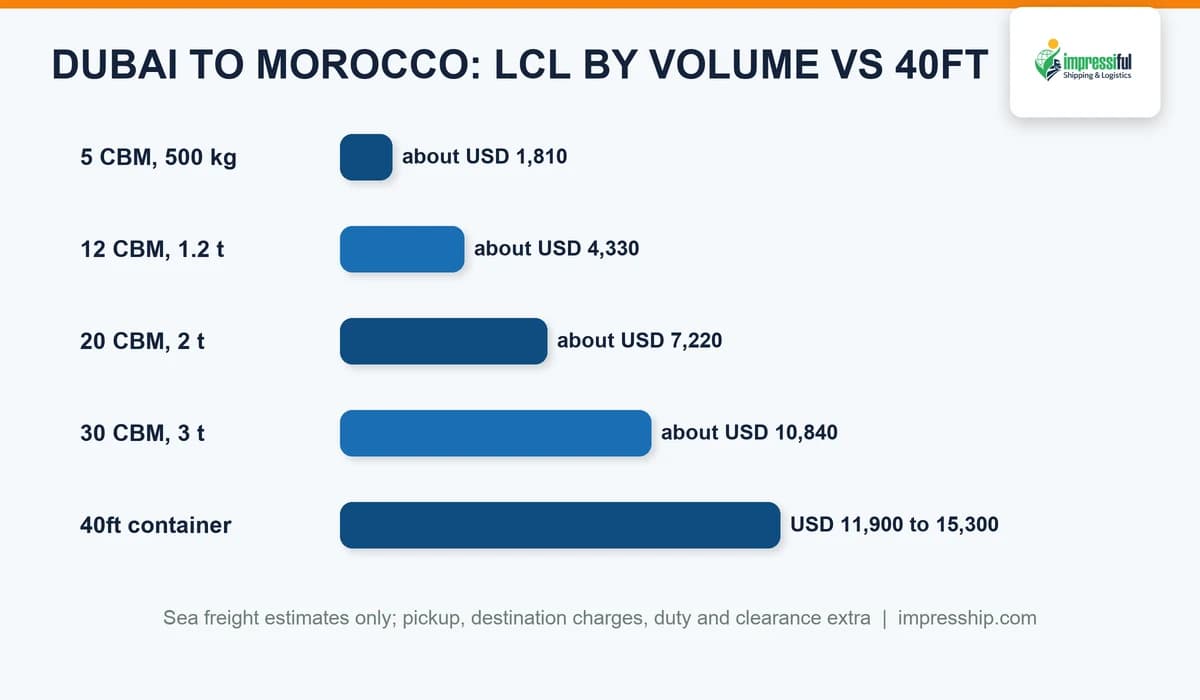
At 30 CBM, shared space comes to about USD 10,840, close to the bottom of the 40ft range. Our team recommends LCL up to roughly 30 CBM and a 40ft container beyond that, because a 40ft holds about 67 CBM and the goods are loaded once and opened once at the port. The LCL vs FCL guide explains the two pricing models.
With the Strait of Hormuz closed, our sea cargo currently loads at one of our partner ports: Sohar (most used) or Salalah in Oman, Jeddah in Saudi Arabia, or Khor Fakkan or Fujairah in the UAE, and your booking confirms the sailing. For urgent or small shipments, our air freight runs worldwide from the UAE, and the shipping calculator gives an estimate for Morocco.
Shipping from Dubai to Morocco?
Send the goods, HS codes if you have them, CBM, gross weight and the port, and we will confirm LCL or a container and quote sea freight to Tanger Med or Casablanca.
Tanger Med or Casablanca: which port to choose#
The two ports do different jobs:
- Tanger Med sits on the Strait of Gibraltar, on one of the busiest shipping lanes in the world. The Tanger Med group describes its port complex as the leading port in the Mediterranean and Africa and a hub for transshipment and import and export. It suits cargo for northern Morocco, the Tangier industrial and free zones, and buyers who move goods on by truck.
- Casablanca is the traditional import gateway for the domestic market, run under the national port authority, the ANP. It puts general cargo and consumer goods close to Casablanca, Rabat and the central regions, where most importers are based.
For most traders the deciding question is where the buyer is. If the goods are going to a shop or warehouse in Casablanca, landing them in Casablanca avoids a long road leg. If the buyer is in the north, or the goods feed a factory in a Tangier zone, Tanger Med is usually simpler. Tell us the final delivery city when you ask for a quote and we will confirm the better port for that sailing.
Import duty, TPI and VAT in Morocco#
Imports into Morocco pay three main charges. According to PwC's Morocco tax summary (last reviewed April 2026):
- Import duty, charged on the value of the goods at the rate set for the HS code. Rates can be reduced when the goods are covered by one of Morocco's free trade agreements.
- The parafiscal import tax (TPI) of 0.25 percent of the value of the goods.
- VAT on imports at 20 percent, with a lower 10 percent rate for specifically designated imports.
Some goods, such as tobacco, alcohol and lubricants, also carry excise tax. Duties and taxes are paid in Moroccan dirhams.
As an illustration of the method only, goods with a CIF value of USD 10,000 and a 10 percent duty rate would pay USD 1,000 in duty and USD 25 in TPI, and 20 percent VAT on the duty-paid value of USD 11,025 would add about USD 2,205, a total of about USD 3,230 before any fees. Your HS code sets the real duty rate, and your clearing agent confirms the exact base; our guide to HS codes for importers explains how to find the code.
Can goods from Dubai pay less duty? Morocco and the UAE have a bilateral free trade agreement, and both are members of the Greater Arab Free Trade Area. Preferences depend on origin, though: goods genuinely made in the UAE can qualify with a valid certificate of origin, while goods made in China or elsewhere and simply bought in Dubai pay the normal rate. Our certificate of origin guide explains how origin is proved.
Documents for shipping from Dubai to Morocco#
The US Commercial Service guide to Morocco's import documents lists what Moroccan customs expect for imports. In practice your shipment needs:
- Commercial invoice on the supplier's letterhead, describing the goods fully in French, with the HS code, the value, the payment currency and the buyer's address, and dates written dd/mm/yyyy. Our commercial invoice for export guide shows every field and the matching rules.
- Packing list, matching the invoice line by line, with package counts, weights and CBM.
- Bill of lading. We provide telex release bills of lading.
- The importer's licence and import commitment. The Moroccan importer needs a licence for the physical import and an import commitment, the authorisation from the Foreign Exchange Office that lets them pay the supplier abroad. Ask your buyer to arrange it before you ship.
- Customs declaration, filed in Morocco for the import through the port.
- Conformity certificate for regulated products. Under Morocco's Verification of Conformity (VoC) programme, in force since February 2020, products covered by national quality and safety rules must be certified before they ship. Your importer can tell you whether your goods are covered.
- Certificate of origin, if you want to claim a trade preference. For products that contain chemicals or are dangerous goods, we work with the supplier to get the safety data sheet (MSDS) and the certificate of origin when applicable.
- Insurance certificate. All our shipments are insured.
What to check before you ship#
Three things catch out first time shippers to Morocco:
- French descriptions. An invoice in English only, or with vague lines such as "general goods", invites questions. Ask your Dubai supplier to add French descriptions, or prepare a French version with your importer.
- Regulated products. Products covered by the VoC programme need their certificate before shipment, not after the cargo arrives. Ask your importer to check your HS codes against the list before you pay the supplier.
- Dangerous goods. Perfume, aerosols and anything with a lithium battery ship as dangerous goods. We ship them, but every dangerous goods shipment is subject to approval, so declare them when you ask for a quote; our dangerous goods shipping guide lists the everyday items that count.
How a Dubai to Morocco shipment runs#
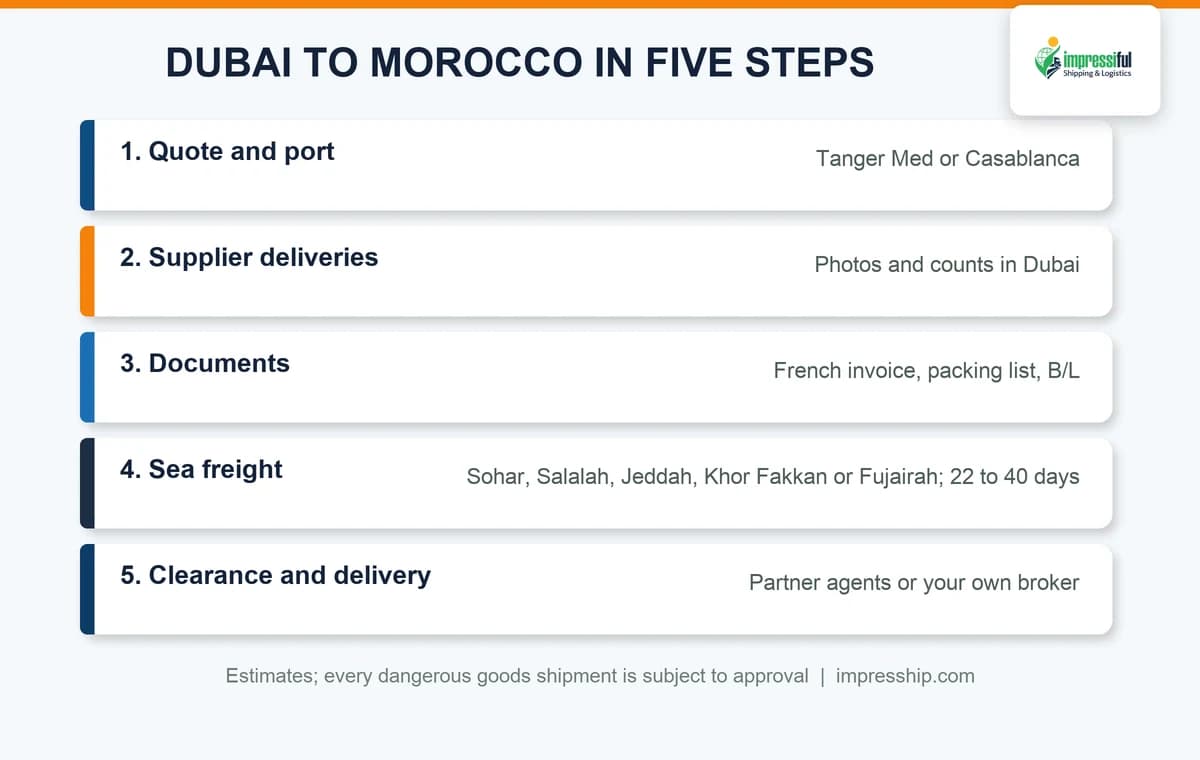
- Quote and port. Send the product list, CBM, weight and the delivery city. We confirm LCL or a container and the better port.
- Supplier deliveries. Your suppliers deliver to our shared warehouse in Dubai, and we confirm every delivery with photos and counts. Storage is free when the cargo is loaded within two weeks of confirmed shipping; if shipping is not confirmed, storage is charged at AED 20 per sq ft per month.
- Documents. The invoice with French descriptions, packing list, certificate of origin if needed and any conformity certificate are prepared, and the bill of lading is issued.
- Sea freight. The cargo loads at a partner port (Sohar, the one we use most, or Salalah in Oman, Jeddah in Saudi Arabia, or Khor Fakkan or Fujairah in the UAE) and sails to Tanger Med or Casablanca, about 22 to 40 days at sea.
- Clearance and delivery. We handle customs clearance at destination through our partner agents, or your importer can use their own customs broker. Delivery beyond the port is on request.
Traders who ship to Morocco often supply North and West Africa too. Our guides to shipping from Dubai to Egypt, shipping from Dubai to Senegal and the West Africa vs East Africa routes cover those lanes.
Frequently asked questions#
How much does it cost to ship to Morocco?#
By sea, shared container space to Tanger Med or Casablanca is an estimated USD 361 per CBM, so 5 CBM weighing 500 kg comes to about USD 1,810 in sea freight. A 20ft container is an estimated USD 10,700 to 12,800 and a 40ft USD 11,900 to 15,300. These are sea freight estimates; Dubai pickup, destination charges, duty and clearance are extra.
How to ship items to Morocco?#
For commercial goods from Dubai, send us the product list, CBM, weight and delivery city, and we confirm LCL or a container. Your suppliers deliver to our Dubai warehouse, the documents are prepared with French descriptions, and the cargo sails to Tanger Med or Casablanca. Your Moroccan importer arranges the import licence and commitment, and we handle clearance through our partner agents.
How much is import tax in Morocco?#
Imports pay customs duty at the rate for the HS code, a parafiscal import tax of 0.25 percent and VAT, which is 20 percent on most imports and 10 percent on some designated goods. Some products also carry excise tax. Duty can be lower for goods covered by Morocco's free trade agreements, but only when the goods genuinely originate in a partner country.
What are the customs rules for Morocco?#
The importer needs a licence for the physical import and an import commitment from the Foreign Exchange Office, and files a customs declaration for each shipment. The commercial invoice should describe the goods in French with HS codes and values, and products covered by Morocco's Verification of Conformity programme need a certificate before they ship.
How long does shipping take from Dubai?#
To Morocco by sea, allow about 22 to 40 days at sea, plus a few days for consolidation in Dubai, depending on the sailing and transshipment. Our sea cargo currently loads at one of our partner ports: Sohar (most used) or Salalah in Oman, Jeddah in Saudi Arabia, or Khor Fakkan or Fujairah in the UAE. Air freight is much faster and runs worldwide from the UAE; the shipping calculator gives an estimate.
Send your cargo details for a same-day quote#
Tell us what you are shipping from Dubai to Morocco, the HS codes if you have them, the CBM and gross weight, and the delivery city. We will confirm LCL or a container, the better port, and quote the sea freight with the destination charges spelled out, with a telex release bill of lading. All our shipments are insured, we ship general cargo and dangerous goods, with every dangerous goods shipment subject to approval, and we handle customs clearance through our partner agents, or your importer can use their own broker.
Request a same-day quote or message us on WhatsApp with your cargo details.