
Shipping Solar Panels to Africa from Dubai: Panels, Batteries and Costs
Shipping solar panels to Africa from Dubai: how panels, inverters and lithium or lead acid batteries are classed and packed, the papers batteries need for approval, sea freight estimates to Tema, Lagos and Mombasa, and duty checks.
Shipping solar panels to Africa has become one of the busiest trades on the continent. Africa's solar panel imports from China rose 60 percent in the 12 months to June 2025, to more than 15,000 MW, according to Ember's analysis of the take-off in African solar, and a large share of the kits sold in Lagos, Accra and Nairobi are bought through Dubai traders. This guide explains how panels, inverters and batteries are classed, packed and booked from Dubai, what the sea freight costs as estimates, and what to check at the destination port.
For most buyers, the panels themselves are the easy part: they ship by sea as general cargo, on pallets, either in shared container space or in a full container. The batteries are what need planning. Lithium batteries are dangerous goods, and every dangerous goods shipment is subject to approval, so the order you book them in and the papers you send decide how smoothly the whole kit moves on our ocean freight service.
What ships how: panels, inverters and batteries#
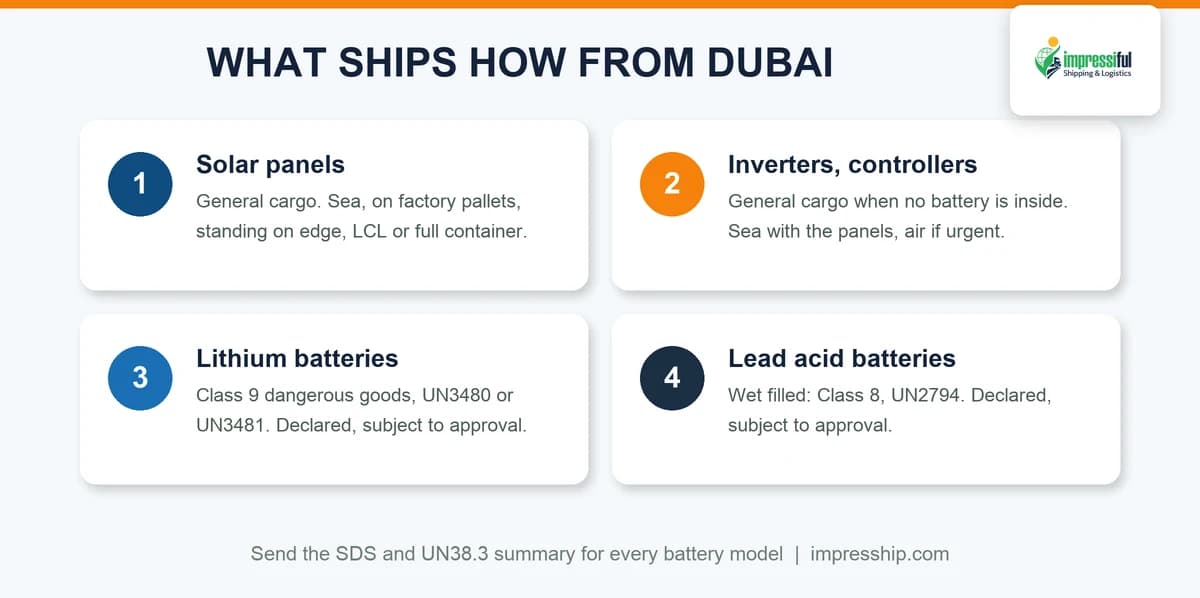
A solar kit is really four kinds of cargo. Each one has its own classification, and the battery line is the one that changes the booking.
| Item | Usual HS heading | Transport class | How it ships from Dubai |
|---|---|---|---|
| Solar panels (PV modules) | 8541.43 | General cargo | Sea, palletised, LCL or full container |
| Inverters and charge controllers | 8504.40 | General cargo (no battery inside) | Sea with the panels; air if urgent |
| Mounting rails, cables, connectors | 7610, 8544 | General cargo | Sea, in cartons or crates |
| Lithium ion batteries on their own (incl. LiFePO4) | 8507.60 | Class 9 dangerous goods, UN3480 | Sea as declared DG, subject to approval |
| Lithium batteries packed with or inside equipment | 8507.60 or the equipment heading | Class 9 dangerous goods, UN3481 | Sea as declared DG, subject to approval |
| Lead acid batteries, wet filled | 8507.20 | Class 8 dangerous goods, UN2794 | Sea as declared DG, subject to approval |
The HS headings are the usual ones under the Harmonized System; your supplier's invoice and the destination tariff confirm the exact code. Sealed, non-spillable lead acid batteries (UN2800) can be exempt when they pass the test conditions, and the supplier's Safety Data Sheet says which applies.
Need this handled end to end?
Tell us your lane and cargo profile and we'll come back with a routing plan and an all-in rate.
Shipping solar panels by sea#
Panels are glass, long and heavy for their size, so they almost always go by sea. A typical large format module measures about 2.3 m by 1.1 m and weighs around 25 to 30 kg, and manufacturers ship them on their own pallets of roughly 30 to 36 panels, standing on edge.
- Keep the factory pallet. Original pallets have corner protectors and strapping designed for the panels. If you buy loose panels from several traders, bring them to our shared warehouse in Dubai and we repack them onto pallets.
- Upright, never flat under other cargo. Panels should travel on edge with nothing heavy stacked on top, marked fragile and this way up.
- Measure the loaded pallet. A pallet of large panels is usually more than 3 CBM. Our CBM guide shows the sum, and the CBM calculator does it for you.
- Check the datasheet for container loading. Module datasheets list the pieces per pallet and per container, which tells you quickly whether a full container makes sense.
Once your shipping is confirmed, panels, inverters and mounting kits from different suppliers can be delivered to our shared warehouse in Dubai in the two weeks before sailing and shipped together, with no storage charge if they are loaded within those two weeks. If shipping is not confirmed, storage is AED 20 per sq ft per month.
Shipping solar batteries: the dangerous goods rules#
Lithium batteries are classed as dangerous goods by sea under the IMDG Code, and by air under the IATA rules. That does not stop them shipping; it means they must be declared, packed and labelled as what they are. We ship dangerous goods as well as general cargo, and every dangerous goods shipment is subject to approval.
To get a battery shipment approved, send us:
- The Safety Data Sheet (SDS) for each battery model. Section 14 gives the UN number and class.
- The UN38.3 test summary. Lithium batteries must pass the UN38.3 tests before they can be transported, and the manufacturer issues the summary.
- The battery specification: chemistry, watt hours per battery, weight and number of units.
- The packing details: whether the batteries are loose, packed with an inverter or built into a power station.
By air, loose lithium ion batteries are far more restricted. IATA's lithium battery guidance limits them to cargo aircraft at a reduced state of charge, which is why solar storage batteries from Dubai almost always go by sea. Our dangerous goods shipping guide covers the wider DG rules, including perfume, aerosols and paints.
Shipping solar panels to Africa: what it costs#
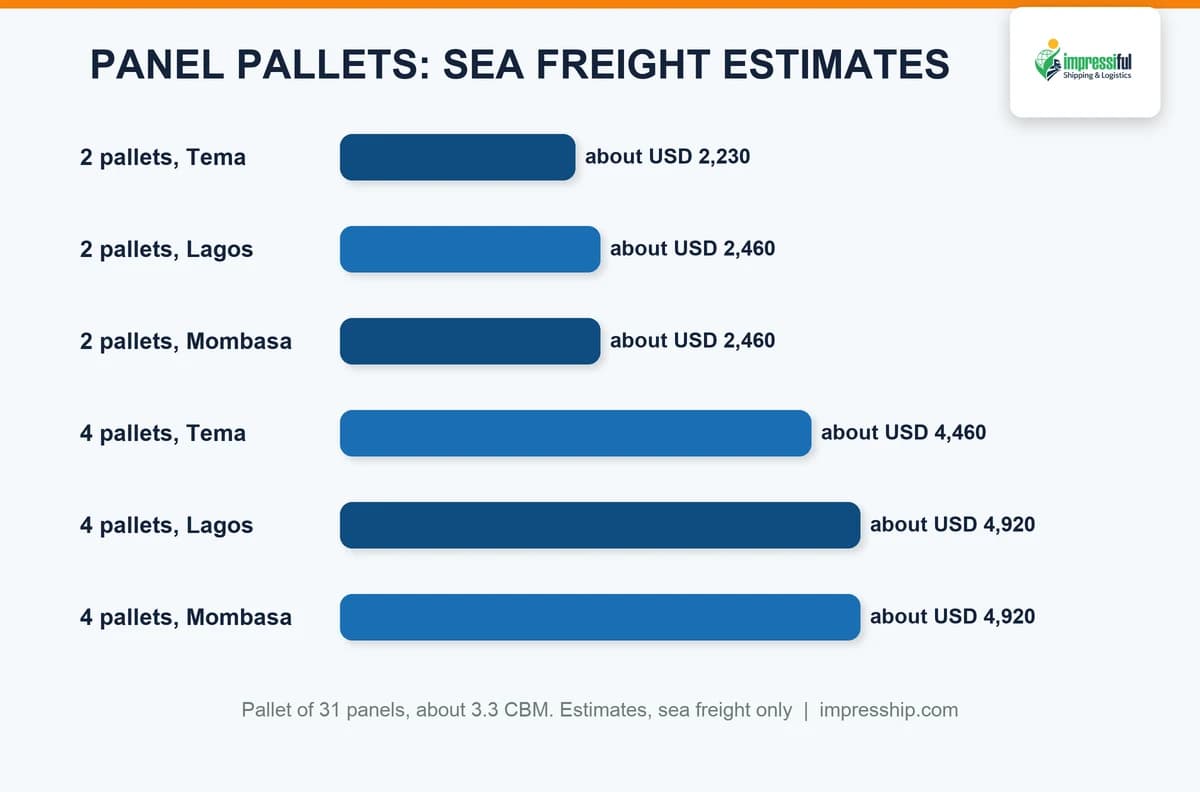
Shared container space (LCL) is charged on revenue tonnes: the greater of the cubic metres and the metric tonnes. Panels are bulky as well as heavy, so a pallet is usually charged on its volume. Here is how panel pallets work out on our shipping calculator, using an example pallet of 31 panels (about 3.3 CBM and 870 kg):
| Shipment | CBM | Weight | Tema estimate | Lagos estimate | Mombasa estimate |
|---|---|---|---|---|---|
| 2 pallets of panels | 6.61 | 1,740 kg | about USD 2,230 | about USD 2,460 | about USD 2,460 |
| 4 pallets of panels | 13.22 | 3,480 kg | about USD 4,460 | about USD 4,920 | about USD 4,920 |
| 40ft container | 67 to 76 | by datasheet | about USD 11,700 to 15,000 | about USD 12,600 to 16,200 | about USD 9,900 to 12,800 |
These are estimates for sea freight only, and they depend on the product and the destination. Dubai pickup, destination charges, duty and clearance are extra. Shipments under 1,000 kg are charged by weight band when that comes out higher, which is often the case for a single heavy pallet, so run your exact figures through the calculator. Battery shipments are quoted after dangerous goods approval.
For most loads, shared space is the right choice up to roughly 30 CBM; above that, we recommend a 40ft. Our LCL vs FCL guide explains the trade off, and the container sizes guide gives the inside dimensions. Sea transit to West Africa is 30 to 48 days.
Shipping a solar kit?
Send us the panel datasheet, the number of pallets, and the SDS and UN38.3 summary for any batteries. We will confirm how each item ships and quote the shipment to your African port.
Duty and paperwork at the destination#
Panels are often treated more kindly than the rest of the kit. In Nigeria, the customs service said in September 2024 that solar panels remain free of import duty, as reported by Daily Trust; inverters, batteries and other components are classified separately and can attract duty. Rules change, so confirm the current treatment for every line with your clearing agent before you buy.
- List each item separately on the commercial invoice and packing list, with the watts per panel and the watt hours per battery. A single line called "solar system" invites questions.
- Check conformity rules. Nigeria's SONCAP and similar schemes in other countries can apply to inverters and batteries.
- Estimate the duty early with our import duty calculator, line by line.
We handle destination customs clearance, or you can use your own agent.
Frequently asked questions#
How many solar panels can fit in a shipping container?#
It depends on the panel size, so check the module datasheet, which lists the pieces per pallet and per container. For common large format panels, datasheets typically show about 30 to 36 panels per pallet and several hundred panels in a 40ft high cube. Our container sizes guide gives the inside dimensions to plan against.
How much does it cost to ship solar panels?#
As estimates from our current rate card, two pallets of large panels (about 6.6 CBM) cost about USD 2,230 to Tema and USD 2,460 to Lagos by shared container, for sea freight only. A 40ft container runs from about USD 11,700 to 15,000 to Tema. Destination charges, duty and clearance are extra, and the shipping calculator gives the figure for other ports.
Is solar panel duty free in Nigeria?#
The Nigeria Customs Service said in September 2024 that solar panels remain duty free, but inverters, batteries and other components are classified separately and can attract duty and VAT. Confirm the current rate for each HS code with your clearing agent before you ship.
Can I ship a lithium ion battery internationally?#
Yes, as declared dangerous goods. Lithium ion batteries ship as Class 9 under UN3480, or UN3481 when packed with or inside equipment, with a Safety Data Sheet and a UN38.3 test summary. Every dangerous goods shipment we handle is subject to approval, and our dangerous goods guide explains the process.
Are batteries allowed to be shipped?#
Most batteries can be shipped, but lithium and wet lead acid batteries are dangerous goods and must be declared, packed and labelled under the IMDG Code by sea. Damaged or recalled batteries need special approval, and air rules are much stricter than sea rules.
Send your cargo details for a same-day quote#
Tell us what is in the kit (panels, inverters, batteries, mounting), the number of pallets or cartons, the total weight and the destination port. Attach the SDS and UN38.3 summary for any batteries. You can bring your cargo to our shared warehouse in Dubai or ask for a pickup quote.
Request a same-day quote or message us on WhatsApp with your cargo details. See the UAE to Africa shipping guide for every lane we serve.