
1 CBM to kg in Sea Freight: Why 1 CBM Counts as 1,000 kg and When Weight Bands Apply (2026)
1 CBM to kg in sea freight: why 1 CBM counts as 1,000 kg, a CBM to kg conversion table, and from our own rate card the point where weight bands take over for Tema, Lagos and Mombasa, with worked examples.
Short answer: For 1 CBM to kg in sea freight, the rule is 1 CBM = 1,000 kg: shared container freight is charged on whichever is greater, the cubic metres or the metric tonnes. On our rate card, shipments under 1,000 kg also have weight bands, so small heavy loads of more than about 130 kg per CBM are charged by weight.
Search for 1 CBM to kg in sea freight and every answer gives the same ratio: one cubic metre counts as 1,000 kg. That is correct for the basic rule, but it is not how most small shipments from Dubai are actually priced. This guide explains the 1:1,000 rule, converts common volumes to kilograms, and then shows, from our own rate card, where the weight bands take over and how to work out which charge your cargo will pay.
1 CBM to kg in sea freight: the 1:1,000 rule#
Sea freight in shared containers (LCL) is priced per "revenue tonne", also called weight or measure (W/M). The forwarder compares two numbers and charges the larger:
- Volume: length x width x height of every carton in metres, added up, gives the CBM.
- Weight: the gross weight in kilograms, divided by 1,000, gives metric tonnes.
Because a metric tonne is 1,000 kg (the tonne is a unit accepted for use with the International System of Units), the rule is often written as 1 CBM = 1,000 kg. A shipment of 2 CBM weighing 600 kg is charged as 2 revenue tonnes, because the volume is the bigger number. A shipment of 2 CBM weighing 3,000 kg is charged as 3 revenue tonnes, because the weight is.
Physically, of course, a cubic metre of goods can weigh anything from a few kilograms (foam, pillows) to well over a tonne (tiles, metal parts). The 1,000 kg figure is a pricing convention, not a weight. Air freight uses a far smaller one: 1 CBM counts as about 167 kg, which our guide to volumetric weight explains.
Need this handled end to end?
Tell us your lane and cargo profile and we'll come back with a routing plan and an all-in rate.
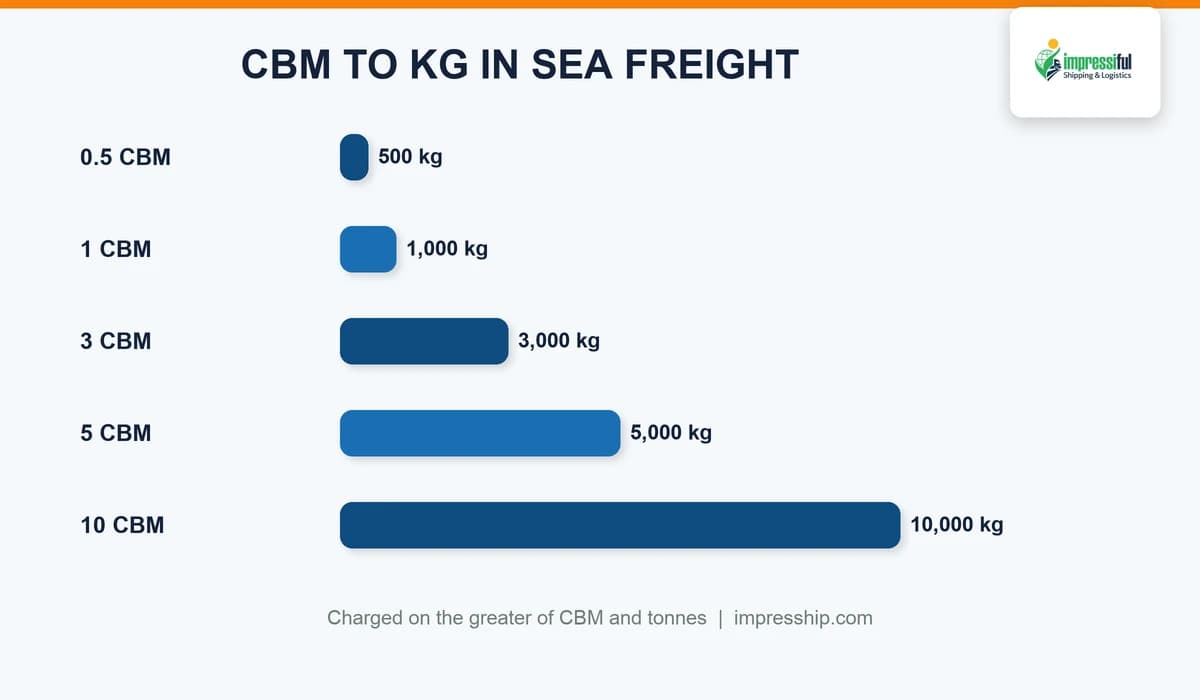
CBM to kg conversion table#
| Volume | Counts as (sea freight) | Charged on weight if heavier than |
|---|---|---|
| 0.1 CBM | 100 kg | 100 kg |
| 0.5 CBM | 500 kg | 500 kg |
| 1 CBM | 1,000 kg | 1,000 kg (1 tonne) |
| 2 CBM | 2,000 kg | 2,000 kg |
| 3 CBM | 3,000 kg | 3,000 kg |
| 5 CBM | 5,000 kg | 5,000 kg |
| 10 CBM | 10,000 kg | 10,000 kg |
To convert, multiply the CBM by 1,000. To go the other way, divide the kilograms by 1,000. If you do not know the CBM yet, our guide to how to calculate CBM and the CBM calculator work it out from carton sizes.
Why the 1:1,000 rule is not the whole story under 1,000 kg#
Most answers online say a 1 CBM shipment weighing 300 kg is simply billed as 1 revenue tonne. On our rate card, it is not. Up to 999 kg, the card has 12 weight bands, and the price is whichever is higher: the CBM charge or the band for the shipment's weight. Our CEO confirmed that weights of about 300 to 999 kg are deliberately priced above the CBM rate, so customers buy space by the CBM, and small, heavy loads are charged by weight.
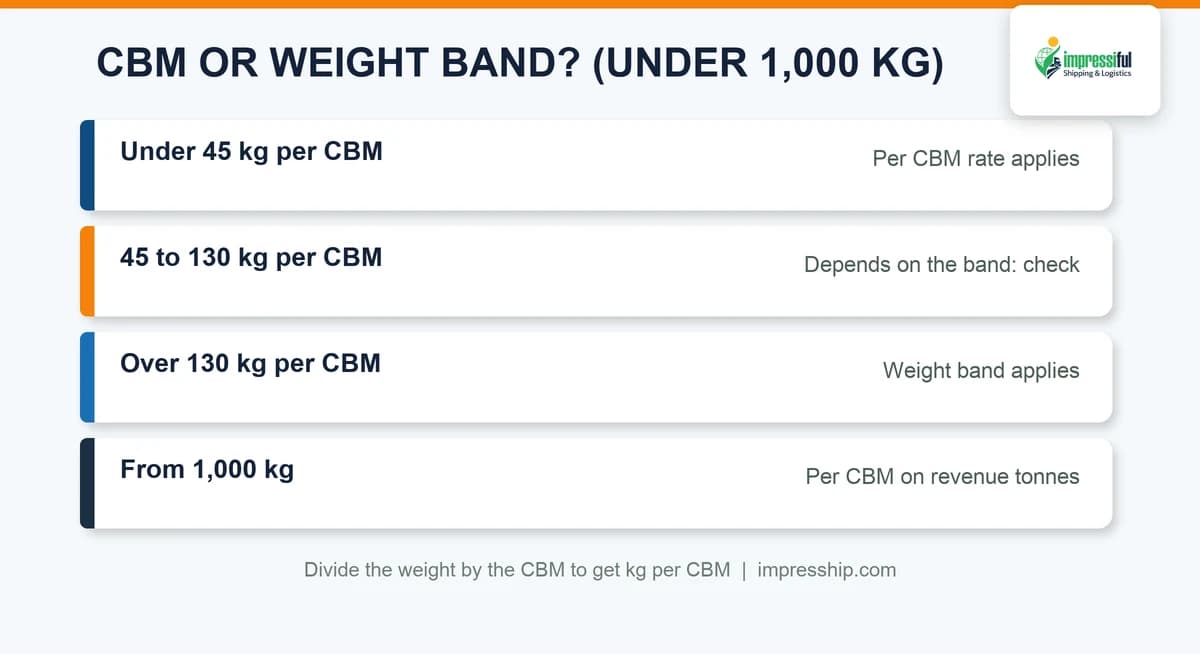
The result is a simple test. Divide the weight by the CBM to get the density of your load:
- Lighter than about 45 kg per CBM: the per CBM rate sets the price (or the minimum charge, for very small loads).
- Heavier than about 130 kg per CBM: the weight band sets the price.
- In between: it depends on the band your weight falls in, so check the shipping calculator.
From 1,000 kg, the bands stop and the per CBM rate applies to the revenue tonnes, the greater of the CBM and the tonnes.
When the weight band takes over: Tema, Lagos and Mombasa#
This table shows each band on our current card for three of the busiest lanes, and the volume at which the per CBM charge overtakes it. A shipment smaller than that volume pays the band; a larger one pays per CBM.
| Weight band | Tema, Ghana | Lagos, Nigeria | Mombasa, Kenya | Per CBM rate takes over from about |
|---|---|---|---|---|
| 25 to 49 kg | USD 177 | USD 196 | USD 196 | 0.5 CBM |
| 50 to 99 kg | USD 368 | USD 406 | USD 406 | 1.1 CBM |
| 100 to 149 kg | USD 490 | USD 542 | USD 542 | 1.4 CBM |
| 150 to 199 kg | USD 626 | USD 689 | USD 692 | 1.8 CBM |
| 200 to 249 kg | USD 762 | USD 841 | USD 841 | 2.2 CBM |
| 250 to 349 kg | USD 953 | USD 1,051 | USD 1,051 | 2.8 CBM |
| 350 to 449 kg | USD 1,225 | USD 1,348 | USD 1,351 | 3.6 CBM |
| 450 to 549 kg | USD 1,498 | USD 1,650 | USD 1,650 | 4.4 CBM |
| 550 to 649 kg | USD 1,770 | USD 1,950 | USD 1,952 | 5.2 CBM |
| 650 to 749 kg | USD 2,042 | USD 2,246 | USD 2,252 | 6.0 CBM |
| 750 to 849 kg | USD 2,314 | USD 2,546 | USD 2,551 | 6.8 CBM |
| 850 to 999 kg | USD 2,668 | USD 2,935 | USD 2,941 | 7.8 CBM |
The per CBM rates behind the table are about USD 340 to Tema and about USD 376 to Lagos and Mombasa (the card is in dirhams, converted at 3.6725 per dollar). All figures are estimates for sea freight only; Dubai pickup, destination charges, duty and clearance are extra. The first band is also the minimum charge.
Worked examples from the calculator#
Each example below was run through the same pricing rule as our shipping calculator.
| Shipment | Density | Tema | Lagos | Mombasa | Charged on |
|---|---|---|---|---|---|
| 0.3 CBM, 40 kg | 133 kg per CBM | about USD 177 | about USD 196 | about USD 196 | minimum (first band) |
| 1 CBM, 80 kg | 80 kg per CBM | about USD 368 | about USD 406 | about USD 406 | weight band |
| 1 CBM, 300 kg | 300 kg per CBM | about USD 953 | about USD 1,051 | about USD 1,051 | weight band |
| 1.5 CBM, 120 kg | 80 kg per CBM | about USD 511 | about USD 564 | about USD 564 | per CBM |
| 2 CBM, 200 kg | 100 kg per CBM | about USD 762 | about USD 841 | about USD 841 | weight band |
| 5 CBM, 500 kg | 100 kg per CBM | about USD 1,702 | about USD 1,879 | about USD 1,879 | per CBM |
| 3 CBM, 4,500 kg | 1,500 kg per CBM | about USD 1,532 | about USD 1,691 | about USD 1,691 | 4.5 revenue tonnes |
Two of these surprise people. One cubic metre at 80 kg pays the 50 to 99 kg band, slightly more than the per CBM rate. And two shipments with the same density (2 CBM at 200 kg and 5 CBM at 500 kg) are charged differently, because only the bigger one is large enough for the per CBM charge to pass its band. Our guide to how much 1 CBM costs from Dubai lists the per CBM rate for every coastal African port.
How to lower the chargeable weight#
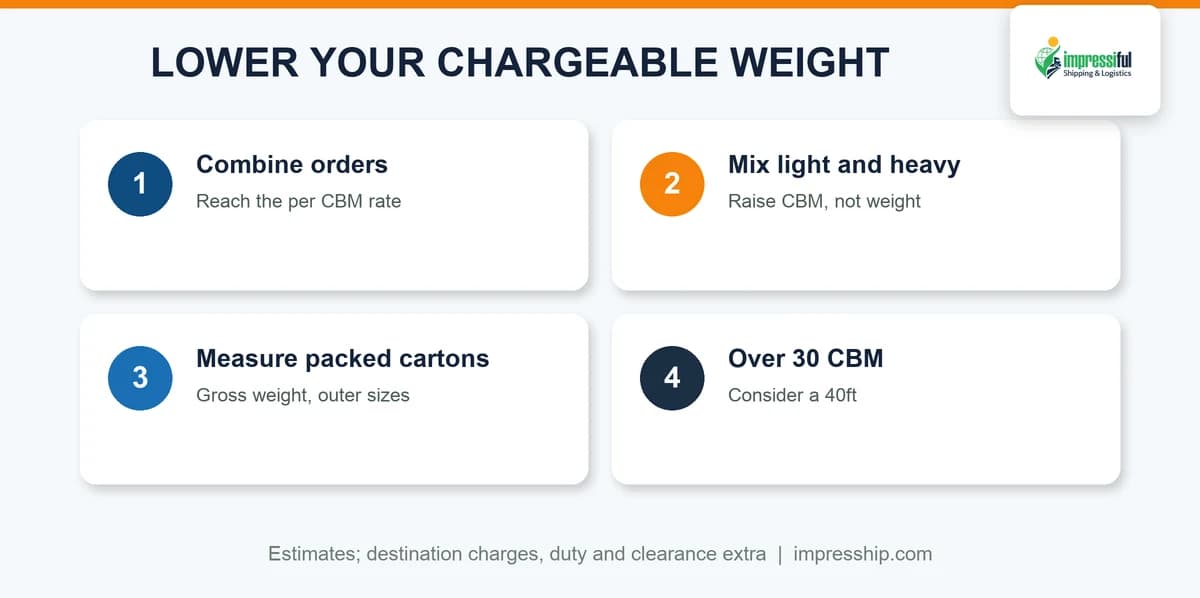
- Combine orders. Several small heavy orders shipped together move up into a larger volume, where the per CBM rate is more likely to apply.
- Mix light and heavy goods. Bulky, light items in the same shipment raise the CBM without adding much weight.
- Weigh and measure packed cartons. Use the gross weight and outer sizes after packing; estimates from product pages are usually low.
- Ask about a container above roughly 30 CBM. We recommend shared space up to roughly 30 CBM, then a 40ft. Our LCL vs FCL guide explains the switch.
- Send urgent small parcels by air instead. For a few light cartons, air can be competitive; compare in the calculator.
Not sure if your load is charged by CBM or by weight?
Send the number of cartons, their sizes and the total weight, and the destination port, and we will tell you which charge applies and quote the sea freight.
Declare the same weight everywhere#
The weight you give for the quote should match the packing list, the bill of lading and the customs declaration at destination. Customs at destination checks the declaration against these documents, whether it is lodged in Ghana's ICUMS or on Nigeria's new B'Odogwu customs platform, and a gap between declared and actual weight invites queries and delays. Our guides to the ICUMS duty calculator and the commercial invoice for export show what the documents must say.
Prices are confirmed on the real weight and sizes when you book, and we confirm every supplier delivery with photos and counts, so you see the numbers before the cargo sails.
Frequently asked questions#
How to convert CBM to kg?#
For sea freight, multiply the CBM by 1,000: 1 CBM counts as 1,000 kg, so 0.5 CBM is 500 kg and 2.5 CBM is 2,500 kg. For air freight, multiply by about 167 instead. These are pricing conversions, not real weights. On our sea rate card, loads under 1,000 kg are also checked against weight bands, and the higher charge applies.
How much is 3 CBM in kg?#
In sea freight, 3 CBM counts as 3,000 kg, or 3 revenue tonnes. If your 3 CBM shipment weighs less than 3,000 kg, it is charged on the volume; if it weighs more, on the weight. On our card, 3 CBM weighing 300 kg to Tema is charged per CBM, about USD 1,021, while 3 CBM weighing 4,500 kg is charged as 4.5 tonnes, about USD 1,532.
Send your cargo details for a same-day quote#
Tell us what you are shipping from Dubai, the number and size of cartons, the total weight and the destination port. We will confirm whether it is charged per CBM or by weight, shared space or a container, and the sailing from one of our partner ports: Sohar (most used) or Salalah in Oman, Jeddah, Khor Fakkan or Fujairah. All prices are estimates that depend on the product and are confirmed when you book.
Request a same-day quote or message us on WhatsApp with your cargo details.