
Prohibited Goods in Kenya: The Official List, Restricted Goods and the 2026 Rule Changes
Prohibited goods in Kenya from the EAC Customs Management Act Second Schedule, the restricted goods that need a permit (including mobile phones), Kenya specific rules for 2026 on plastic bags, used cars and shisha, and how to check goods before buying in Dubai.
Short answer: Prohibited goods in Kenya are set by Part A of the Second Schedule to the East African Community Customs Management Act, 2004. They include counterfeit goods, narcotic drugs, fake currency, pornography, hazardous waste, soaps and cosmetics containing mercury, used tyres for cars and light commercial vehicles and banned chemicals. Kenya law adds others, such as plastic carrier bags.
Shipping goods from Dubai to Kenya? Send us the product list before you buy and we will flag anything prohibited or restricted, then request a same-day quote or message us on WhatsApp with your cargo details.
Kenya Revenue Authority (KRA) applies the East African Community customs law, so the core list of prohibited goods in Kenya is the same one used across the EAC. On top of it, Kenyan laws ban or control some goods on their own, and some of those rules changed in 2026. This guide lists the prohibited goods in Kenya from the official schedule, the restricted goods that need a permit, the Kenya specific bans an importer from Dubai should know and how to check a product before you buy. When your goods are clear to ship, our customs clearance service handles the Mombasa side through our partner agents.
Prohibited goods in Kenya vs restricted goods#
The difference matters before you pay a supplier:
- Prohibited goods (Part A of the Second Schedule) cannot be imported at all. There is no permit that makes them legal.
- Restricted goods (Part B) can be imported only with a permit, licence or approval from the agency that controls them.
- Regulated goods under other Kenyan laws need a standard, inspection or certificate, for example a used car's roadworthiness certificate.
Both lists are published by KRA in its summary of prohibited and restricted goods under the Second and Third Schedules of the EAC Customs Management Act. The first item on each list also brings in every good that another law in force in Kenya prohibits or regulates, which is why the Kenya specific bans below count too.
Need this handled end to end?
Tell us your lane and cargo profile and we'll come back with a routing plan and an all-in rate.
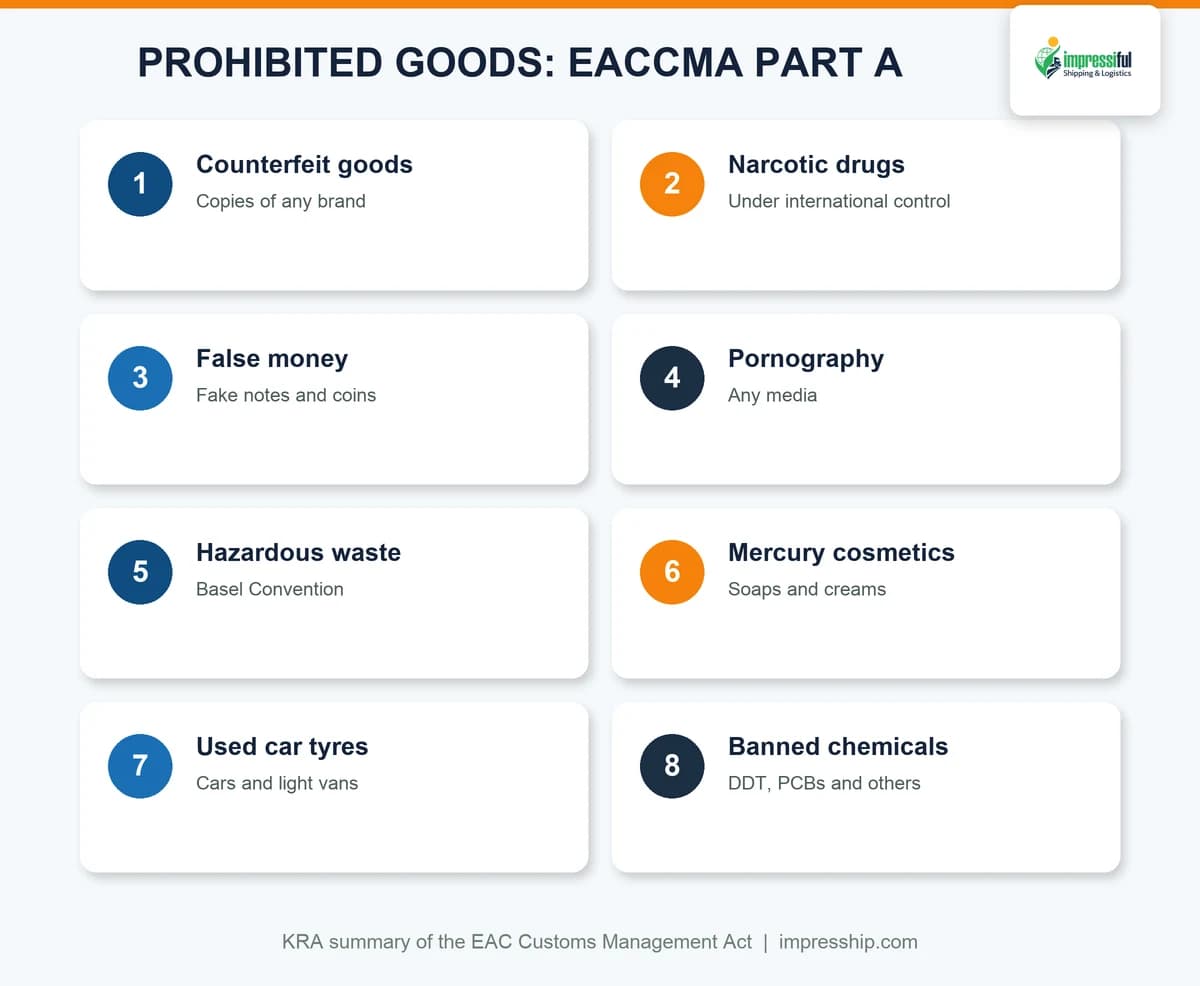
The prohibited goods list (EACCMA Second Schedule, Part A)#
| Item | What it covers | Typical Dubai purchase that gets caught |
|---|---|---|
| Counterfeit goods | Goods of all kinds that copy a brand without authority | Copy watches, bags, shoes and phone accessories |
| False money | Counterfeit notes and coins, money below the set standard | Novelty or "prop" banknotes |
| Pornographic material | Indecent or obscene material in any media | Printed or digital material |
| Narcotic drugs | Drugs under international control | Medicines containing controlled substances |
| Hazardous waste | Waste covered by the Basel Convention | Scrap electronics or used batteries sold as "waste" |
| Mercury cosmetics | All soaps and cosmetic products containing mercury | Skin lightening creams and soaps |
| Used tyres | Used tyres for light commercial vehicles and passenger cars | Part worn tyres bought cheaply in the UAE |
| White phosphorus matches | Matches made with white phosphorus | Rare today, still on the list |
| Banned chemicals | Listed agricultural and industrial chemicals, such as DDT, aldrin, dieldrin, lindane, parathion, PCBs and crocidolite asbestos | Old pesticide stock |
| Harmful spirits | Distilled drinks with injurious oils such as absinthe and hyssop | Absinthe style spirits |
| National emblems | Articles carrying an EAC state's coat of arms without authority | Unofficial souvenirs |
Two lines catch most importers from Dubai. Counterfeit goods are seized whatever the quantity, and some skin lightening creams and soaps contain mercury, so check the ingredients. If you cannot prove a brand item is genuine, do not ship it.
Restricted goods: allowed only with a permit#
Part B lists goods that need a permit or approval. The ones that come up most from the UAE:
| Restricted good | Why it is controlled |
|---|---|
| Mobile devices | Need regulatory permits from the Communications Authority of Kenya; importers must declare each device's IMEI number |
| Arms, ammunition, gun parts, scopes, bows, arrows and fencing foils | Security controls |
| Unwrought precious metals and precious stones | Trade and revenue controls |
| Ivory, rhino horn, tortoise shell, coral and other animal products | Wildlife protection under CITES |
| Genetically modified products | Biosafety approval |
| Ozone depleting substances | Montreal Protocol controls, relevant for some refrigerants |
| Second hand tyre casings | Commercial casings are restricted |
| Psychotropic drugs | International drug controls |
| Historical artefacts and antiques of arms | Heritage controls |
The mobile phone rule is the one Dubai traders meet most often. In its public notice on mobile devices, KRA says mobile devices are restricted imports under Part B, need permits from the Communications Authority of Kenya, and must be entered with accurate quantities, model descriptions and IMEI numbers, effective 1 January 2025.
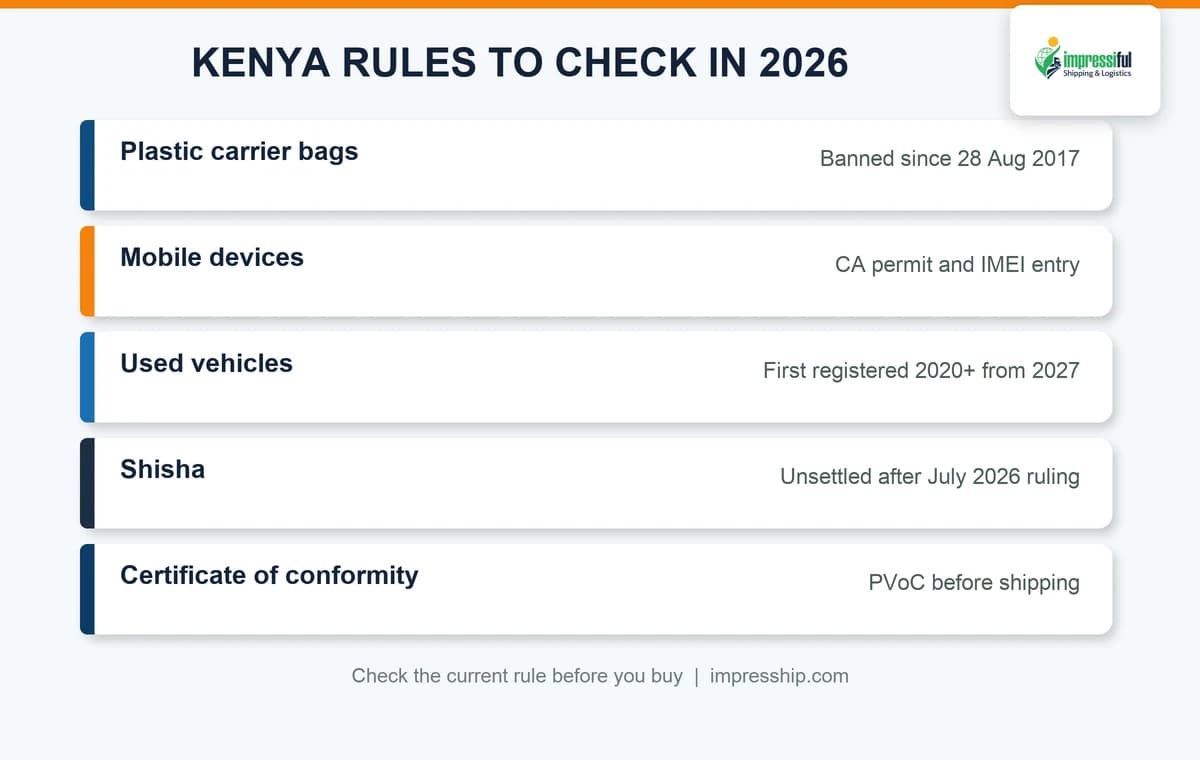
Kenya specific bans and rules to know in 2026#
Beyond the EAC schedule, these Kenyan rules matter for cargo from Dubai:
- Plastic carrier bags: NEMA states that Gazette Notices 2334 and 2356 banned the use, manufacture and importation of plastic bags for commercial and household packaging, effective 28 August 2017. Do not pack goods for sale in plastic carrier bags; use cartons or approved packaging.
- Used vehicles: Kenya enforces an eight year age limit under the KS 1515:2000 standard. KEBS announced on 24 November 2026 that from 1 January 2027 only right hand drive vehicles first registered on or after 1 January 2020 may be imported, and vehicles from the UAE need a certificate of roadworthiness from the KEBS appointed inspection agency, as The Star reported.
- Shisha: the 2017 shisha rules banned the importation and sale of shisha, but the High Court ruled on 28 July 2026 that those rules had ceased to have effect, as The Star reported, and the Ministry of Health has consulted on new rules. Treat shisha as unsettled and check the current position before you ship any.
- Standards and inspection: many products need a certificate of conformity from pre-export verification before they ship to Kenya. We arrange the Kenya PVoC pre-export inspection for our clients.
Not sure if your goods can enter Kenya?
Send the product list, quantities and HS codes if you have them, and we will flag anything prohibited or restricted before you pay a supplier, then quote sea freight to Mombasa.
Dangerous goods are a separate check#
A product can be legal to import into Kenya and still need special handling to ship. Perfume, aerosols, lithium batteries, paint and some cleaning chemicals are dangerous goods for transport. We ship general cargo and dangerous goods, and every dangerous goods shipment is subject to approval. Our guide to what you cannot send by air from Dubai explains the transport rules, which are not the same as the customs lists above.
How to check a product before you buy in Dubai#
- Get the HS code. The code tells you the duty and whether a permit or standard applies. Our guide to HS codes explained for importers shows how to find it.
- Check both lists. Compare the product with Part A (prohibited) and Part B (restricted) above.
- Check Kenyan rules. Plastic packaging, used vehicles, shisha, phones and products that need a certificate of conformity.
- Ask for permits early. A permit applied for after the goods land means storage costs at Mombasa while you wait.
- Keep the paperwork consistent. The invoice, packing list and declaration must describe the goods the same way; our guide to documents required for clearing goods in Kenya lists them.
Prohibited goods found at the port are liable to seizure and forfeiture under the Act, and the importer can face penalties, so the check costs far less than the mistake. If you also ship to West Africa, our guide to prohibited and restricted imports in Ghana and Nigeria covers those lists.
Shipping permitted goods from Dubai to Kenya with us#
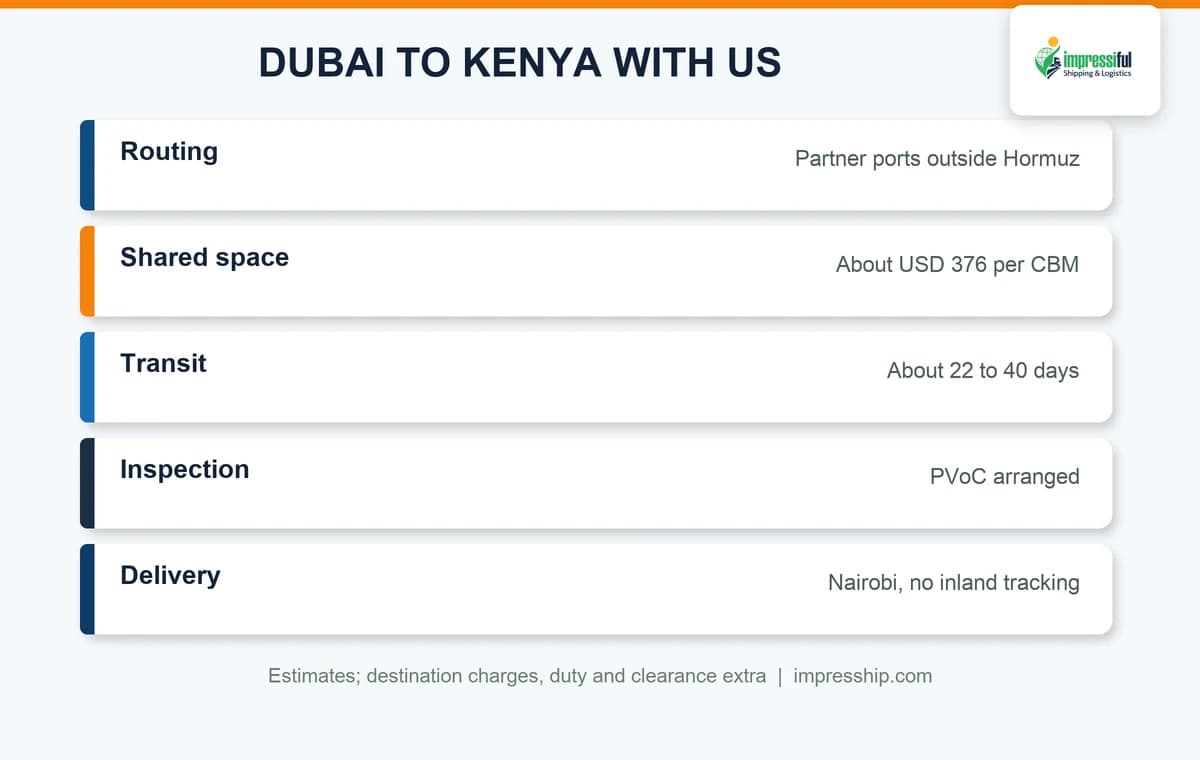
Once your goods are clear, here is how we ship them, using only what we can confirm:
- Routing: sea cargo arrives at Mombasa. With the Strait of Hormuz closed to normal traffic, it currently loads at one of our partner ports: Sohar (most used) or Salalah in Oman, Jeddah, Khor Fakkan or Fujairah, and our estimates include the move from Dubai to that port.
- Transit: about 22 to 40 days at sea to Mombasa.
- Pricing: shared container space is about USD 376 per CBM on our estimates, and small heavy loads are charged by weight band from about USD 196 for 25 to 49 kg. A 20ft container is about USD 8,900 to 10,600 and a 40ft about USD 9,900 to 12,800. Estimates depend on the product; Dubai pickup, destination charges, duty and clearance are extra, and the shipping calculator gives a figure for your load.
- Inspection: we arrange the Kenya PVoC pre-export inspection.
- Clearance and delivery: we handle clearance through our partner agents, or you can use your own agent, and we arrange delivery to inland cities such as Nairobi; we do not offer tracking on inland legs.
Duty is a separate sum: our guide to Kenya import duty calculation works through the rates with an example, and the shipping from Dubai to Mombasa guide covers the lane in full.
Frequently asked questions#
What are the prohibited items to bring into Kenya?#
The prohibited items are those in Part A of the Second Schedule to the EAC Customs Management Act: counterfeit goods, false money, pornographic material, narcotic drugs, hazardous waste, soaps and cosmetics containing mercury, used tyres for cars and light commercial vehicles, white phosphorus matches and listed chemicals. Goods banned by other Kenyan laws, such as plastic carrier bags, are prohibited too. Restricted goods, such as mobile devices and arms, need a permit instead.
Can I take plastic bags into Kenya?#
Not plastic carrier bags. NEMA says Gazette Notices 2334 and 2356 banned the use, manufacture and importation of plastic bags for commercial and household packaging from 28 August 2017, so do not pack goods or gifts in them. Plastic used as primary industrial packaging is treated differently: NEMA processes clearances for it through its online licensing portal. If you are unsure about your packaging, ask us before you pack.
Send your cargo details for a same-day quote#
Tell us what you are shipping to Kenya, the number and size of cartons, the gross weight and the delivery town. We will check the goods against the prohibited and restricted lists, quote sea freight from the UAE to Mombasa with every line listed, and handle clearance through our partner agents or hand over to your own agent. All prices are estimates that depend on the product and are confirmed when you book.
Request a same-day quote or message us on WhatsApp with your cargo details.