
Prohibited and Restricted Imports in Ghana and Nigeria: The 2026 Lists Explained
Prohibited and restricted imports in Ghana and Nigeria: the difference, Nigeria's 17 category prohibition list from 1 April 2026, Ghana's GRA bans and permits, NAFDAC, SONCAP and FDA approvals, and how to check a product before you buy in Dubai.
One banned line can hold up a whole container. Nigeria revised its import prohibition list on 1 April 2026 and it now has 17 categories, from frozen poultry and bagged cement to soaps, cartons and ball point pens, as published by the Nigeria Customs Service. Ghana keeps a shorter list of absolute bans and a longer list of goods that need a permit. This guide sets out the prohibited and restricted imports for both countries in plain language, the goods Dubai buyers most often get wrong, and how to check a product before you pay for it.
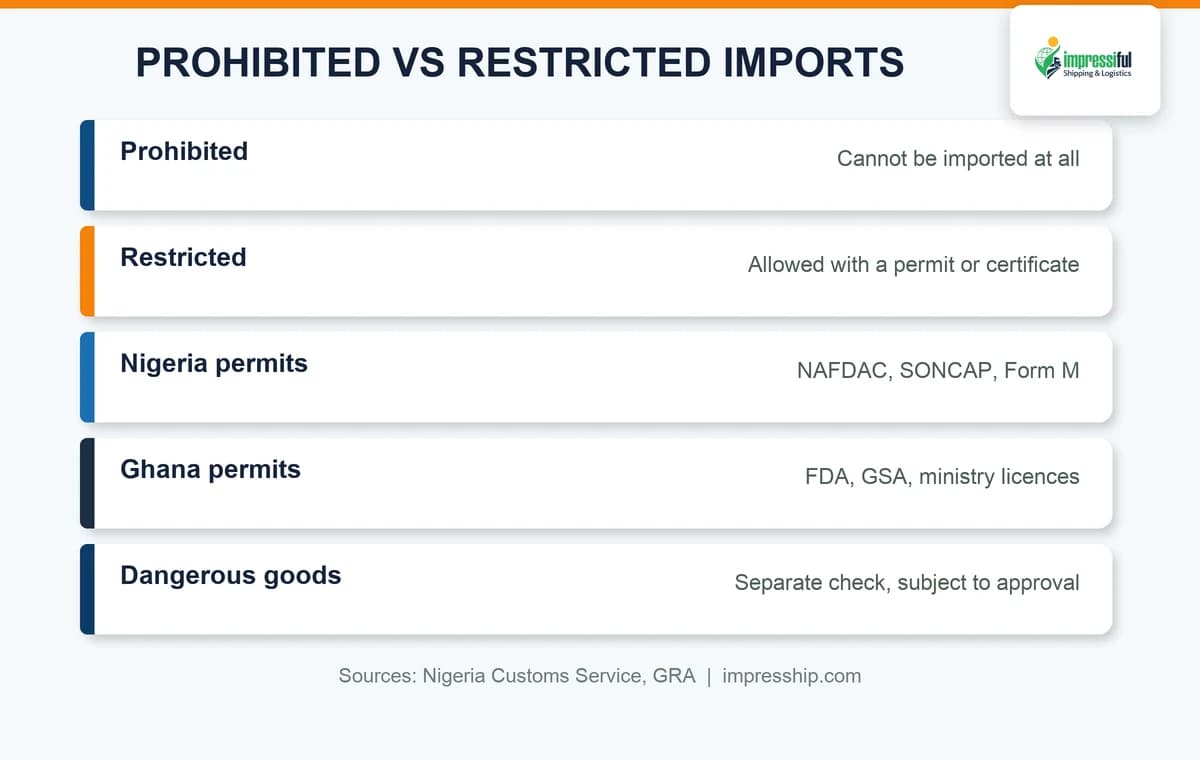
For most importers, the useful split is simple. Prohibited imports cannot enter at all and are seized or sent back, while restricted imports can enter once you hold the right permit, licence or certificate. Check both lists for every product line before you buy in Dubai, because our customs clearance service can only clear what the law allows into the country.
Prohibited vs restricted imports: the difference#
The two words sound alike, but they lead to very different outcomes at the port.
| Prohibited imports | Restricted imports | |
|---|---|---|
| What it means | The goods may not be imported at all | The goods may be imported with an approval |
| Typical reasons | Protecting local industry, health, security or public morals | Safety, quality, health or licensing control |
| What you need | Nothing will make them legal to import | A permit, licence, registration or product certificate before shipping |
| What happens if you ship anyway | Seizure, possible penalties, and delays for the rest of the shipment | Goods held until the approval is produced, with storage charges running |
| Nigeria examples | Bagged cement, retail soap and detergent, ball point pens | Food, drugs and cosmetics (NAFDAC), regulated products (SONCAP) |
| Ghana examples | Counterfeit currency, obscene articles, flick knives | Arms (Ministry of the Interior), mercury (Ministry of Mines), plants and soil (Ministry of Food and Agriculture) |
Need this handled end to end?
Tell us your lane and cargo profile and we'll come back with a routing plan and an all-in rate.
Nigeria import prohibition list: the 17 categories in 2026#
Nigeria's Revised Import Prohibition List (Trade) came in with the 2026 Fiscal Policy Measures and replaced the 2023 version. It applies to goods from outside ECOWAS, so it covers everything shipped from Dubai, whether the goods were made in the UAE, China or anywhere else. The categories are:
- Live or dead birds, including frozen poultry
- Pork and beef, plus other listed meat and offal
- Bird eggs, except hatching eggs of grandparent stock for breeding and research
- Refined vegetable oil (refined linseed, castor and olive oil are excluded, and crude vegetable oil is not banned)
- Cane or beet sugar with added flavouring or colouring, in retail packs
- Cocoa butter, cocoa powder and cocoa cakes
- Tomatoes and tomato paste or concentrate put up for retail sale
- Sweetened or flavoured waters and other non-alcoholic drinks (energy and health drinks are excluded)
- Bagged cement
- Listed medicines, including paracetamol, metronidazole, chloroquine, aspirin and multivitamin tablets and syrups, and intravenous fluids
- Waste pharmaceuticals
- NPK fertilisers
- Soaps and detergents in retail packs
- Corrugated paper and paperboard, and cartons, boxes and cases made from them
- Hollow glass bottles of more than 150 ml
- Corrugated sheets of iron or non-alloy steel 600 mm wide or more
- Ball point pens and their parts, including refills
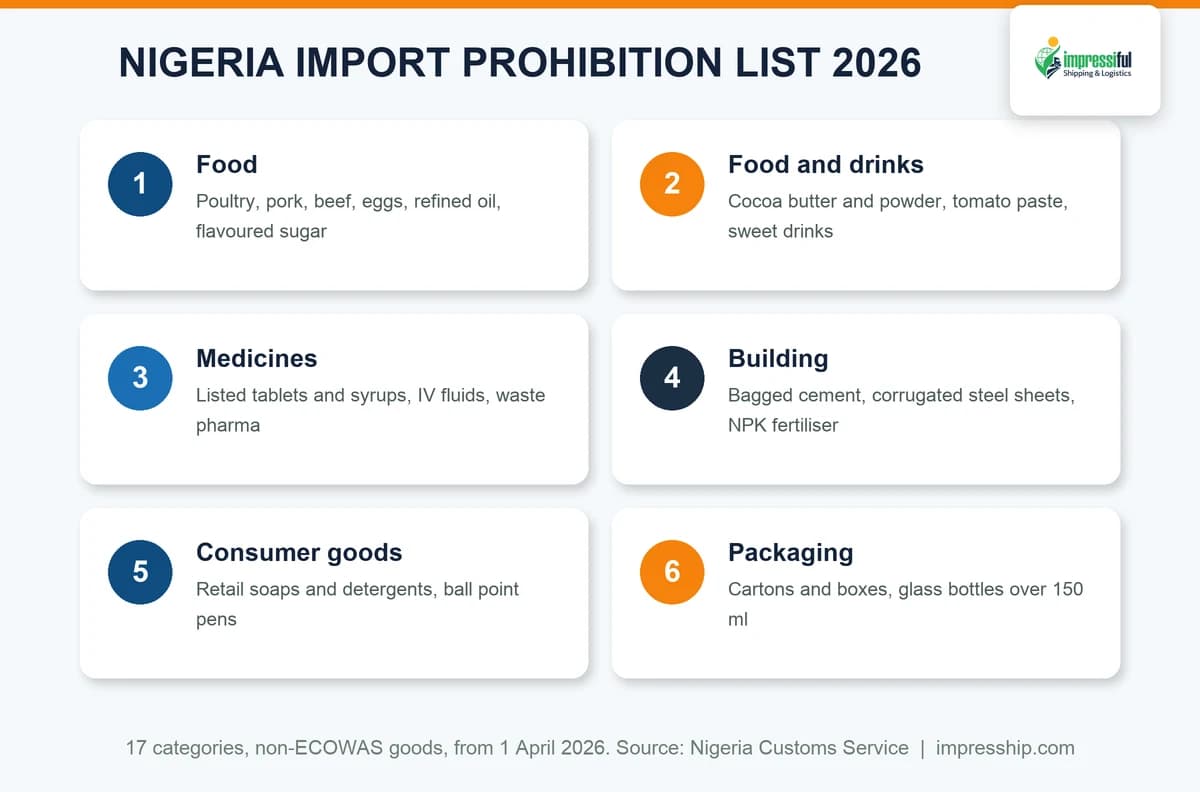
Some lines catch Dubai traders by surprise. Empty cartons and boxes count as imports in their own right (the cartons your goods are packed in do not), so packaging businesses need to check first. Glass bottles over 150 ml affect perfume and oil decanting businesses that buy empty bottles in bulk. Promotional pens and refills are banned too.
Older Nigerian lists you will still find online#
Search for Nigeria's banned items and you will find older versions that also list footwear, bags and suitcases, carpets, mosquito coils, textiles and used fridges and air conditioners. Some of these copies sit on official portals without a date. Those lines are not on the 1 April 2026 trade list, but other rules (standards, NAFDAC or later circulars) can still apply to them, so ask your clearing agent to confirm a product against the current list, not a copy you found in a forum.
Restricted imports in Nigeria: NAFDAC and SONCAP#
Most of what traders buy in Dubai is not banned in Nigeria, but much of it is regulated.
- NAFDAC. Food, drinks, drugs, cosmetics, medical devices and chemicals need registration or a permit from NAFDAC before they can be cleared and sold.
- SONCAP. Products regulated by the Standards Organisation of Nigeria, such as many electrical goods, building materials and auto parts, need a SONCAP certificate for each shipment.
- Form M. Almost every commercial import starts with a Form M, which your clearing agent raises through your bank. Our guide to customs clearance in Nigeria walks through Form M, SONCAP, NAFDAC and the PAAR in order.
Counterfeit and pirated goods are seized whatever the product, and used vehicles have their own age rule (widely reported as 12 years; check the current rule before you buy).
Prohibited and restricted imports in Ghana#
The Ghana Revenue Authority publishes two lists. The absolute prohibitions are short: diseased animals and carcasses, beads made of inflammable celluloid, raw coffee imported overland, substandard foreign coin, food declared unfit to eat, knuckle dusters, defamatory or obscene printed matter, counterfeit coins and notes, dangerous knives such as flick knives, and anything else another Ghanaian law bans.
The restricted list is where most commercial cargo is affected:
| Goods | What you need | Issued by |
|---|---|---|
| Arms, ammunition, explosives, handcuffs, key duplicating machines | Permit or licence | Ministry of the Interior |
| Mercury, rough diamonds | Licence or Kimberley Process certificate | Ministry of Mines |
| Plants, seeds, soil and plant products | Permit | Ministry of Food and Agriculture |
| Banknotes, coins and securities | Licence | Bank of Ghana |
| Gaming machines | Permit | Gaming Commission |
| Food, drugs, cosmetics and medical devices | Product registration or import permit | Food and Drugs Authority |
| High risk goods such as electrical appliances, toys and chemicals | Conformity check before release | Ghana Standards Authority |
Ghana has also banned imports of used fridges, freezers and air conditioners since 2013 under the Energy Commission's appliance regulations (L.I. 1932), so second-hand cooling units from Dubai are a poor bet. Our guide to customs clearance in Ghana covers how these permits fit into the ICUMS declaration at Tema.
Dangerous goods are a separate check#
A product can be legal to import and still be dangerous goods for transport. Perfume, aerosols, power banks and anything with a lithium battery ship under the IMDG Code at sea. We ship dangerous goods, but every dangerous goods shipment is subject to approval, so declare them when you ask for a quote. Our guide to dangerous goods shipping to West Africa lists the everyday items that count.
How to check a product before you buy in Dubai#
- Find the HS code. Every list above works by tariff line. Our guide to HS codes for importers shows how to classify a product.
- Check the prohibition list for your country. Use the official list, and note the exceptions (retail pack sizes, net content, excluded oils or drugs).
- Check for permits. NAFDAC or SONCAP in Nigeria; FDA, Standards Authority or a ministry permit in Ghana.
- Get the supplier's description right. The invoice description should match the HS code. Vague lines such as "assorted goods" invite an examination.
- Ask before you pay. Send us the product list and we will flag anything that looks banned, restricted or dangerous before it reaches the warehouse.
Then work out what the legal goods will cost to land. The import duty calculator gives an estimate, and our Nigeria import duty calculation guide builds a full bill line by line. If you are buying at Dragon Mart, our Dragon Mart buying guide covers what to get from each shop.
What happens if banned goods are found#
At the port, prohibited goods are seized and the importer can face penalties under each country's customs law. Restricted goods without a permit are held until the permit is produced or the goods are re-exported, and port storage keeps running while they wait. In a shared container (LCL), one consignee's problem can slow the release of everyone else's cargo, which is why we check product lists before loading. We handle customs clearance at destination through our partner agents, or you can use your own agent.
For a wider view of the routes, documents and costs on each lane, see our guide to shipping from the UAE to Africa.
Frequently asked questions#
What are the import restrictions in Ghana?#
Ghana restricts goods such as arms and explosives (Ministry of the Interior), mercury (Ministry of Mines), plants and soil (Ministry of Food and Agriculture) and currency (Bank of Ghana), and food, drugs and cosmetics need Food and Drugs Authority approval. High risk goods such as electrical appliances and toys also go through Ghana Standards Authority checks. The full list is on the GRA prohibitions and restrictions page.
What are the prohibited goods under the customs Act?#
In Ghana, the customs law bans goods such as counterfeit currency, obscene prints and books, dangerous knives, knuckle dusters, infected animals and food unfit to eat. In Nigeria, the trade prohibition list adds 17 categories of goods from outside ECOWAS, including bagged cement, retail soaps and detergents, and ball point pens. Our customs clearance in Nigeria guide explains how the list is applied at Lagos.
What foods are banned from importing into Nigeria?#
Nigeria's 2026 list bans frozen poultry and other birds, pork and beef, bird eggs, refined vegetable oil (except olive, linseed and castor oil), flavoured sugar in retail packs, cocoa butter and powder, tomatoes and retail tomato paste, and sweetened or flavoured non-alcoholic drinks. Energy and health drinks are excluded from the drinks ban. Food that is allowed still needs NAFDAC approval before it can be cleared.
What are banned goods?#
Banned goods are products that the law does not allow into a country at all, whatever permits or paperwork the importer has. They differ from restricted goods, which can enter once the right approval is in place. Banned goods are usually seized at the port, and in a shared container they can delay everyone else's cargo too.
What is the difference between prohibited and restricted goods?#
Prohibited goods cannot be imported under any conditions, while restricted goods can be imported once you hold a permit, licence or certificate, such as NAFDAC registration in Nigeria or a ministry permit in Ghana. Restricted goods that arrive without their approval are held until it is produced. Our dangerous goods guide covers the separate rules for perfume, aerosols and batteries.
Send your cargo details for a same-day quote#
Send us your product list with HS codes if you have them, the quantities and your destination port. We will flag anything that looks prohibited, restricted or dangerous, confirm the freight and send a dated, itemised quote.
Request a same-day quote or message us on WhatsApp with your cargo details.