
Documents Required for Clearing Goods in Kenya: The 2026 Checklist for Cargo from Dubai
The documents required for clearing goods in Kenya in 2026: a 12 document checklist, the new certificate of origin, ACD, export declaration and digital marine insurance rules, the consolidated cargo limits, papers for personal effects and transit, and the iCMS steps.
Short answer: The documents required for clearing goods in Kenya are the commercial invoice, packing list, bill of lading, a certificate of origin, the Import Declaration Form (IDF) and the importer's KRA PIN. Since 2026 you also need an ACD reference code, an export declaration from the country of export and a digital marine cargo insurance certificate.
Most lists of the documents required for clearing goods in Kenya were written before 2026, and Kenya has added four new requirements in the past eighteen months. Cargo that arrives at Mombasa without them can now be blocked from clearance in KRA's Integrated Customs Management System (iCMS). This guide gives the full 2026 checklist, who provides each document and when, the extra rules for shared container cargo, and the papers for personal effects and transit goods, each taken from a dated KRA notice.
Documents required for clearing goods in Kenya: the 2026 checklist#
| # | Document | Who provides it | When it is needed |
|---|---|---|---|
| 1 | Commercial invoice | Your supplier or shipper | Before loading |
| 2 | Packing list | Your supplier or shipper | Before loading |
| 3 | Bill of lading (or telex release) | The carrier, through your forwarder | After loading |
| 4 | ACD reference code on the bill of lading | The exporter, on acd.kra.go.ke | At loading (containerised cargo) |
| 5 | Export declaration from the country of export | The exporter, from UAE customs for cargo from Dubai | At export |
| 6 | Certificate of origin | A competent authority in the exporting country | Before the goods arrive |
| 7 | Import Declaration Form (IDF) | The importer, through the clearing agent | Before the entry |
| 8 | KRA PIN of the importer | The importer | Before the entry |
| 9 | Digital marine cargo insurance certificate | An insurer licensed by Kenya's Insurance Regulatory Authority (IRA) | Before the entry is lodged |
| 10 | Certificate of conformity (PVoC) | An appointed verification agent | Before shipment, for regulated goods |
| 11 | Import standards mark | The importer, where it applies | Before release |
| 12 | Import permits or licences | The agency that controls the goods | Before shipment, for controlled goods |
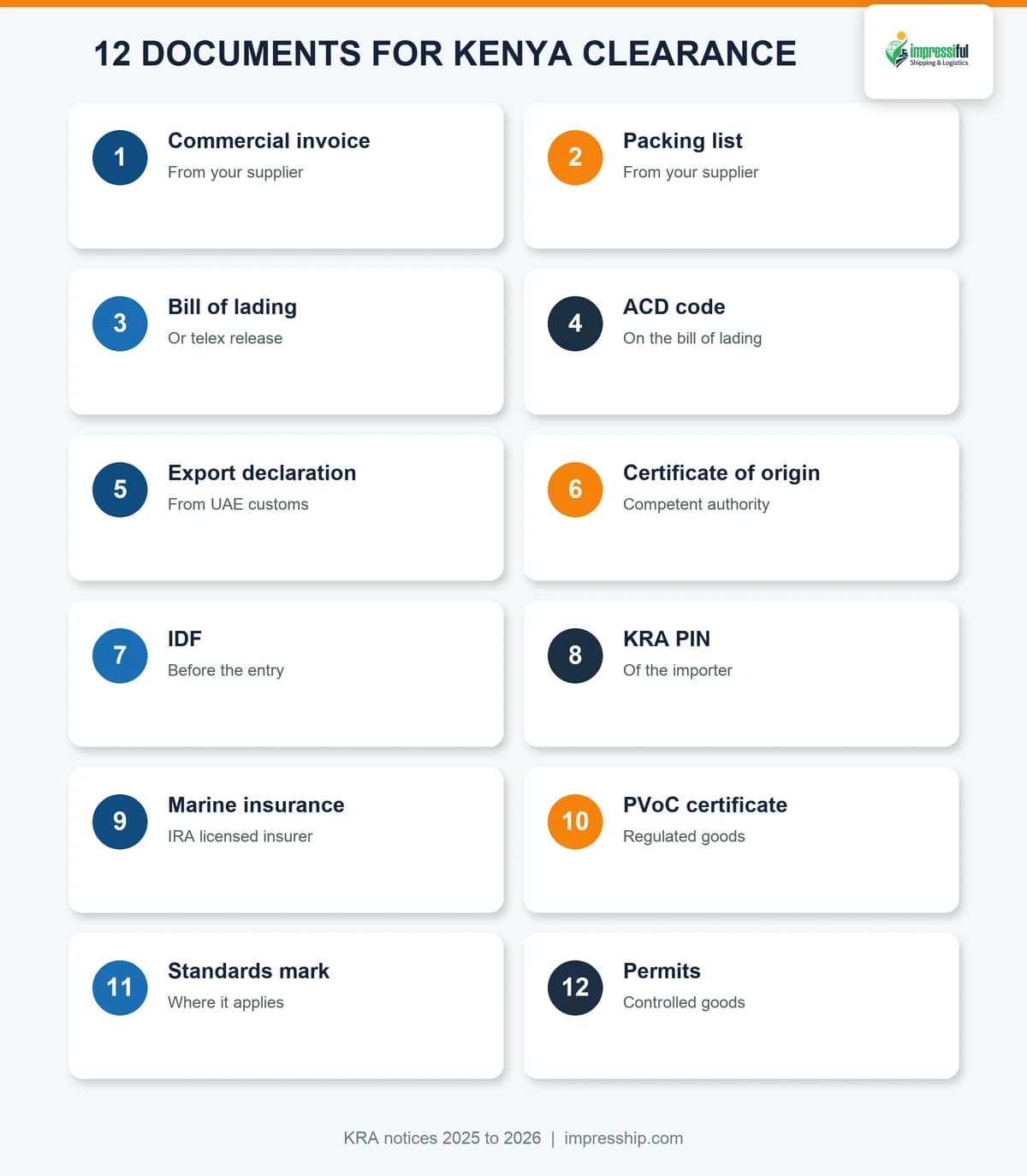
The first eight cover almost every commercial shipment. KRA's own how to import page still lists the older core set (IDF, customs entry, certificate of conformity for regulated products, import standards mark where it applies, commercial and pro forma invoices) and says imports must be cleared through a licensed customs clearing agent. The newer requirements below come from KRA public notices.
Need this handled end to end?
Tell us your lane and cargo profile and we'll come back with a routing plan and an all-in rate.
What changed in 2025 and 2026#
| Date | Requirement | What it means for you |
|---|---|---|
| 1 July 2025, enforced from 1 October 2025 | Mandatory certificate of origin | Every consignment needs a certificate of origin from a competent authority in the exporting country |
| 3 August 2026 | Advance Cargo Declaration (ACD) | The exporter uploads the draft bill of lading, commercial invoice, freight invoice and export declaration, and the ACD code is endorsed on the bill of lading |
| September 2026 | Export declaration (Section 23B, Tax Procedures Act) | KRA confirmed on 7 September 2026 that an export declaration is required to clear imported goods |
| 13 September 2026 | Importer details for consolidated cargo | Each importer's name, PIN, ID number, phone, item description and value must be declared |
| 1 November 2026 | Digital marine cargo insurance | The certificate must come from an IRA licensed insurer and reach iCMS before the declaration, or clearance is blocked |
| 5 November 2026 | Exclusion list for consolidated cargo | Some goods cannot clear under the consolidated cargo framework for consignments under KES 2 million |
Certificate of origin. Under Section 44A of the Tax Procedures Act, all consignments must carry a certificate of origin. KRA's certificate of origin notice allows, case by case, an origin declaration, an export permit, a customs export declaration or a PVoC certificate when the certificate is not available, and exempts used goods, personal effects, samples of no commercial value and some postal and courier parcels.
ACD code. KRA's Advance Cargo Declaration notice applies to all containerised cargo for Kenyan ports. Because the export declaration is one of the four uploads, the UAE export paperwork now has to be ready before the cargo sails.
Marine cargo insurance. KRA's marine cargo insurance notice of 22 October 2026 says consignments without a valid policy from an IRA licensed insurer, sent through the Digital MCI System to iCMS, will be blocked from clearance. Arrange this with your clearing agent or a Kenyan insurer before the goods arrive.
Shared container cargo: the consolidated cargo rules#
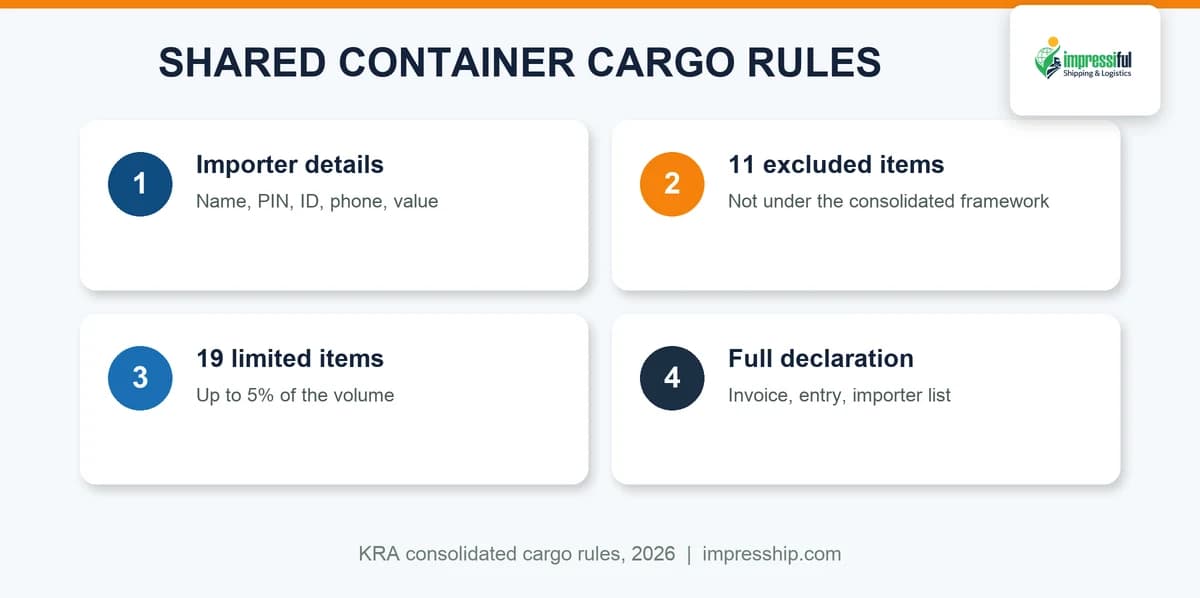
If your goods travel in shared container space (LCL), they are usually cleared as part of a consolidated shipment, and two recent KRA rules apply:
- Importer details. The consolidator must declare every importer's name, KRA PIN, ID number, phone number, item description and value. Have these ready when you book.
- Excluded goods. KRA's exclusion list names 11 items that cannot clear under the consolidated framework for consignments under KES 2 million, including assorted foodstuff, complete kitchens, designer brand goods, plant and machinery (small machinery excepted), smartphones and watches, used clothes and shoes, doors, televisions, car accessories, entertainment equipment and sanitary ware.
- Limited goods. A further 19 items, such as ready made garments, fabrics, cables, cosmetics, computer and phone accessories, may travel as consolidated cargo only if they stay under 5 percent of the total volume, are fully declared and are valued at customs unit values.
If your goods are on either list, tell us before booking so the shipment can be planned and declared on its own. Our guide on how much 1 CBM from Dubai costs shows the shared container estimate to Mombasa, about USD 376 per CBM in sea freight.
Documents by type of shipment#
| Shipment | Extra documents |
|---|---|
| Commercial goods for sale in Kenya | The 2026 checklist above, plus permits for controlled goods |
| Personal effects of returning residents | Passport (and the previous one if issued in the last 2 years), KRA PIN certificate, a valued inventory in 3 copies numbered by box, and an authority letter naming a licensed clearing agent |
| Personal effects of new arrivals on a contract | Proof of a contract of at least two years and the work permit; used household goods must have been owned and used for at least a year and arrive within three months of the work permit |
| Transit cargo for Uganda, Rwanda or South Sudan | A transit declaration secured by a customs bond; the cargo moves under electronic cargo tracking seals |
KRA's importing goods page sets out the conditions for duty free personal effects, including two years abroad for returning residents and import within three months. For cargo heading inland, our guide to shipping to landlocked African countries covers the transit routes.
Shipping to Mombasa?
Send the goods, the HS codes if you have them, the CBM and gross weight, and we will check the paperwork your shipment needs and quote sea freight to Mombasa.
How clearance works on iCMS#
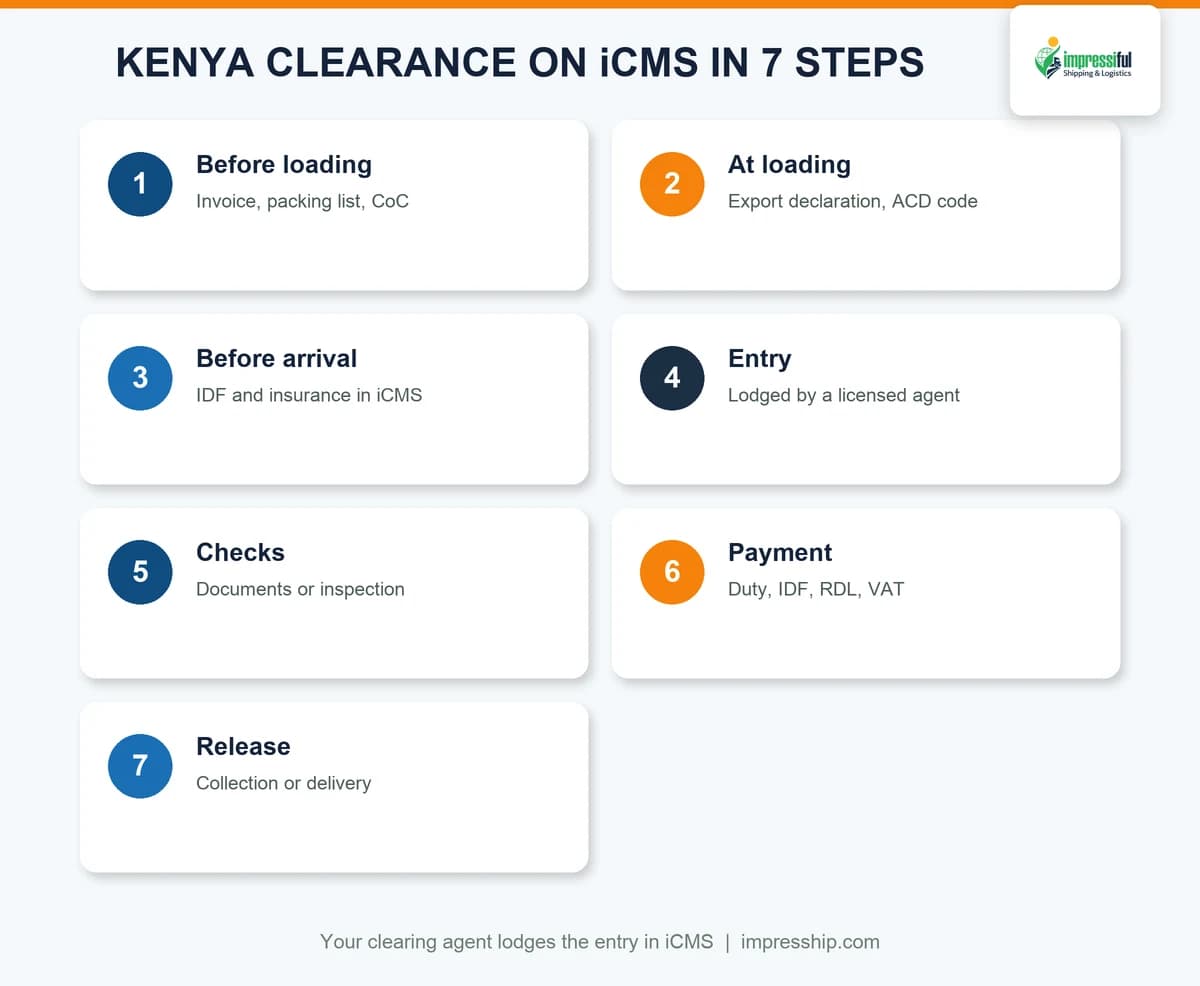
- Before loading. Your supplier prepares the commercial invoice and packing list; regulated goods get their certificate of conformity in the UAE.
- At loading. The exporter files the UAE export declaration and obtains the ACD code, which goes on the bill of lading.
- Before arrival. The importer's IDF is in place and the marine cargo insurance certificate is sent to iCMS.
- Entry. A licensed clearing agent lodges the customs entry in iCMS with the full document set.
- Checks. KRA may release the entry on the documents, ask for a document review or inspect the goods; partner agencies may check regulated goods.
- Payment. Import duty, the IDF fee, the Railway Development Levy and VAT are paid. Our Kenya import duty calculation guide shows the formula, and the EAC CET 2022 tariff gives the duty rate for each HS code.
- Release. The goods are released for collection or onward delivery.
Mistakes that hold cargo at Mombasa#
- Names that do not match. The consignee on the bill of lading must match the importer's KRA PIN registration exactly. Our bill of lading guide lists the fields to check on the draft.
- Vague descriptions and wrong HS codes. "Assorted goods" invites a query. See our guide to HS codes for importers.
- No certificate of origin or export declaration. Both now come from the exporting side, so they cannot be fixed easily once the ship has sailed.
- Insurance from the wrong insurer. A policy that is not from an IRA licensed insurer and not on the Digital MCI System does not meet the 1 November 2026 rule.
- Late documents. Send draft copies to your clearing agent as soon as the booking is confirmed. Our customs clearance documents guide covers the general checks.
How we help on the Dubai to Mombasa lane#
We check your invoice and packing list against the cargo, we provide telex release bills of lading for sea shipments, and for products that contain chemicals or are dangerous goods we work with your supplier to get the MSDS and the certificate of origin when applicable.
With the Strait of Hormuz closed to normal traffic, sea cargo currently loads at one of our partner ports: Sohar (most used) or Salalah in Oman, Jeddah, Khor Fakkan or Fujairah (why the routing changed); we plan on about 22 to 40 days at sea to Mombasa.
We handle customs clearance at destination through our partner agents, or you can use your own clearing agent; our checklist for the best clearing agent in Kenya lists what to ask. Delivery inland from Mombasa is arranged on request.
Frequently asked questions#
What documents are required to clear customs?#
For goods imported into Kenya, customs needs the commercial invoice, packing list, bill of lading, certificate of origin, the Import Declaration Form and the importer's KRA PIN, lodged in iCMS by a licensed clearing agent. Since 2026 containerised cargo also needs an ACD code, an export declaration and a digital marine cargo insurance certificate, and regulated goods need a PVoC certificate.
What are the customs clearance procedures in Kenya?#
A licensed clearing agent lodges the customs entry in KRA's iCMS with the shipping, origin and insurance documents. KRA then releases the entry, reviews the documents or inspects the goods, the importer pays import duty, the IDF fee, the Railway Development Levy and VAT, and the goods are released for collection or onward transit.
Send your cargo details for a same-day quote#
Tell us what you are shipping from Dubai to Kenya, the HS codes if you have them, the CBM and gross weight and the delivery town. We will check which documents the shipment needs, quote sea freight to Mombasa with the charges spelled out, and handle customs clearance through our partner agents or hand over to your own clearing agent. All prices are estimates that depend on the product and are confirmed when you book.
Request a same-day quote or message us on WhatsApp with your cargo details.