
Telex Release: How to Collect Your Cargo at Tema or Lagos Without the Original Bill of Lading (2026)
Telex release explained for importers shipping from Dubai to Ghana and Nigeria: what it is and is not, the 7 steps from surrender in the UAE to the gate at Tema or Lagos, when to use it, 5 checks against release fraud and what it costs.
Short answer: A telex release lets you collect your cargo without the paper bill of lading. The shipper hands the full set of originals back to the shipping line at the port of loading, and the line tells its agent at Tema or Lagos to release the goods to the consignee. You pay the line's local charges, collect a delivery order and clear customs.
A sea shipment from Dubai to West Africa takes about 30 to 48 days on our estimates, yet importers still lose days at the port because the paper bill of lading is stuck in a courier bag or at a bank. The telex release was built to remove that wait. It is also one of the most misunderstood steps in shipping: insurers of ship agents have reported cargo worth USD 250,000 released by mistake after a telex release instruction was cancelled and nobody updated the system.
This telex release guide explains what the term means, the 7 steps from surrender in the UAE to the gate at Tema or Lagos, when to use it and when not to, the fraud checks that protect you and how it works on our shipments.
What a telex release is, and what it is not#
The name is historic. Lines once sent the release message by telex; today it travels by email or inside the carrier's own system, but the idea has not changed. The TT Club describes it as a process: the shipper returns all the original bills of lading to the carrier, usually at the port of loading, and the carrier instructs its office at destination to deliver to the consignee the shipper named.
Three points are often confused:
- A telex release is still a bill of lading. The line issues the bill first; the originals are then stamped "surrendered" or "telex release" and kept at origin.
- It is not a sea waybill. A sea waybill is never a title document, so there is nothing to surrender. A telex release always concerns a bill of lading.
- It is not a switch bill. A switch bill replaces the originals with a new set showing changed details; a telex release ends the paper trail.
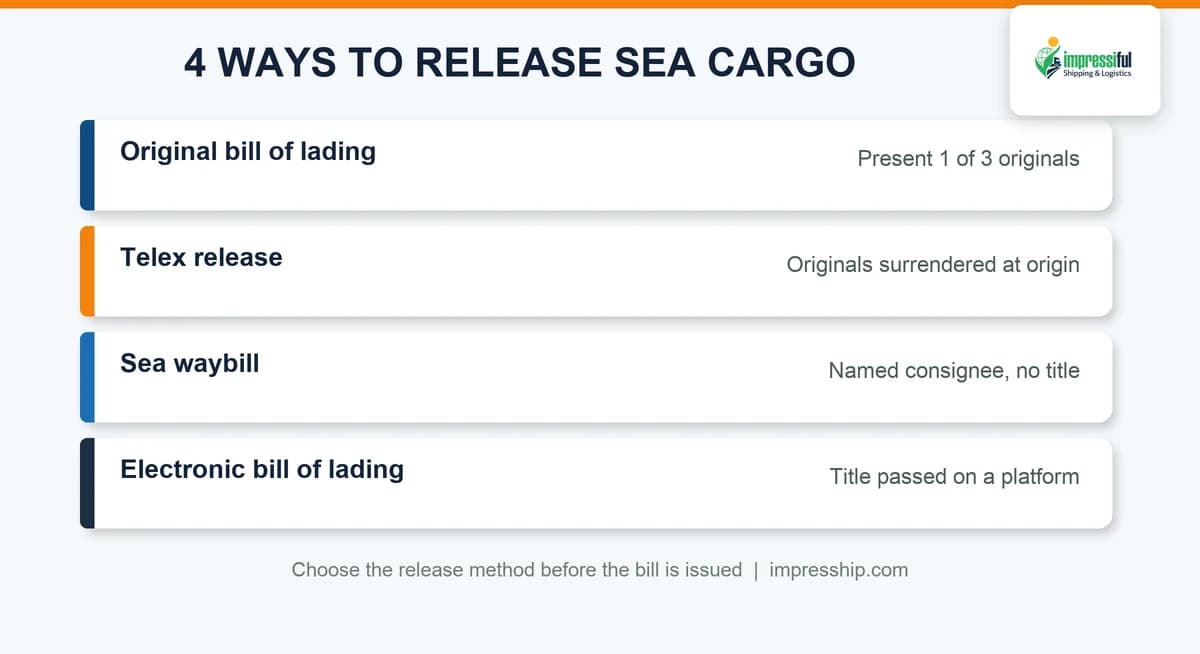
| Release method | What the consignee shows at Tema or Lagos | When the cargo can be released | Main risk |
|---|---|---|---|
| Original bill of lading | One endorsed original from the set of three | When the original arrives by courier or bank | Late or lost originals, storage charges |
| Telex release | Identity and the line's release confirmation | As soon as the line confirms the surrender | Fake or unclear release emails |
| Sea waybill | Identity as the named consignee | On arrival | Shipper gives up control before payment |
| Electronic bill of lading | Title passed on an approved platform | When the platform transfer completes | Not every bank, line or agent accepts it |
Our guide to the bill of lading explained covers the types of bill and the fields to check on a draft; this guide covers the release itself.
Need this handled end to end?
Tell us your lane and cargo profile and we'll come back with a routing plan and an all-in rate.
How a telex release works: 7 steps from Dubai to Tema or Lagos#
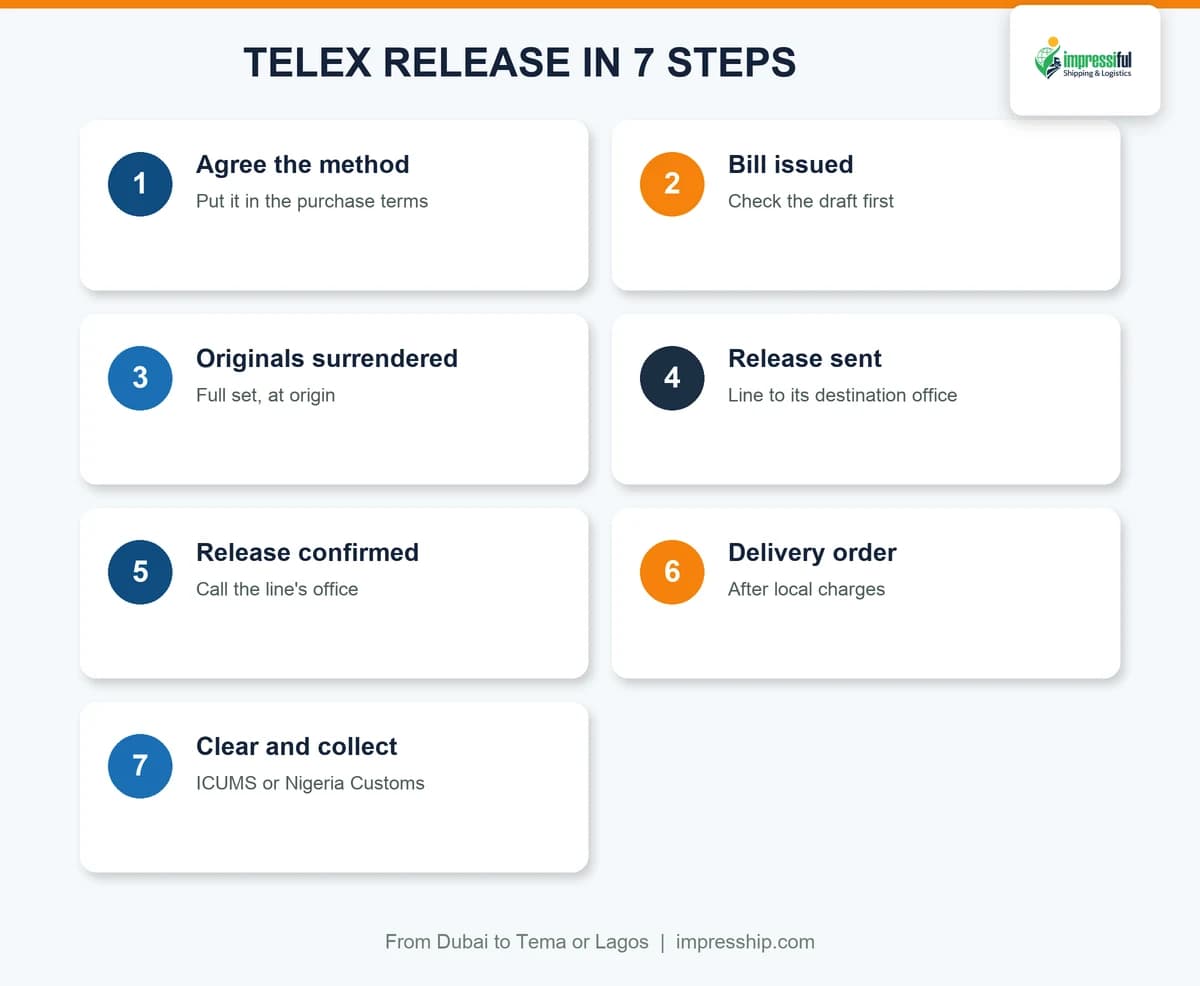
- Agree the release method with your supplier. Put "telex release" in the purchase terms, together with the Incoterm, so everyone knows who pays the freight and when the originals are surrendered. Our FOB vs CIF guide explains who books what.
- The goods load and the line issues the bill of lading. Check the draft first: consignee name, notify party, port of discharge and the cargo description must match the commercial invoice and packing list.
- The shipper surrenders the full set of originals. Usually three originals, handed back to the line at origin with a written instruction naming who may collect. A missing original stops the process.
- The line sends the release to its agent at destination. The bill is marked surrendered, and the release goes by email or through the carrier's system to its office at Tema or Lagos.
- You or your clearing agent confirm the release with the line's office. Ask the destination office, on a number or address you already trust, to confirm that the telex release for your bill of lading number is on their system.
- Pay the local charges and collect the delivery order. The line's agent issues the delivery order once its charges, and any freight payable at destination, are paid.
- Clear customs and take delivery. In Ghana the declaration goes through ICUMS (our ICUMS duty guide shows how to check the figure first); in Nigeria your agent files it at Apapa, Tin Can or Lekki, where the B'Odogwu customs system is being rolled out. With duty paid and the release granted, the terminal lets the cargo out.
Steps 5 and 6 are where most delays happen. If the line's office has no record of the surrender, nothing moves, so ask your supplier for a copy of the surrendered bill and the line's confirmation as soon as step 3 is done.
When to use a telex release, and when not to#
| Situation | Best option | Why |
|---|---|---|
| You have paid the supplier in full | Telex release | No reason to wait for paper; collect as soon as the cargo lands |
| Payment by letter of credit | Original bill of lading | The bank needs the original as security |
| New supplier, balance due on documents | Original bill of lading | The original is your supplier's security until you pay |
| Related companies or a long trusted supplier | Telex release or sea waybill | Speed matters more than control |
| Goods sold on while at sea | Original order bill | Title has to pass from buyer to buyer |
| Urgent stock or perishable goods | Telex release | Removes courier time from the critical path |
For a supplier, surrendering the originals means giving up control of the goods, so most will only agree once they are paid. For you as the buyer, the telex release only helps if the surrender really happened: a scanned "surrendered" stamp from the supplier is not the same as the line's own confirmation.
Telex release fraud: 5 checks that protect your cargo#
Insurers of ship agents report two recurring problems. The ITIC describes vague release messages that staff read as instructions they were not, and faked emails made to look as if they came from the load port agent. Five checks close most of the gaps:
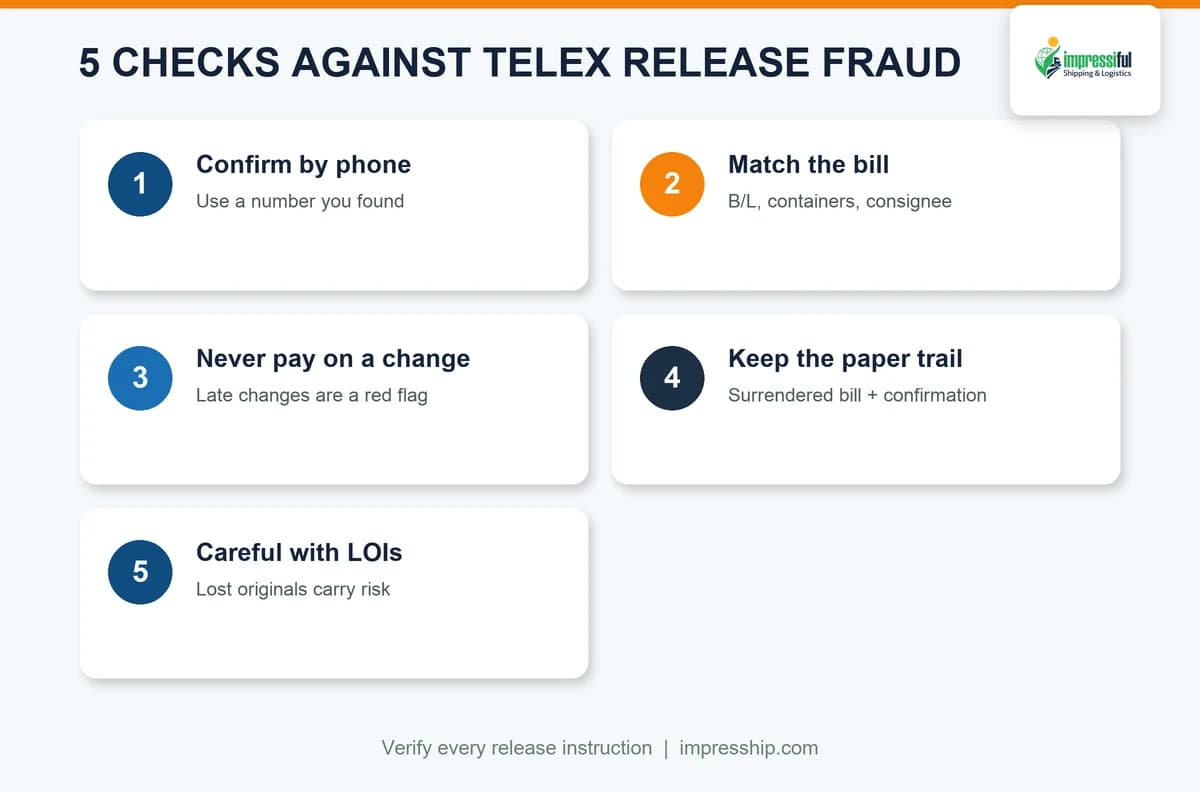
- Confirm by phone. Call the line's office on a number you found yourself, never one in the email asking for action.
- Match the bill number. The release must quote your bill of lading number, container numbers and consignee exactly.
- Never pay on a change. A late email changing the consignee, the bank account or the release terms is the classic fraud pattern. Stop and verify.
- Keep the paper trail. Ask your supplier for the surrendered bill and the line's confirmation, and file them with your invoice.
- Do not accept a letter of indemnity lightly. If originals are lost, lines may release against a letter of indemnity, often backed by a bank. The UK P&I Club explains why such releases carry real risk for everyone involved.
What a telex release costs#
Shipping lines charge a fee at origin to process a surrendered bill, and their agents charge local charges at destination before issuing the delivery order. Both are set by each line, change over time and are not part of our freight estimates. In Nigeria, shipping line local charges are overseen by the Nigerian Shippers' Council, which ordered lines to suspend newly approved tariffs in March 2026, as ThisDay reported. Ask for the surrender fee and the destination charges in writing with your quote.
How telex release works on our shipments#
We provide telex release bills of lading on our sea shipments from the UAE. The bill of lading comes from the shipping line itself; we do not issue our own house bills. Once the originals are surrendered, the line releases the cargo to the consignee at destination, so nobody waits for couriered papers.
Our sea freight estimates are about USD 340 per CBM to Tema and about USD 376 per CBM to Lagos in shared container space, with small heavy loads charged by weight band. Transit is about 30 to 48 days, and sea cargo currently loads at one of our partner ports: Sohar (most used) or Salalah in Oman, Jeddah, Khor Fakkan or Fujairah. Estimates depend on the goods; Dubai pickup, destination charges, duty and clearance are extra, and the shipping calculator gives a figure for your load. We handle customs clearance at destination through our partner agents, or hand the documents to your own agent. The full document set is in our guide to customs clearance documents for Africa.
Need cargo released fast at Tema or Lagos?
Send your goods, cartons and weight, and we will quote sea freight from the UAE with a telex release bill of lading from the shipping line.
Frequently asked questions#
What is telex release BL vs Original BL?#
With an original bill of lading, the consignee must hand one endorsed paper original to the shipping line's agent at Tema or Lagos before a delivery order is issued. With a telex release, the full set of originals is surrendered at the port of loading and the line releases the cargo to the named consignee on its own confirmation, so nothing travels by courier. The original keeps the shipper's control until payment, while the telex release trades that control for speed, as our bill of lading guide explains.
How long does a telex release take?#
There is no fixed time, because the release message itself is electronic. The wait sits at the two ends: the shipper surrendering the full set of originals and paying any fees at origin, and the line's destination office recording the release before your agent pays the local charges. Ask your supplier to surrender as soon as the vessel sails and you have paid, and ask the line's office at Tema or Lagos to confirm the release on its system well before arrival.
Is telex release the same as surrender BL?#
In practice, yes: a "surrendered" bill of lading is the original set handed back to the line, and the telex release is the line's message telling its destination agent the cargo can be released. The TT Club notes the surrendered originals are stamped "surrendered" or "telex release" and kept at origin. It is different from a sea waybill, which is never a title document, and from a switch bill, which replaces the originals with a new set. We provide telex release bills of lading from the shipping line on our ocean freight shipments.
Send your cargo details for a same-day quote#
Tell us what you are shipping, the number and size of cartons, the gross weight, the destination port and how you want the cargo released. We will quote sea freight from the UAE with every line listed, arrange a telex release bill of lading from the shipping line and handle customs clearance through our partner agents or hand over to your own clearing agent. All prices are estimates that depend on the goods and are confirmed when you book.
Request a same-day quote or message us on WhatsApp with your cargo details.