
EAC CET 2026: Kenya Import Duty Changes in the 2026/27 EAC Gazette
EAC CET 2026 explained for Kenya importers: the four CET bands, what Legal Notice EAC/160/2026 changed for 2026/27, 30 Kenya rate changes with HS codes, the CET amendments for every partner state and a worked duty example on furniture from Dubai.
Short answer: The EAC CET 2026 keeps the four bands of 0, 10, 25 and 35 percent. What changed for 2026/27 is the EAC Gazette of 30 June 2026 (Legal Notice EAC/160/2026), which lets Kenya charge different rates on listed goods for one year, for example 45 percent on furniture, 35 percent on vehicles and 25 percent on mobile phones.
Ask an AI assistant about the EAC CET 2026 and you usually get two facts: furniture at 45 percent and mobile phones at 25 percent. Both are right, but the Kenya entries in the 2026/27 Gazette run to well over a hundred lines, from televisions and cables to steel, soap and rice. This guide reads the Gazette itself and lists the 30 Kenya changes that matter most for goods shipped from Dubai, the changes that apply across the whole East African Community, and how to check the rate for your own HS code.
EAC CET 2026: the four bands still apply#
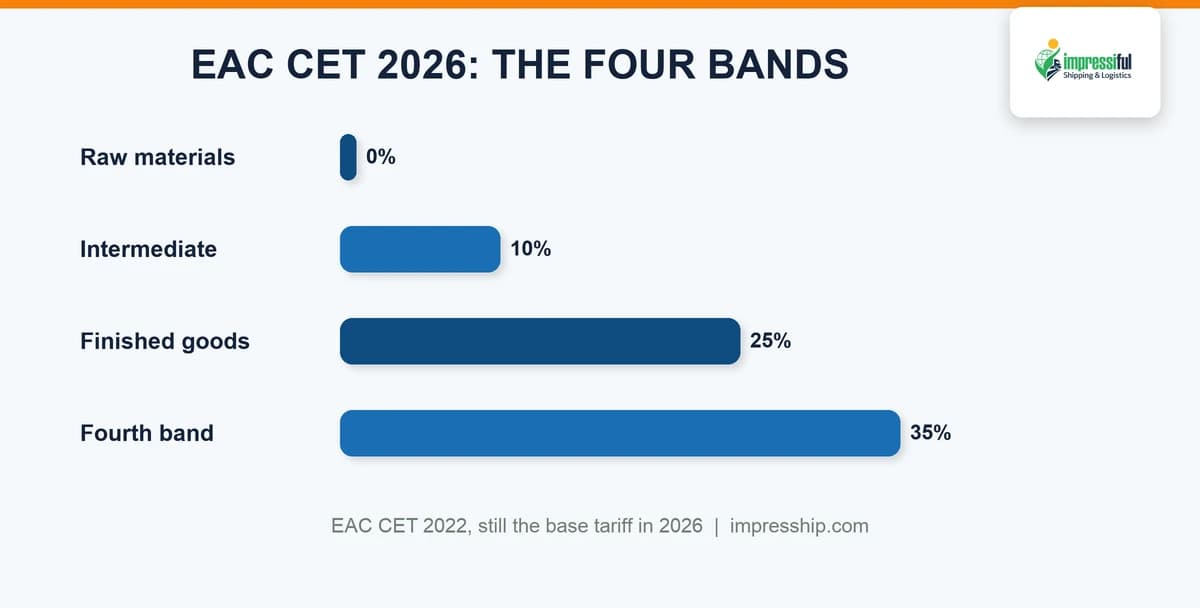
The East African Community Common External Tariff (EAC CET) is the import duty schedule shared by the partner states, including Kenya, Uganda, Tanzania, Rwanda and Burundi. The 2022 version, published by the Kenya Revenue Authority, is still the base tariff in 2026:
| CET band | Typical goods | Import duty rate |
|---|---|---|
| Raw materials and capital goods | Machinery, many medicines, most raw materials | 0 percent |
| Intermediate goods | Inputs and parts used by manufacturers | 10 percent |
| Finished goods | Most consumer products | 25 percent |
| Fourth band | Finished goods the region wants to protect | 35 percent |
| Sensitive items | Rice, sugar, some textiles and other listed goods | Higher rates, sometimes a USD amount per kg or tonne |
The import duty rate for a product depends on its HS code. Duty is charged on the customs value (cost, insurance and freight), and Kenya adds the Import Declaration Fee, the Railway Development Levy and VAT on top. Our Kenya import duty calculation guide works through all four.
Need this handled end to end?
Tell us your lane and cargo profile and we'll come back with a routing plan and an all-in rate.
What the 30 June 2026 Gazette changed#
Each year the EAC Council of Ministers publishes the budget measures in the EAC Gazette. For 2026/27 the key notice is Gazette Vol. AT 1 No. 16 of 30 June 2026, Legal Notice EAC/160/2026, "Approved measures on import duty rates in the EAC CET". It does three things:
- Stays of application. A partner state is allowed to "stay" the common rate on a product and apply its own rate for one year. Most Kenya changes work this way, so they are temporary and lapse after a year unless a later Gazette renews them.
- Sensitive item listings. Some goods are made "sensitive" for one country, which allows a rate above 35 percent. Furniture is now sensitive for Kenya.
- Amendments to the CET itself. A short table (Table X) changes the common rate for every partner state, not just Kenya.
Many Kenya rates are now written as "35 percent or USD 350 per tonne, whichever is higher". That second figure matters for heavy, low value goods such as steel, board and rice: customs works out both and charges the higher one.
Kenya import duty changes in the EAC CET 2026: 30 lines#
These are the Kenya entries in Legal Notice EAC/160/2026 that come up most on cargo from Dubai. "CET rate" is the common rate the Gazette says Kenya is setting aside; where the Gazette does not state it, the column says so. Every Kenya rate here applies for one year.
| # | Goods | HS code | CET rate | Kenya rate 2026/27 |
|---|---|---|---|---|
| 1 | Furniture (now sensitive for Kenya) | 9403.10 to 9403.70 | 35% | 45% |
| 2 | Motor vehicles currently at 25% | 87.02, 87.03, 87.04 | 25% | 35% |
| 3 | Mobile phones | 8517.13, 8517.14 | 0% | 25% |
| 4 | Television sets | 8528.72.90 | 25% | 35% |
| 5 | Lithium ion batteries | 8507.60 | 25% | 0% |
| 6 | Lead acid starter batteries | 8507.10 | 25% | 35% |
| 7 | Insulated wire and cable | 85.44 (not 8544.70) | 25% | 35% |
| 8 | Optical fibre cables | 8544.70 | 0% | 10% |
| 9 | Switches up to 1,000 volts | 8536.50 | 10% | 35% |
| 10 | Distribution boards up to 1,000 volts | 8537.10 | 10% | 25% |
| 11 | Stone tiles | 6802 | 25% | 35% or USD 2 per m2 |
| 12 | Plastic tableware and household articles | 3924.10, 3924.90 | 25% | 35% |
| 13 | Printed poly bags, sacks and bags | 3923.21, 3923.29 | 25% | 35% |
| 14 | Handbags of plastic or textile | 4202.22 | 25% | 35% |
| 15 | Leather suitcases and travel goods | 4202.11 | 25% | 35% |
| 16 | Clothing (chapters 61 and 62) | 61, 62 | not stated | 35% |
| 17 | Fabrics now at 25% (chapters 50 to 60) | 50 to 60 | 25% | 25% or USD 0.75 per kg |
| 18 | Bed, table, toilet and kitchen linen | 6302 | 25% | 25% or USD 0.75 per kg |
| 19 | Worn clothing | 6309.00.10 | 35% or USD 0.40 per kg | 35% or USD 0.20 per kg |
| 20 | Soap | 3401 | not stated | 35% or USD 500 per tonne |
| 21 | Stainless steel cookware | 7323.93 | 25% | 35% |
| 22 | LPG gas cylinders | 7311.00.10 | 0% | 35% |
| 23 | LPG stoves | 7321.11 | 10% | 25% |
| 24 | Steel U, I, H, L and T sections | 7216.31 to 7216.40 | 0% | 35% or USD 350 per tonne |
| 25 | Screws and bolts | 7318.15 | 25% | 35% or USD 350 per tonne |
| 26 | Particle board and OSB | 4410 | 25% | 35% or USD 140 per tonne |
| 27 | Rice | 1006 | 75% or USD 345 per tonne | 35% or USD 200 per tonne |
| 28 | Sweet biscuits | 1905.31 | 35% | 35% or USD 525 per tonne |
| 29 | Baby diapers | 9619.00.90 | 25% | 35% |
| 30 | Dates | 0804.10 | 25% | 0% in January and February 2027 only |
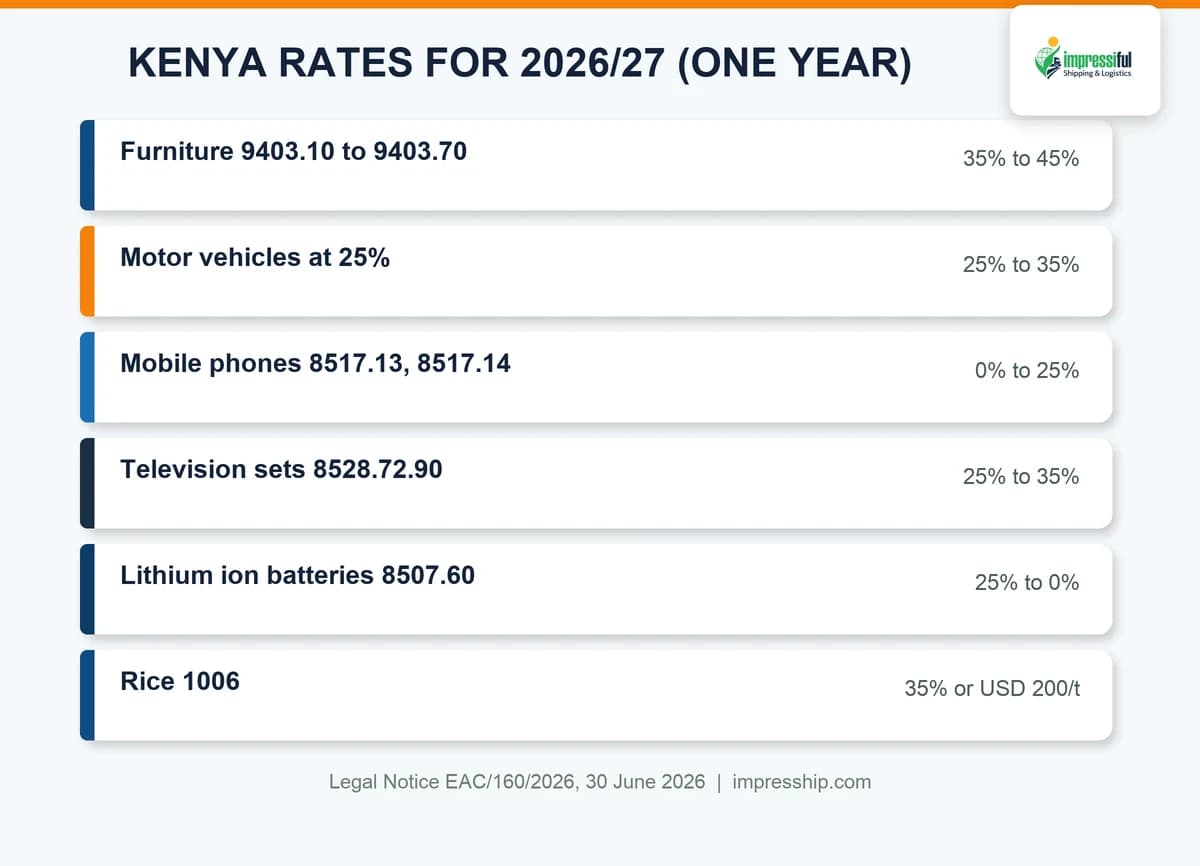
Two things stand out. Most changes push rates up for goods Kenya also makes or assembles (furniture, steel, cables, plastics, soap), while a few cut them to zero (lithium ion batteries) or bring a sensitive rate down (rice). And several lines now carry a minimum per kg or per tonne, so a cheap invoice no longer means a small duty bill. The full notice also covers steel flat products, aluminium, plywood, food products and more; check your exact line before you order.
EAC CET 2026 changes for every partner state#
Table X of the same notice amends the common tariff for all partner states, so these apply in Kenya, Uganda, Tanzania, Rwanda and Burundi alike:
| Goods | HS code | Old CET rate | New CET rate |
|---|---|---|---|
| Active yeasts | 2102.10 | 25% | 25% or USD 0.66 per kg |
| Lubricants in liquid form | 2710.19.51 | 25% | 25% or USD 0.46 per litre |
| Paper, 40 to 150 g/m2, small sheets | 4802.56 | 25% | 25% or USD 0.20 per kg |
| Other paper, 40 to 150 g/m2 | 4802.57 | 10% | 10% or USD 0.08 per kg |
| Ceramic tiles and finishing ceramics | 6907.21 to 6907.40 | 35% | 35% or USD 3 per m2 |
| Nails, tacks and staples of iron or steel | 7317.00 | 35% | 35% or USD 0.35 per kg |
Lubricants show how the two layers meet: the common rate is now "25 percent or USD 0.46 per litre", while Kenya has a one year stay at 35 percent for the same line.
How the new import duty rate changes a real shipment#
Say you buy furniture in Dubai for USD 15,000 and ship 10 CBM weighing 1,500 kg to Mombasa in shared container space. At about USD 376 per CBM the sea freight estimate is about USD 3,758 (from our shipping calculator, sea freight only). With USD 60 of insurance, used here only to show the method, the customs value is about USD 18,818.
| Line | At the old 35% | At the 2026/27 rate of 45% |
|---|---|---|
| Import duty | about USD 6,586 | about USD 8,468 |
| IDF (2.5%) | about USD 470 | about USD 470 |
| RDL (2%) | about USD 376 | about USD 376 |
| VAT (16% of customs value plus duty) | about USD 4,065 | about USD 4,366 |
| Total taxes | about USD 11,498 | about USD 13,680 |
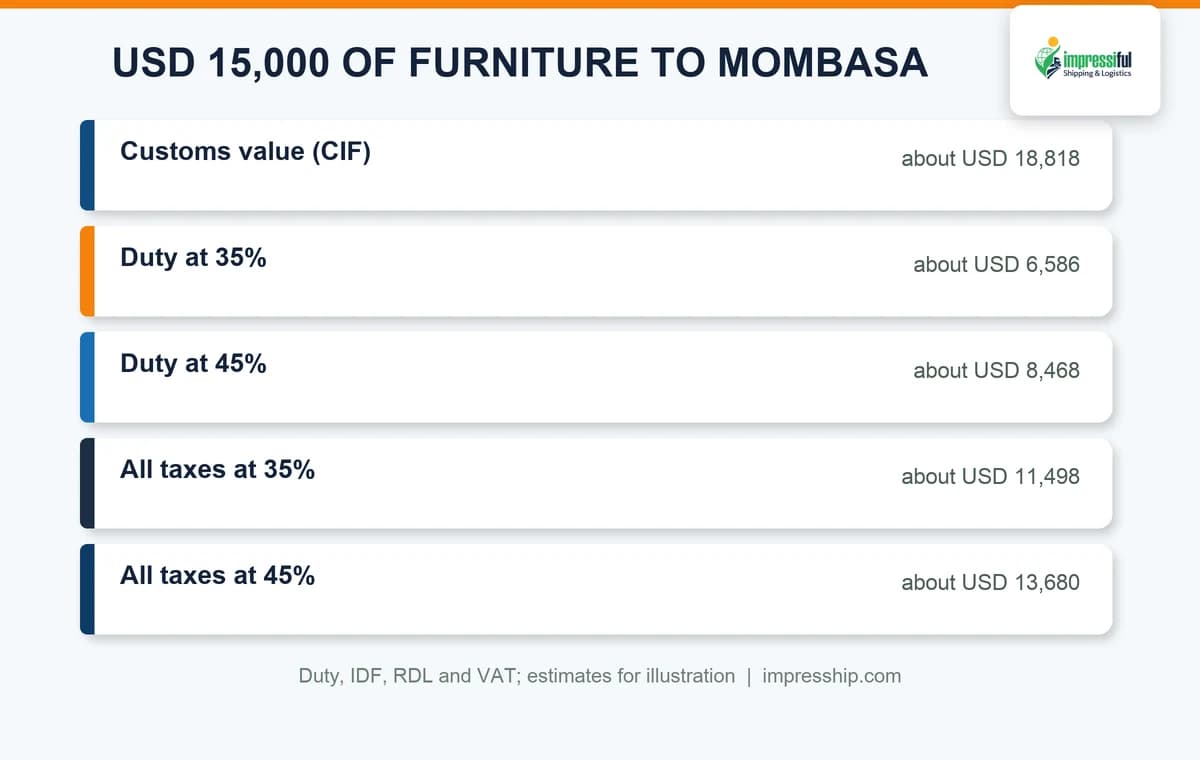
The 10 point rise in the duty rate adds about USD 2,183 to the tax bill, because VAT is charged on top of the duty. Port charges, clearance and delivery come on top. The IDF and RDL rates are the ones our Kenya duty guide explains; the furniture rate comes straight from the Gazette.
Importing into Kenya from Dubai?
Send the goods, the HS codes if you have them, the CBM and gross weight, and we will quote sea freight to Mombasa and give you the freight figure your duty is worked out on.
How to check the EAC CET rate for your HS code#
- Find the HS code. Agree the code with your clearing agent before you buy. Our guide to HS codes for importers explains how the codes work.
- Look up the base rate in the EAC CET 2022 (the KRA copy is linked above) or the EAC online customs tariff.
- Check the 2026/27 Gazette for your line. Search Legal Notice EAC/160/2026 for the HS code and for the word "Kenya". If there is a stay, that rate applies until it expires.
- Check later gazettes. The EAC publishes further notices through the year, mostly duty remissions for named manufacturers. A remission only helps an approved importer, not general traders.
- Run the numbers in our duty calculator, then confirm the final assessment with the clearing agent who lodges your entry.
What it means for cargo from Dubai#
- Furniture, appliances and fittings now cost more to land in Kenya. Price your goods with the 2026/27 rate, not last year's.
- Electronics are mixed. Phones and TVs pay more; lithium ion batteries pay nothing for the year.
- Heavy, low value goods (steel, board, tiles) may now pay by weight or area. Check both parts of the rate.
- The invoice still matters. Duty is charged on the customs value, so a correct invoice, packing list and HS code protect you from a higher assessment later.
On the freight side, our sea estimates to Mombasa are about USD 376 per CBM in shared container space, and about 22 to 40 days at sea; our guide on how much 1 CBM from Dubai costs compares every port and how long it takes to ship from Dubai has the transit table. With the Strait of Hormuz closed to normal traffic, sea cargo currently loads at one of our partner ports: Sohar (most used) or Salalah in Oman, Jeddah, Khor Fakkan or Fujairah (why the routing changed). We handle customs clearance at Mombasa through our partner agents, or you can use your own; our checklist for the best clearing agent in Kenya lists what to ask.
Frequently asked questions#
What is a common external tariff (CET)?#
A common external tariff is one import duty schedule that all members of a customs union apply to goods from outside the union. In the East African Community it has four bands: 0 percent for raw materials and capital goods, 10 percent for intermediate goods, 25 percent for most finished goods and 35 percent for a fourth band, plus higher rates for sensitive items.
Where can I find the East African customs tariff Book?#
The EAC Common External Tariff 2022 is published as a PDF by the Kenya Revenue Authority and on the EAC website, which also has an online tariff search. The yearly changes are not in the book: they are in the EAC Gazette, so for 2026/27 also check Legal Notice EAC/160/2026 of 30 June 2026.
What are the HS code tariffs in Kenya?#
Kenya applies the EAC CET rate for each HS code: 0, 10, 25 or 35 percent, or a higher sensitive rate. For 2026/27 some lines differ for one year under Legal Notice EAC/160/2026, for example furniture at 45 percent, vehicles at 35 percent and mobile phones at 25 percent. The IDF, RDL and VAT are added on top.
Send your cargo details for a same-day quote#
Tell us what you are shipping from Dubai to Kenya, the HS codes if you have them, the CBM and gross weight and the delivery town. We will quote sea freight to Mombasa with the charges spelled out, give you the freight figure your duty is worked out on, and handle customs clearance through our partner agents or hand over to your own clearing agent. All prices are estimates that depend on the product and are confirmed when you book.
Request a same-day quote or message us on WhatsApp with your cargo details.