
Items Not Allowed in Air Cargo from Dubai: What You Cannot Send by Air and What to Do Instead
Items not allowed in air cargo from Dubai: who sets the rules (IATA DGR and UAE GCAA), perfume, aerosols, power banks and other everyday goods, the 2026 lithium battery rules, UAE requirements for air cargo and what to do when an item cannot fly.
Perfume, deodorant sprays, power banks and phones are some of the most popular goods traders buy in Dubai, and all of them fall under the rules for items not allowed in air cargo unless they are declared and packed as dangerous goods. Some things cannot fly at all, some can only go on cargo aircraft, and many can fly once they are declared, packed and labelled correctly. This guide explains who sets those rules, which everyday goods they catch, the extra rules the UAE applies to air cargo leaving the country, and what to do when an item cannot fly.
The short version: declare everything, and when an item is refused by air, sea freight is usually the way to ship it.
Who decides what can fly from Dubai#
Three sets of rules apply to air cargo from the UAE:
- ICAO Technical Instructions. The international law for dangerous goods by air, under Annex 18 of the Chicago Convention.
- IATA Dangerous Goods Regulations (DGR). The manual airlines actually work from. IATA describes the DGR as the global reference for shipping dangerous goods by air and the only standard recognised by airlines. The current 67th edition applies in 2026, and the 68th edition takes effect on 1 January 2027.
- UAE GCAA rules. The General Civil Aviation Authority's CAR Part VI, Transport of Dangerous Goods by Air (Revision 1.5, September 2024). It states that the UAE applies more restrictions than the ICAO Technical Instructions.
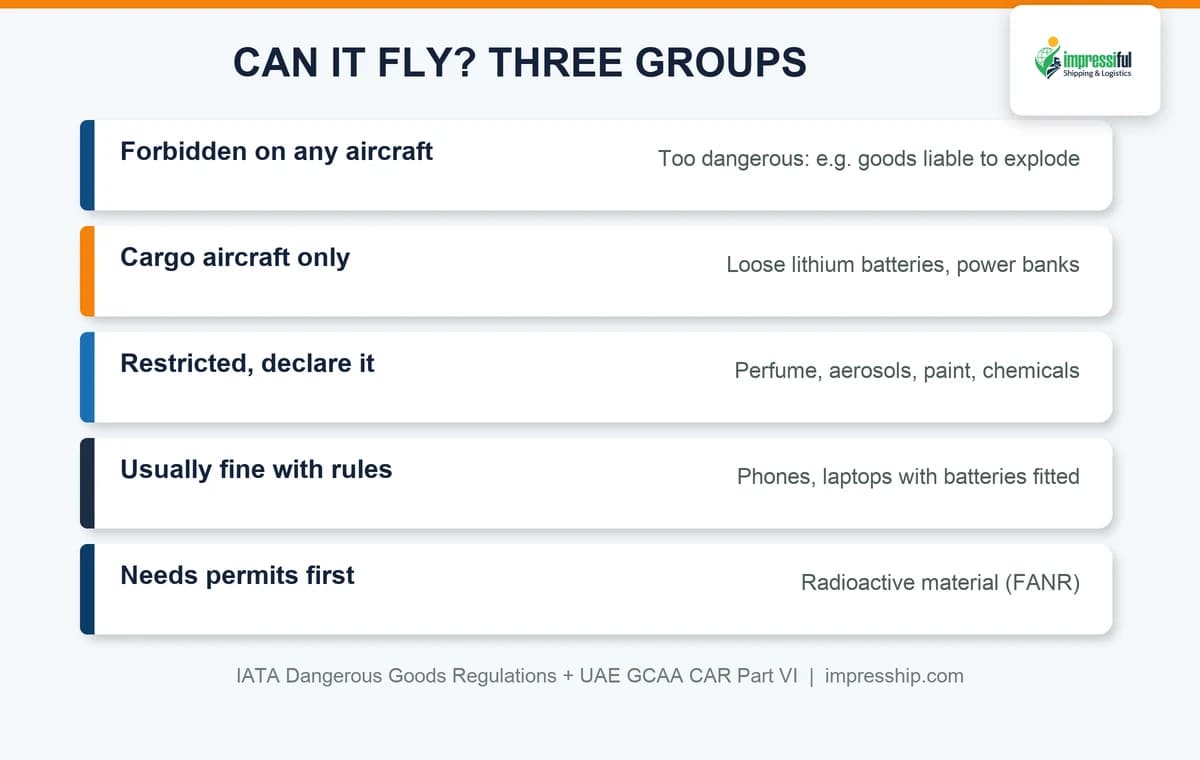
According to GCAA, some dangerous goods are too dangerous to be carried on any civil aircraft, some are forbidden in normal circumstances but may be carried with specific approval from the states concerned, and the rest can fly when every requirement is met. Airlines can also add their own, stricter rules, which IATA publishes as operator variations.
Need this handled end to end?
Tell us your lane and cargo profile and we'll come back with a routing plan and an all-in rate.
Items not allowed in air cargo: everyday goods from Dubai#
IATA's own list of dangerous goods examples includes aerosols, lithium batteries, infectious substances, fireworks, dry ice, gasoline powered engines and machinery, lighters and paint. In practice, these are the items Dubai traders ask about most:
| Item | Why it is regulated | By air |
|---|---|---|
| Perfume, oud oils with alcohol, nail polish | Flammable liquid (Class 3) | Restricted: must be declared, packed and labelled as dangerous goods |
| Deodorant sprays and other aerosols | Gas under pressure (Class 2) | Restricted: declared dangerous goods, quantity limits apply |
| Power banks and loose lithium-ion batteries | Lithium battery (Class 9) | Cargo aircraft only, at no more than 30 percent charge, unless approved |
| Loose lithium metal batteries (coin and button cells) | Lithium battery (Class 9) | Forbidden as cargo on passenger aircraft |
| Phones, laptops and devices with batteries fitted or packed with them | Lithium battery (Class 9) | Can usually fly, with the battery rules for equipment |
| Paints, thinners, adhesives | Flammable liquid (Class 3) | Restricted: declared dangerous goods |
| Lighters, fireworks, explosives | Flammable or explosive (Class 1 and 2) | Heavily restricted; many cannot fly at all |
| Engines, generators and machines that have held fuel | Flammable residue | Restricted: must be declared |
| Bleach, acids, strong cleaning chemicals | Corrosive (Class 8) | Restricted: declared dangerous goods |
| Radioactive material | Class 7 | Needs UAE Federal Authority for Nuclear Regulation permits first |
Lithium batteries: the rules that catch most traders#
Lithium batteries cause more air cargo problems from Dubai than anything else, because they are inside so many of the goods traders buy. IATA's Battery Guidance Document, revised for the 2026 regulations, sets out the main rules:
- Batteries shipped on their own (not inside or packed with a device) are forbidden as cargo on passenger aircraft. This includes power banks and spare battery packs. Lithium-ion batteries shipped this way must also be at a state of charge no higher than 30 percent of their rated capacity.
- Batteries packed with equipment, such as a phone with a spare battery in the same box: from 1 January 2026 these must also be offered at a reduced state of charge, unless the states concerned approve otherwise.
- Batteries inside equipment, such as a phone or laptop in its retail box, can usually fly under the equipment rules.
- Every battery type must have passed UN testing. IATA notes that since 1 January 2019 manufacturers and distributors must make a UN 38.3 test summary available for each cell or battery type. Ask your supplier for it before you buy.
UAE rules add one more point: GCAA requires lithium batteries, including those in or packed with equipment, to be kept away from direct sunlight, heat and humidity during acceptance, storage and loading, with special attention from 1 June to 31 October. Solar kits and e-bikes have their own battery issues; our solar panels and batteries guide covers them.
UAE rules for air cargo leaving the country#
CAR Part VI adds requirements that apply to every shipment from the UAE, not only dangerous goods:
- Shipper's undertaking for every consignment. Since 1 April 2025, freight forwarders and cargo agents in the UAE must make sure the shipper completes an undertaking for every UAE originating consignment, confirming whether it contains dangerous goods or not. The shipper is held fully liable for an incorrect declaration.
- GCAA certified entities only. UAE originating dangerous goods may only be offered and accepted for air transport by a GCAA dangerous goods certified entity.
- No opaque shrink wrap. Outer opaque shrink wrapping is prohibited on air cargo accepted for transport from the UAE, including re-export cargo, so pallets must be wrapped in clear film.
- Emergency contact. A shipper's declaration for dangerous goods must carry a 24 hour emergency telephone number staffed by someone who knows the goods.
In practice this means you tell us exactly what is in every box before it is collected or delivered to us, and we prepare the paperwork on that basis.
Hidden dangerous goods in mixed shipments#
IATA's white paper on safety in the cargo supply chain makes the point plainly: the greatest risk comes when dangerous goods enter the supply chain undeclared or mis-declared. For Dubai traders, the usual culprits are not exotic chemicals but ordinary goods hidden in a mixed load:
- Perfume samples or testers packed with clothing or shoes
- Spare batteries or power banks packed in with phone accessories
- Watches, car key fobs and calculators with lithium metal cells
- Generators, pumps and tools that have held fuel
- Cleaning products and cosmetics sprays packed with general goods
A box that is not declared can be refused at acceptance, held, or sent back, and the delay usually costs more than shipping the item properly. Our guide to air freight vs courier from Dubai explains which service fits small shipments; the dangerous goods rules are the same on both. Our guides to air cargo from Dubai to Lagos and air cargo from Dubai to Nairobi cover the documents for those airports.
What to do when an item cannot fly#
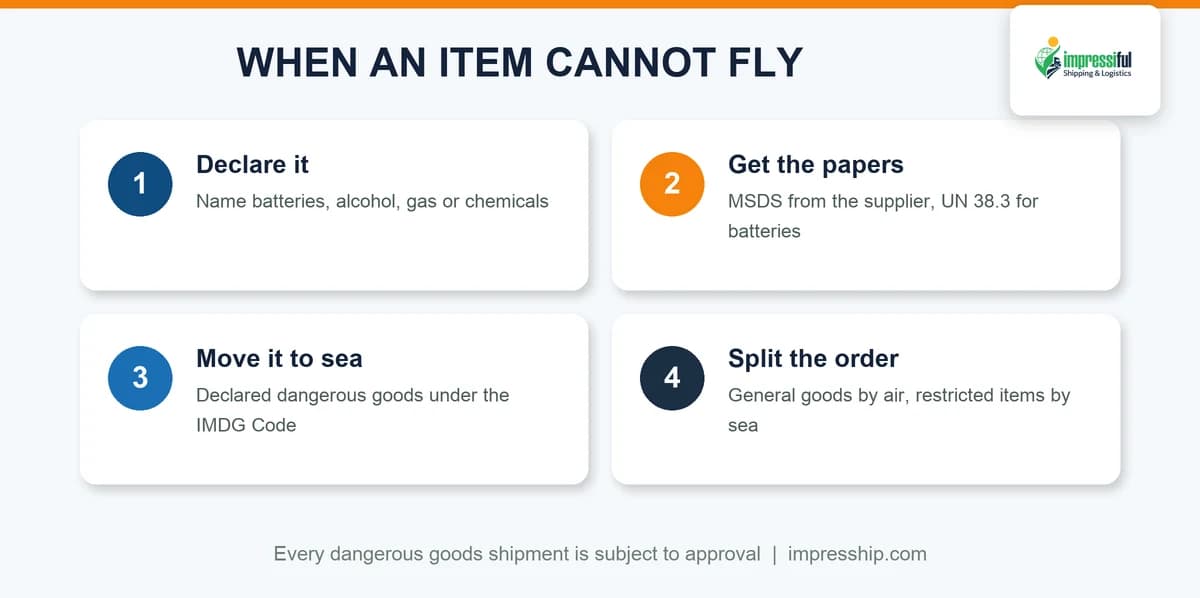
- Declare it when you ask for a quote. Name the product, the quantity and whether it contains batteries, alcohol, gas or chemicals. Every dangerous goods shipment we handle is subject to approval, so we confirm whether it can fly before you book.
- Get the paperwork from your supplier. For products that contain chemicals or are dangerous goods, we work with the supplier to get the safety data sheet (MSDS) and the certificate of origin when applicable. For batteries, ask for the UN 38.3 test summary.
- Move it to sea freight. Sea freight carries many goods that cannot fly, including power banks and bulk perfume, as declared dangerous goods under the IMDG Code. Our dangerous goods shipping guide explains the sea rules, and sea cargo currently loads at one of our partner ports: Sohar (most used) or Salalah in Oman, Jeddah in Saudi Arabia, or Khor Fakkan or Fujairah in the UAE.
- Split the shipment. Send the general goods by air and the restricted items by sea, so one perfume carton does not hold up the whole order.
Air rules are only half the picture. Some goods that fly without trouble are banned or need a permit at the destination; our guide to prohibited and restricted imports in Ghana and Nigeria covers those lists.
Not sure if your goods can fly?
Send the product list, quantities, carton sizes and weights, and say if anything contains batteries, perfume, sprays or chemicals. We will tell you what can go by air, what should go by sea, and quote both.
Frequently asked questions#
What items are not allowed in air cargo?#
Items that are dangerous goods under the IATA Dangerous Goods Regulations are not allowed unless they are declared, packed and labelled to those rules, and some cannot fly at all. Everyday examples include perfume, aerosols, lithium batteries and power banks, paint, lighters, fireworks, fuel and strong chemicals. Airlines and countries, including the UAE, can add stricter rules.
Is perfume allowed in air cargo?#
Yes, but only as declared dangerous goods. Perfume contains alcohol, so it is a Class 3 flammable liquid and must be packed, marked and labelled under the IATA rules, with quantity limits per package. Undeclared perfume in a mixed box is one of the most common reasons air cargo is refused. For larger quantities, sea freight is often simpler.
Is it possible to transport lithium batteries as air cargo?#
Yes, with conditions. Batteries inside or packed with equipment can usually fly under the equipment rules. Lithium batteries shipped on their own, including power banks, are forbidden as cargo on passenger aircraft and can only go on cargo aircraft, and lithium-ion batteries must be at no more than 30 percent charge. Every battery type also needs a UN 38.3 test summary.
What is forbidden for air transport?#
Some dangerous goods are too dangerous to be carried on any civil aircraft, and others are forbidden unless the states concerned give a specific approval. Examples include many explosives and fireworks and certain reactive chemicals. Loose lithium metal batteries are forbidden as cargo on passenger aircraft. The IATA Dangerous Goods Regulations list which items fall in each group.
Can you carry a lithium power bank on a plane?#
As a passenger, power banks normally go in your carry-on bag only; IATA notes that spare batteries are not allowed in checked baggage, and airlines set their own limits. Shipping power banks as cargo is different: they count as batteries shipped on their own, so they can only go on cargo aircraft, at reduced charge, as declared dangerous goods.
Send your cargo details for a same-day quote#
Tell us what you are sending from Dubai, the number of cartons, their sizes and weights, the destination city and anything that contains batteries, perfume, sprays or chemicals. We will tell you what can fly, what should go by sea, and quote both with the destination charges spelled out. Once you know your goods can fly, the shipping calculator gives an estimate for air and sea. Our volumetric weight guide shows how air cargo is charged, and our air freight page covers the service. All our shipments are insured, and every dangerous goods shipment is subject to approval.
Request a same-day quote or message us on WhatsApp with your cargo details.