
Air Freight Dubai to Kampala: How Air Cargo to Uganda Is Priced, Documented and Cleared
Air freight Dubai to Kampala explained: how the price is built, how to work out chargeable weight, Entebbe airport, the URA documents, PVoC and permits Uganda asks for, duty and VAT, and when sea freight through Mombasa is cheaper.
Air freight Dubai to Kampala is how Ugandan importers move phones, electronics, spare parts, cosmetics, clothing and fast selling stock that cannot wait for a ship to reach Mombasa and a truck to cross Kenya. This air freight Dubai to Kampala guide explains how the price is built, how to work out chargeable weight before you book, where the cargo lands, the documents and customs rules Uganda applies, and when sea freight through Mombasa is the better buy.
The route is busy for a reason. According to the World Bank's WITS database, the United Arab Emirates was Uganda's second largest source of imports in 2023, at about USD 1.43 billion, behind only China. A lot of that trade is light, high value stock that traders fly in to keep their shelves full between sea shipments.
How air freight from Dubai to Kampala is priced#
In practice, an air freight quote for this route is built from five layers, and comparing quotes means comparing all five, not just the rate per kg:
| Price layer | What it covers | How it is charged |
|---|---|---|
| Air freight rate | The flight from the UAE to Entebbe | Per kg of chargeable weight, by weight break |
| Surcharges | Fuel and security screening | Per kg or per shipment |
| Origin charges | Air waybill, export declaration, handling in the UAE | Per shipment |
| Destination charges | Handling and storage at the airport cargo terminal | Per kg or per shipment |
| Duty, VAT, levies and clearance | Ugandan duty, VAT, other levies and the customs agent | On the customs value of the goods |
Rates per kg fall as the shipment gets heavier, through weight breaks such as 45, 100, 250, 500 and 1,000 kg. The routing and the space available on the day change the price, so we quote every air shipment individually. Our air freight service page explains what we handle, and the shipping calculator gives sea estimates to compare against.
Where air cargo for Kampala lands#
Uganda's international airport is Entebbe International Airport (EBB), on the shore of Lake Victoria about 40 km south of Kampala, so "air cargo to Kampala" means cargo flown to Entebbe. The goods go to the airport cargo terminal, where they wait for the customs agent to clear them, and storage time starts as soon as they land. Give your agent the air waybill number before the flight, and have the documents ready, so the goods do not sit in the terminal.
After release, the cargo travels by road from Entebbe to Kampala or anywhere else in Uganda. Tell us the final town with the quote request; delivery from the airport is on request.
Air freight Dubai to Kampala: chargeable weight#
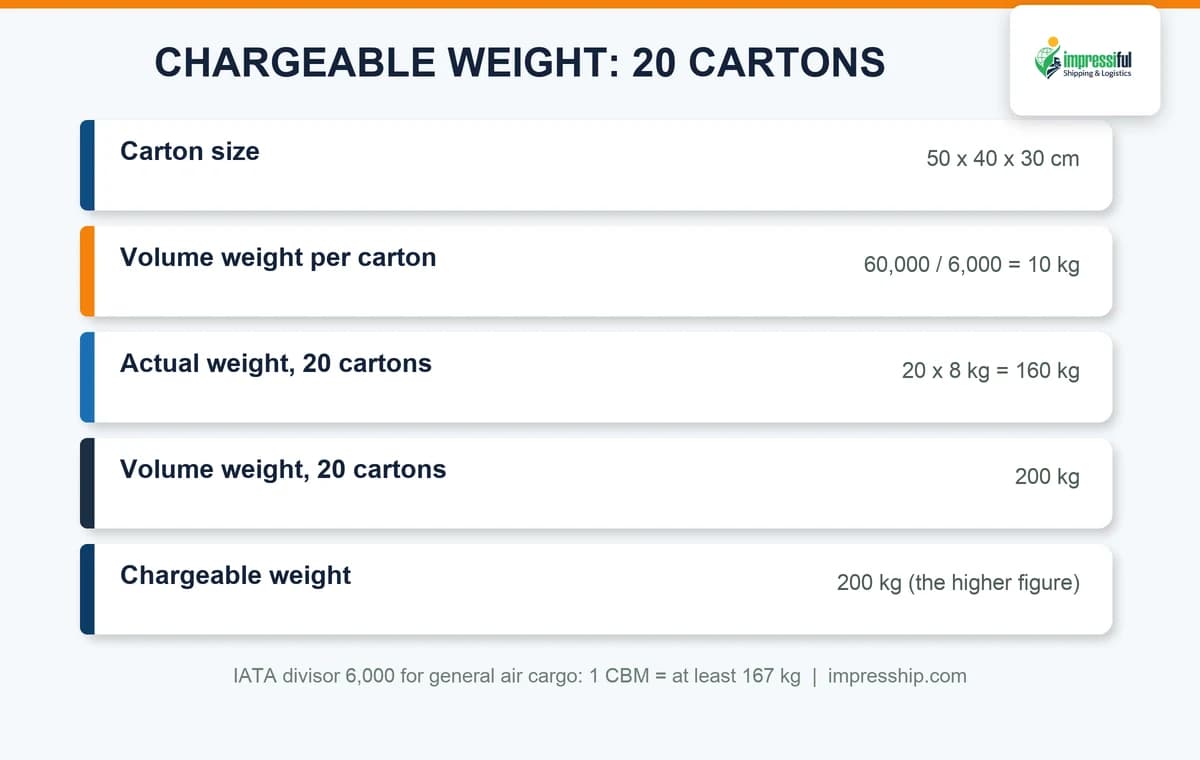
Airlines charge the higher of the actual gross weight and the volume weight. For general air cargo the volume weight is length x width x height in centimetres divided by 6,000, so every CBM is charged as at least 167 kg.
A worked example with light goods: 20 cartons of 50 x 40 x 30 cm, each weighing 8 kg.
- Each carton measures 60,000 cubic centimetres, so its volume weight is 60,000 / 6,000 = 10 kg.
- The 20 cartons weigh 160 kg on the scale and 200 kg by volume.
- The chargeable weight is 200 kg, because the cartons are bigger than they are heavy.
Clothing, shoes, bags and plastic goods usually charge on volume like this, while spare parts, tools and tiles charge on actual weight. For light goods, packing the same items into fewer, fuller cartons is often the easiest saving. Our guide to volumetric weight has more examples, and air freight vs courier explains why a few kilos of parcels and air cargo are priced differently.
Flying cargo from Dubai to Kampala?
Send the number of pieces, dimensions, weight and goods description, and we will work out the chargeable weight and quote air freight to Entebbe for Kampala.
Documents for air cargo into Uganda#
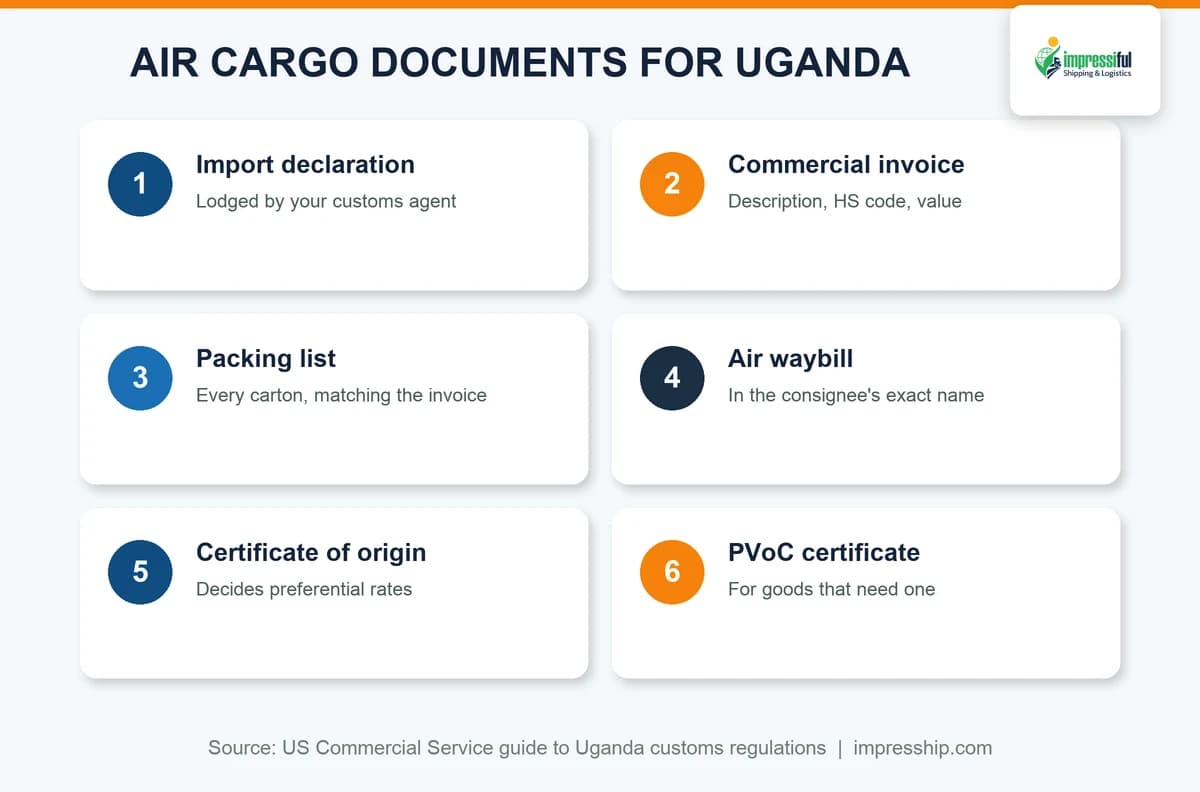
Uganda's customs is run by the Uganda Revenue Authority (URA) under the East African Community Customs Management Act. According to the US Commercial Service guide to Uganda customs regulations, goods are declared through ASYCUDA World, and the documents URA asks for are:
- Import declaration form, lodged by your customs agent.
- Commercial invoice with a clear description, HS code and value for every line; see our commercial invoice for export guide.
- Packing list describing every carton, matching the invoice.
- Air waybill as the transport document, in the consignee's exact name.
- Certificate of origin, which also decides whether a preferential rate applies.
- PVoC certificate for goods that must pass the Pre-Export Verification of Conformity in the country they ship from.
Importers also need a URA tax identification number (TIN), and documents are submitted through the Uganda Electronic Single Window, where the agent can follow every approval. Some agricultural, pharmaceutical and chemical products need permits from the agriculture ministry, the National Drug Authority or the Uganda National Bureau of Standards before they ship, and goods on the "negative list" need an import certificate from the trade ministry.
Clearance, duty and restricted items in Uganda#
When the cargo lands at Entebbe, the licensed customs agent lodges the declaration with the HS code and value, URA assesses duty and taxes, the cargo may be inspected, and the goods are released once payment is made.
Uganda applies the EAC Common External Tariff: 0% for raw materials, 10% for intermediate goods, 25% for most finished goods and 35% for finished goods also made in the region, with higher rates on a list of sensitive items. According to PwC's Uganda tax summary, rates run from 0% to 60% depending on the item, and some plant and machinery can be exempt. On top come VAT at 18%, an infrastructure levy of 1.5% and, for many importers, withholding tax. Your agent confirms the code and the final figure; our guide to HS codes shows why the code matters.
Some goods cannot be imported at all: the US Commercial Service lists used tyres, used computers and appliances, used underwear and pornographic material. Others cannot fly as normal cargo: lithium batteries, aerosols, perfumes, paints and other dangerous goods need special handling under the IATA Dangerous Goods Regulations. We ship dangerous goods, and every dangerous goods shipment is subject to approval. Our guide to what you cannot send by air from Dubai explains what can fly.
Air or sea to Kampala?#
Uganda is landlocked, so sea cargo lands at Mombasa in Kenya (or Dar es Salaam in Tanzania) and travels to Kampala by road or rail. That onward leg adds time, transit paperwork and cost, which is why air makes sense for urgent, light and valuable goods. For bulky or heavy stock, sea is still far cheaper per kilo.
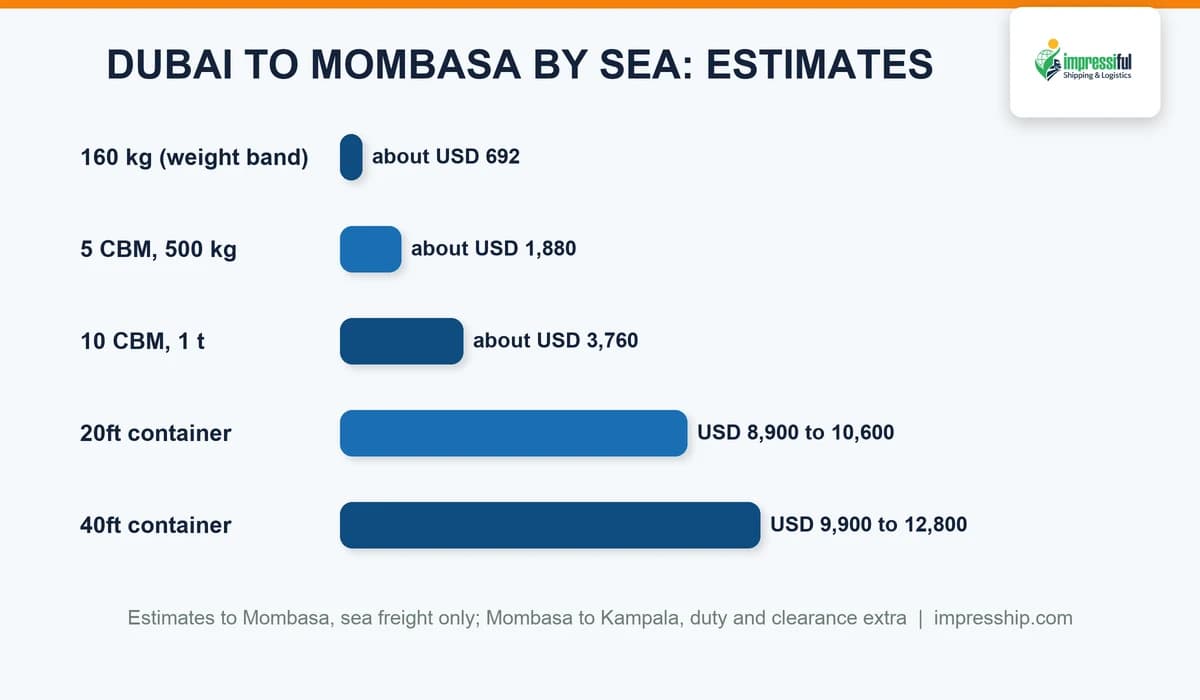
As a guide from our shipping calculator, LCL sea freight from the UAE to Mombasa is estimated at about USD 376 per CBM, a 20ft container at USD 8,900 to 10,600 and a 40ft at USD 9,900 to 12,800, with about 22 to 40 days at sea.
Small, heavy loads are charged by weight band: the 160 kg of cartons in the example above would cost about USD 692 to Mombasa, while 5 CBM weighing 500 kg comes to about USD 1,880 and 10 CBM weighing a tonne about USD 3,760 (examples, not quotes). These are sea freight estimates to Mombasa only: Dubai pickup, the leg from Mombasa to Kampala, transit and destination charges, duty and clearance are extra, and the full sea price to Kampala is confirmed with each quote.
With the Strait of Hormuz closed, our sea cargo currently loads at one of our partner ports: Sohar (most used) or Salalah in Oman, Jeddah, Khor Fakkan or Fujairah.
Many importers fly the urgent part of an order and send the rest by sea; our air freight vs ocean freight guide shows how to split it, our guide to shipping from Dubai to Mombasa covers the sea leg, and shipping to landlocked African countries explains the inland routes.
How to ship air freight from Dubai to Kampala: 6 steps#
- Measure and weigh. Record the dimensions and gross weight of every carton so the chargeable weight is right first time.
- Get a quote. Send the pieces, dimensions, weight, goods description and value; we confirm the chargeable weight, the routing and the price.
- Check permits and PVoC. If your goods need a PVoC certificate, a permit or an import certificate, arrange it before the cargo flies.
- Deliver the cargo. Suppliers deliver to our warehouse, or we quote a pickup. We confirm every delivery with photos and counts.
- Fly. The cargo is screened, the air waybill is issued in your consignee's name and the goods fly to Entebbe.
- Clear and collect. The agent lodges the declaration, duty and taxes are paid, and the goods are released at the airport cargo terminal. Delivery to Kampala is on request.
Every shipment we handle is insured. For a neighbouring air lane, see our guide to air cargo from Dubai to Nairobi.
Frequently asked questions#
What Cargo services are available from Dubai to Uganda?#
From Dubai to Uganda you can send cargo by air to Entebbe for Kampala, priced per kg of chargeable weight, or by sea through Mombasa or Dar es Salaam, in shared container space (LCL) or a full 20ft or 40ft container. We quote both, provide the documents, and handle customs clearance at destination through our partner agents. Our air freight service page explains the air side.
What are the import requirements for Uganda?#
To import into Uganda you need a URA tax identification number, an import declaration lodged by a customs agent through ASYCUDA World, a commercial invoice, packing list, air waybill or bill of lading and a certificate of origin. Some goods also need a PVoC certificate, a permit from a regulator or an import certificate, as the US Commercial Service guide explains.
Which goods are exempted from customs duty in Uganda?#
Under the EAC Common External Tariff, raw materials enter Uganda at 0% duty, and some plant and machinery can be exempt. Goods that qualify under EAC or COMESA rules of origin can get preferential rates. VAT and other levies may still apply, so ask your customs agent to confirm the HS code and the treatment before you ship; our HS codes guide explains how the code decides it.
Send your cargo details for a same-day quote#
Tell us the number of pieces, dimensions, weight, goods description and value, and the town in Uganda where the cargo is going. We will quote air freight to Entebbe for Kampala, show the sea option when it could save you money, and handle customs clearance at destination through our partner agents, or hand over to your own customs agent.
Request a same-day quote or message us on WhatsApp with your cargo details.