
How to Pack Cargo for Shipping: Packing and Labelling Sea Freight from Dubai to Africa
How to pack cargo for shipping by sea from Dubai to Africa: 8 packing steps, ISPM 15 pallets and crates, shipping marks and handling labels, why marks must match the packing list, and packing that cuts your CBM and freight bill.
How to pack cargo for shipping by sea comes down to three jobs: protect the goods for five or six weeks of handling, heat and humidity, keep the volume as small as the goods allow, and mark every carton so it can be matched to the documents at the port. This guide shows how to pack cargo for shipping from Dubai to Africa step by step, how to label each package, and the packing mistakes that cost importers money or hold up clearance.
It is written for traders who buy in the UAE and ship general cargo to ports such as Tema, Lagos, Mombasa or Dar es Salaam, in shared container space (LCL) or a full container.
Why packing matters on the sea route to Africa#
Sea cargo from the UAE spends a long time in transit. On our estimates, West African ports such as Tema and Lagos are about 30 to 48 days at sea, and East African ports about 22 to 40 days, plus a few days for consolidation. Our sea cargo currently loads at one of our partner ports: Sohar (most used) or Salalah in Oman, Jeddah in Saudi Arabia, or Khor Fakkan or Fujairah in the UAE. That means more than one handling stage before the cargo even sails.
In a shared container your cartons travel with other shippers' goods. They are stacked, moved by forklift, and unpacked at a container freight station at destination. A carton that is soft, over-filled or unmarked is the one that gets crushed, wet or left behind.
Packing also sets your price. Shared space is priced by CBM, and heavy, small loads are charged by weight, so every centimetre of empty carton is freight you pay for. Our guide on how to calculate CBM shows how volume is measured.
How to pack cargo for shipping: 8 steps#
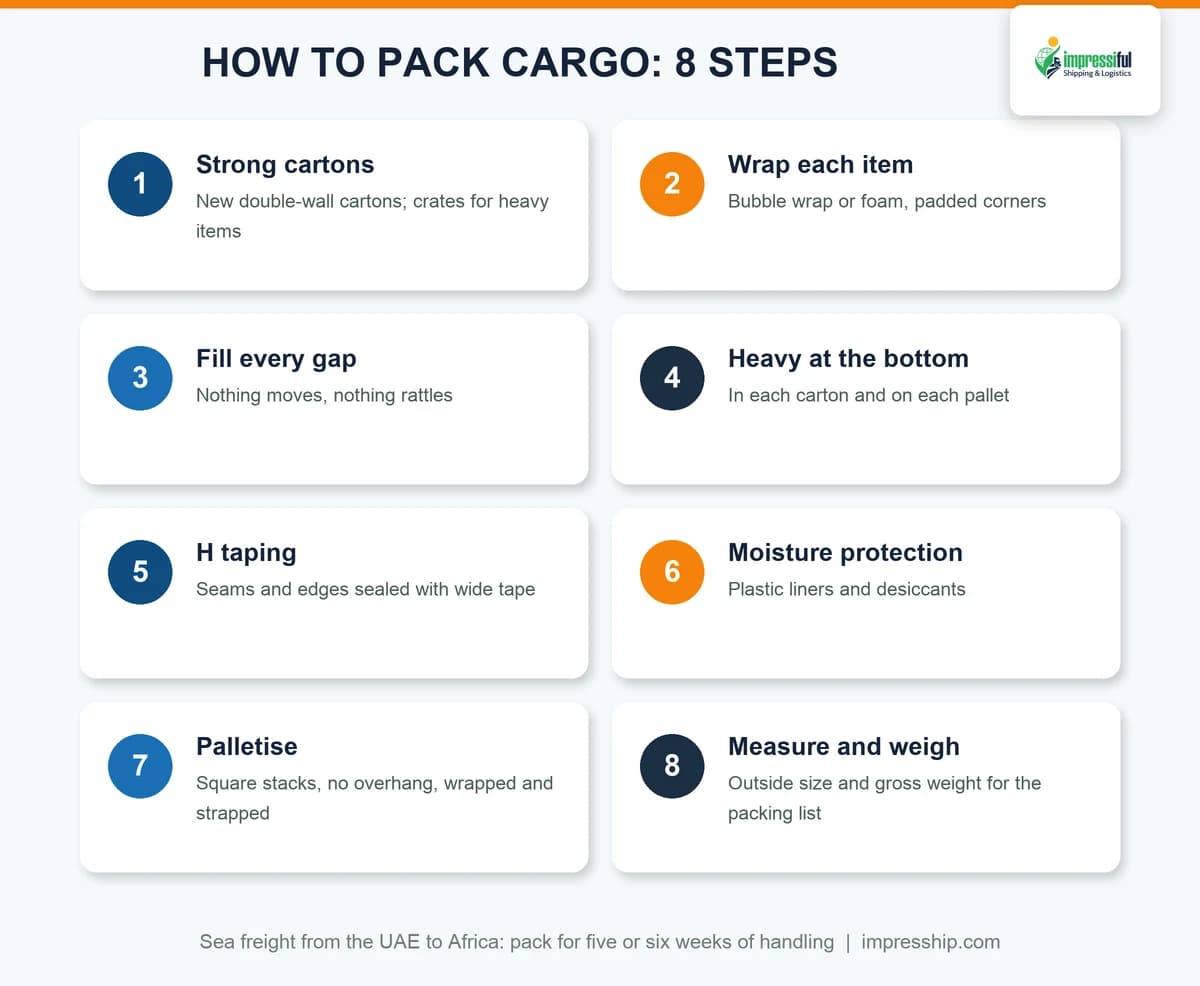
- Choose the right outer packaging. Use new, strong double-wall corrugated cartons for general goods. Avoid reused supermarket boxes: they have already lost much of their strength. Heavy or fragile items such as machines, tiles or glass need a wooden crate or a pallet.
- Wrap each item. Wrap fragile items one by one in bubble wrap, foam or paper, with extra padding on corners and edges. Keep liquids upright and in sealed inner bags.
- Fill every gap. Fill empty space inside the carton with paper, air pillows or foam so nothing moves. A packed carton should not rattle when you lift it.
- Put heavy items at the bottom. Inside each carton, and when cartons are stacked on a pallet, heavy goods go at the bottom and lighter goods on top.
- Seal properly. Tape the top and bottom seams and both edges in an H pattern with strong, wide packing tape.
- Protect against moisture. Line cartons of textiles, paper goods, electronics or metal parts with plastic bags, and add desiccant sachets. Condensation inside a container is common on long voyages.
- Palletise heavy or many small cartons. Stack cartons squarely on a sound pallet, with nothing overhanging the edges, then stretch wrap and strap the load. Pallets are easier to handle and less likely to be split up.
- Measure and weigh the finished packages. Record the outside size and gross weight of every package after packing. These numbers go on the packing list and drive the freight price.
The IMO/ILO/UNECE Code of Practice for Packing of Cargo Transport Units (the CTU Code) is the international reference for how cargo should be packed and secured in containers. You do not need to read it to pack cartons, but it is the standard forwarders and shipping lines work to.
Not sure how to pack your cargo?
Send us the goods, the number of cartons, the sizes and the weights, and we will advise on packing and quote sea freight to your port.
Wooden pallets and crates: the ISPM 15 rule#
If your cargo travels on wooden pallets or in wooden crates, the wood must meet ISPM 15, the international standard for wood packaging material published by the International Plant Protection Convention. Raw wood packaging has to be treated, usually by heat treatment, and stamped with the official ISPM 15 mark before it is used for export.
Ask your supplier or packer for ISPM 15 marked pallets, and check for the stamp before loading. Untreated wood can be refused or treated at the destination port at the importer's cost. Plastic pallets and processed wood such as plywood and particle board are outside the standard.
How to label cargo: shipping marks#
Every package needs a shipping mark, the text printed or labelled on the outside that tells handlers whose cargo it is and where it goes. When you book with us, we give you a mark for your suppliers to use, so cartons from different shops can be grouped as one shipment in our Dubai warehouse.
A good shipping mark shows:
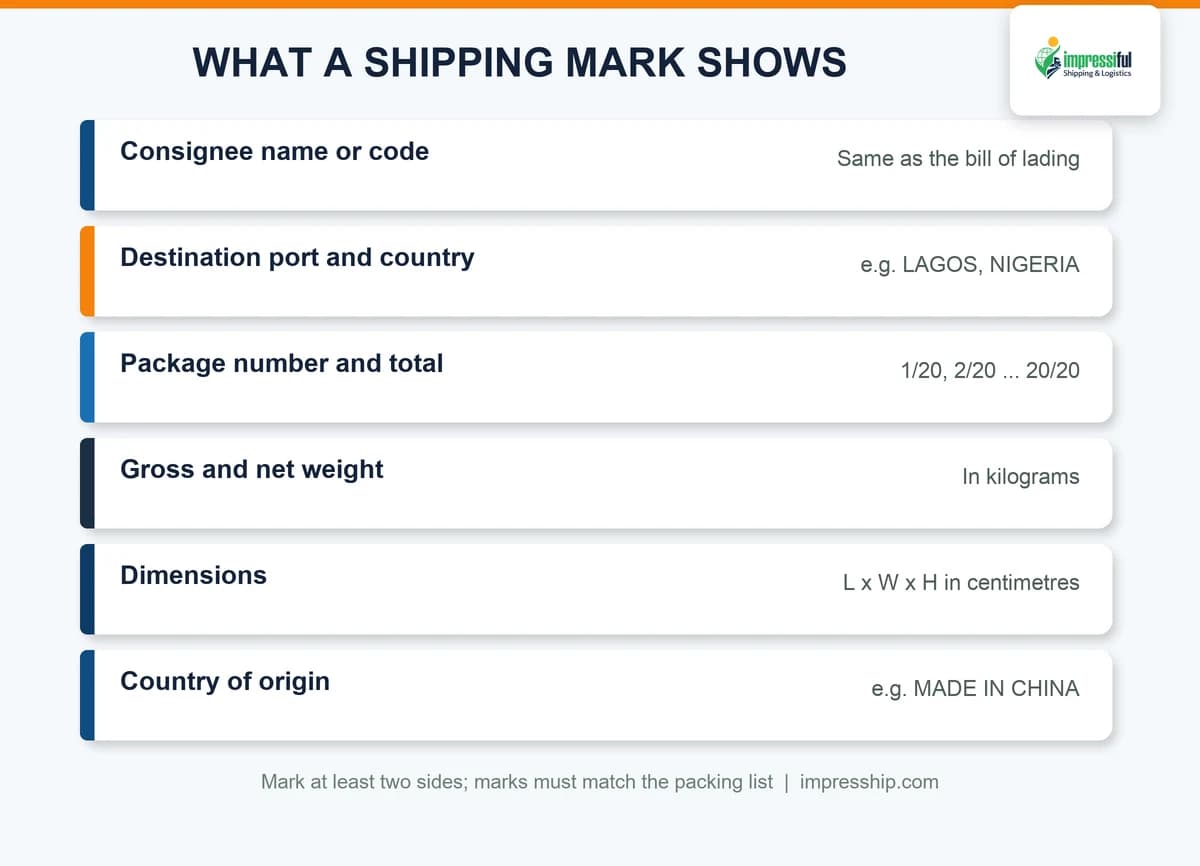
- Consignee name or code, the same as on the bill of lading.
- Destination port and country, for example TEMA, GHANA or LAGOS, NIGERIA.
- Package number and total, such as 1/20, 2/20 and so on up to 20/20.
- Gross weight and net weight in kilograms.
- Dimensions in centimetres.
- Country of origin, such as MADE IN CHINA or MADE IN UAE, where the goods are marked.
Put the mark on at least two sides of each carton, in large black letters, and remove any old labels from reused boxes. Use the same order references the commercial invoice uses.
Handling symbols and dangerous goods labels#
Add the standard handling pictograms where they apply: fragile, keep dry, this way up, do not stack and centre of gravity. They are the international symbols, so handlers understand them whatever language they read.
Dangerous goods need more. Perfume, aerosols, paint, cleaning chemicals and anything with a lithium battery must be packed in approved packaging and carry the correct hazard labels and UN numbers under the sea dangerous goods code. Never pack them inside general cargo without declaring them. We ship dangerous goods, but every dangerous goods shipment is subject to approval, and for products that contain chemicals we work with the supplier to get the safety data sheet (MSDS). Our dangerous goods shipping guide lists everyday items that count, and the guide to prohibited and restricted imports in Ghana and Nigeria covers goods that cannot be imported at all.
Marks and the packing list must match#
Customs officers compare the packages with the documents. If the packing list says 20 cartons, marked 1/20 to 20/20, with a total gross weight of 600 kg, that is what the cargo must show. Different counts, missing numbers or weights that do not add up are a common reason for an entry to be queried or the cargo to be examined.
Prepare the packing list from the packed cargo, not from the order. Our commercial invoice for export guide shows what the packing list must contain and the matching rules customs apply, and the customs clearance documents guide covers the full document set.
Packing that cuts your freight bill#
Because shared space is charged by volume, oversized cartons cost money. As a worked example, 60 cartons of 60 x 50 x 50 cm are 9 CBM. If the same goods fit cartons of 55 x 45 x 45 cm, the shipment is about 6.7 CBM. At 600 kg to Lagos, that is about USD 3,350 in sea freight against about USD 2,485, a saving of about USD 865 on the same goods (sea freight estimates, not quotes).
Other ways to keep volume down:
- Ask suppliers to use the smallest carton that protects the goods, and to remove retail display boxes when they add nothing.
- Flat pack furniture and shelving where the design allows. Our guide to shipping furniture from Dubai covers bulky items.
- Combine part-filled cartons from different suppliers. We repack and relabel at our warehouse, on request, so loose or damaged cartons can be consolidated before loading.
On LCL to Lagos, the estimate is about USD 372 per CBM, and to Tema about USD 337 per CBM; the shipping calculator gives the estimate for your port. Dubai pickup, destination charges, duty and clearance are extra. Our team recommends LCL up to roughly 30 CBM and a 40ft container beyond that.
What happens when cargo reaches our warehouse#
Your suppliers deliver to our shared warehouse in Dubai, or you can ask us for a pickup quote. We confirm every delivery with photos and counts, so you know what arrived and in what condition before it is loaded. If cartons arrive damaged, unmarked or loose, we tell you, and repacking or relabelling can be arranged.
We only bring goods into the warehouse when shipping is confirmed within the next two weeks. Storage is free when the cargo is loaded within those two weeks; if shipping is not confirmed, storage is charged at AED 20 per sq ft per month. All our shipments are insured, and good packing is still the best way to make sure the goods arrive as they left.
Frequently asked questions#
How do I pack items for shipping?#
Use new, strong double-wall cartons, wrap each item separately, fill every gap so nothing moves, put heavy items at the bottom and seal the seams in an H pattern. For sea freight, add plastic liners and desiccants against moisture, palletise heavy loads, and use ISPM 15 marked wood for pallets and crates. Then measure and weigh every package for the packing list.
What are the 5 requirements of packaging?#
For sea cargo, packaging should contain the goods, protect them from impact and crushing, protect them from moisture, be easy to handle and stack, and identify the goods through clear shipping marks and labels. For export, wooden packaging must also meet ISPM 15, and dangerous goods need approved packaging and hazard labels.
What are shipping marks?#
Shipping marks are the text and numbers on the outside of each package that identify the cargo: the consignee name or code, the destination port and country, the package number out of the total (1/20, 2/20), weights, dimensions and often the country of origin. They link each carton to the packing list and the bill of lading.
What are marks and numbers in shipping?#
"Marks and numbers" is the box on the bill of lading and packing list that repeats the shipping marks and package numbers on the cargo. Customs and the warehouse use it to check that the packages they see are the ones declared, so the marks on the cartons must match the documents exactly.
What items are not allowed in sea cargo?#
Each destination bans some goods, such as counterfeit products and items on its import prohibition list, and some goods need a permit. Dangerous goods such as perfume, aerosols, chemicals and lithium batteries are not banned outright, but they must be declared and packed under dangerous goods rules, and every dangerous goods shipment we handle is subject to approval. Check the destination's list before you buy.
Send your cargo details for a same-day quote#
Tell us what you are shipping, the number of cartons, their sizes and weights, and the destination port. We will advise on packing, confirm LCL or a container and quote sea freight with the destination charges spelled out, with a telex release bill of lading. We ship general cargo and dangerous goods, with every dangerous goods shipment subject to approval, and we handle customs clearance at destination through our partner agents, or you can use your own clearing agent.
Request a same-day quote or message us on WhatsApp with your cargo details.