Starting an Import Business from Dubai to Africa: A Beginner's Guide
Starting an import business from Dubai: six steps for first time importers in Nigeria, Ghana and across Africa, from choosing a product and checking import rules to registering, budgeting the landed cost, buying, shipping LCL and clearing.
Dubai has become one of Africa's main wholesale markets. Non-oil trade between Dubai and Africa reached about USD 146 billion in 2025, according to Dubai Chamber of Commerce figures reported by Zawya, and much of it is carried by small traders who buy phones, fashion, perfumes, spare parts and household goods in Dubai to sell at home. This guide walks a first time importer through starting an import business from Dubai: choosing a product, registering, budgeting the landed cost, buying, shipping and clearing your first consignment.
For most beginners, the safest start is a small, tested first shipment rather than a big container. Pick one or two products you can sell quickly, register the business at home, work out the full landed cost before you pay a supplier, then ship by sea as shared container space (LCL) and grow from there. Our e-commerce and trader shipping service is built for exactly this kind of first order.
Starting an import business from Dubai: the six steps#
- Choose the product and the market.
- Check the import rules for that product.
- Register the business at home.
- Budget the full landed cost.
- Buy from Dubai suppliers.
- Ship, clear and sell.
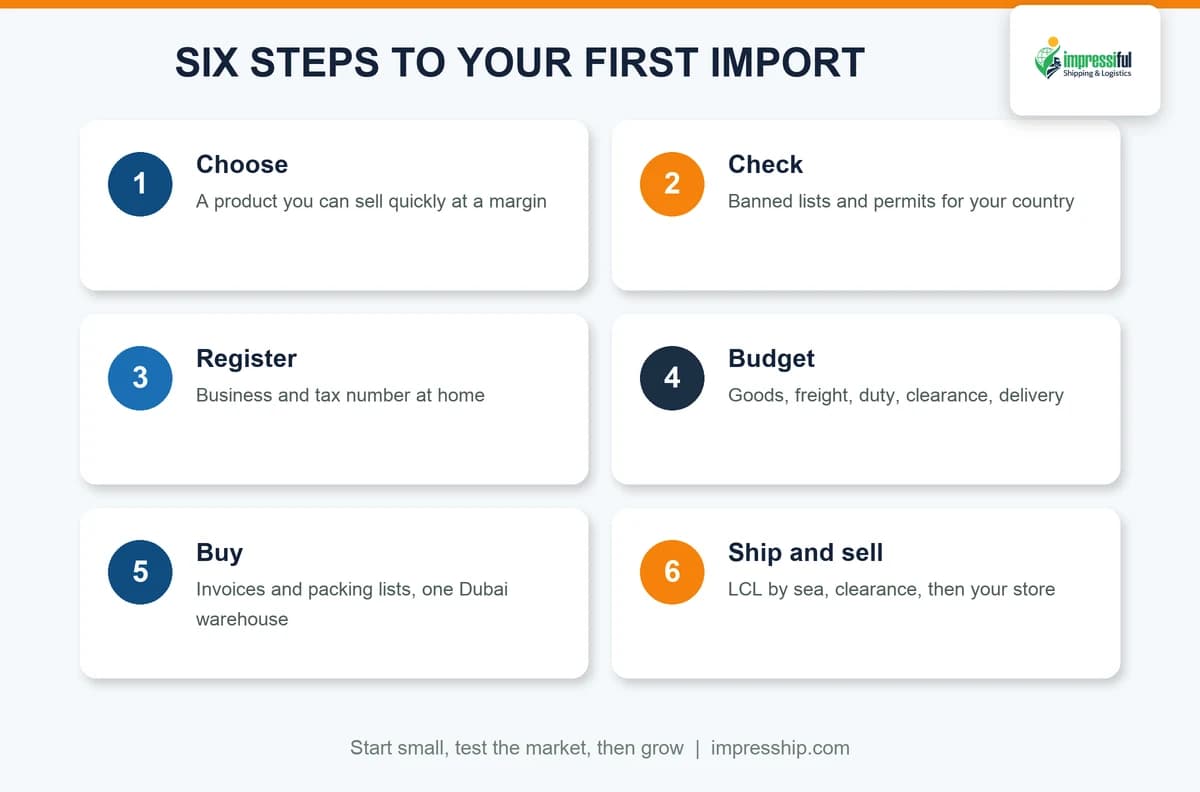
The sections below take each step in turn.
Need this handled end to end?
Tell us your lane and cargo profile and we'll come back with a routing plan and an all-in rate.
Step 1: choose a product you can sell#
Start with what you already know sells in your city, and price it before you buy. Visit the markets or online shops where it is sold, note the selling price, and work backwards to see whether there is a margin after freight, duty and your own costs.
Good first products are compact, steady sellers with prices that do not crash overnight: phone accessories, small electronics, fashion and footwear, beauty products, household goods and vehicle spare parts. Avoid fragile, heavily regulated or seasonal goods for your first order.
Step 2: check the import rules before you pay#
Some goods that sell well are banned or need a permit at the port. Nigeria's 2026 prohibition list covers 17 categories, from frozen poultry to retail soaps and glass bottles, and Ghana keeps its own list of banned and restricted goods. Our guide to prohibited and restricted imports in Ghana and Nigeria explains both lists.
Also check whether the product needs an approval: NAFDAC or SONCAP in Nigeria, FDA Ghana or the Ghana Standards Authority in Ghana, or a Certificate of Conformity for Kenya. Perfumes, aerosols and batteries are dangerous goods; we ship them, but every dangerous goods shipment is subject to approval.
Step 3: register the business at home#
Customs, banks and regulators deal with a registered importer, so register before your first commercial shipment.
- Nigeria: register a business name or company with the Corporate Affairs Commission, get a tax identification number and open a business bank account. Your clearing agent raises the Form M for each import through your bank, and the Nigeria Trade Information Portal lists the permits each product needs.
- Ghana: register with the Office of the Registrar of Companies, make sure your Ghana Card is linked for tax, and check the GRA customs pages for import rules and duty.
- Other countries: register with your national business registry and tax authority, and ask a licensed clearing agent which importer registration customs expects.
Step 4: budget the full landed cost#
The supplier's price is only the first line. Beginners lose money when they forget the costs between the shop in Dubai and the shelf at home.
| Cost line | What it covers | Where the number comes from |
|---|---|---|
| Goods | The supplier invoice | Your supplier |
| Dubai pickup | Collection from suppliers, if they do not deliver | Pickup quote, or deliver to our warehouse yourself |
| Sea freight | Shared space (LCL) or a container to your port | Our estimates below, then a dated quote |
| Destination charges | Port and terminal charges at arrival | Your quote and your clearing agent |
| Duty, levies and VAT | Charged on the customs value by product (HS code) | Customs tariff, or our duty calculator |
| Clearance and delivery | Clearing at the port, then transport to your store | Our partner agents or your own agent |
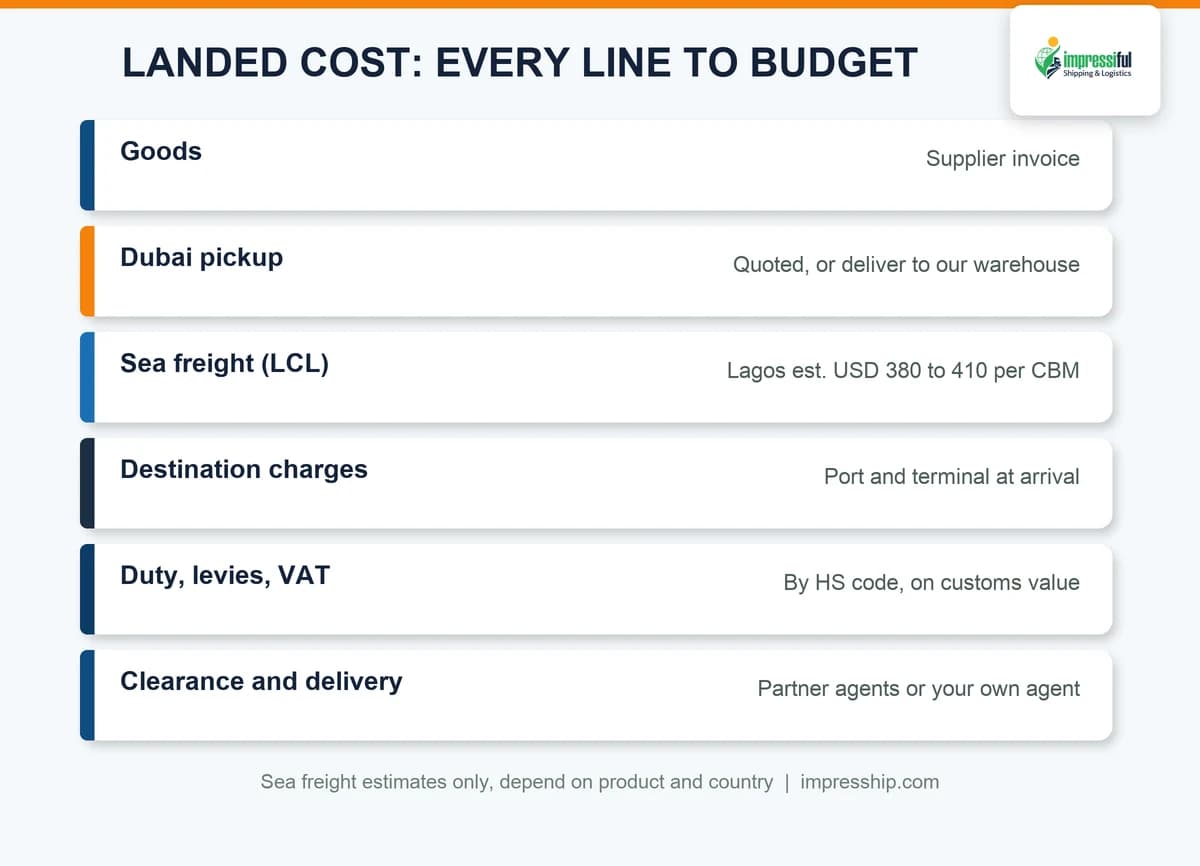
These are our LCL sea freight estimates per CBM from Dubai. They depend on the product and the country, and they cover sea freight only; Dubai pickup, destination charges, duty and clearance are extra.
| Destination port | LCL estimate per CBM (USD) | Time at sea |
|---|---|---|
| Lagos, Nigeria | About 376 | 30 to 48 days |
| Tema, Ghana | About 340 | 30 to 48 days |
| Abidjan, Côte d'Ivoire | About 351 | 30 to 48 days |
| Conakry, Guinea | About 340 | 30 to 48 days |
| Mombasa, Kenya | About 376 | 22 to 40 days |
Shipments up to 999 kg are charged by weight band instead when that comes out higher, from about USD 196 for 25 to 49 kg to Lagos. For a worked example of the duty side, see our landed cost guide for Ghana; then divide the total by the number of units to get your cost per unit and set a selling price.
Step 5: buy from Dubai suppliers#
Dubai's wholesale areas, such as Deira, the Naif and Murshid markets and Dragon Mart, sell in carton quantities to traders from across Africa. Our Dragon Mart buying guide lists what to get from every shop before you pay.
From every supplier, get an invoice with clear item descriptions, quantities and values, and a packing list with carton sizes and weights. Ask them to mark each carton with your shipping mark and deliver to our warehouse in Dubai. We confirm every supplier delivery with photos and counts, so you know what arrived before it ships.
If you cannot travel, our product sourcing team can find and price the goods for you, or our Buy for me service can buy items you have already chosen.
Step 6: ship, clear and sell#
When the goods are in, we check them against the invoices, repack and relabel where needed, measure the volume and ship them as one consignment with one bill of lading. Storage is free when the cargo is loaded within two weeks of confirmed shipping; if shipping is not confirmed, storage is charged at AED 20 per sq ft per month, so buy close to your shipping date.
At the port, we handle customs clearance through our partner agents, or you can use your own agent. Onward delivery to your store is on request, so ask us for your city. Once you have shipped a few times, our guide to shipping online store stock from Dubai shows how to plan regular restocks and split urgent lines by air. When the volume passes roughly 30 CBM, a 40ft container is usually the better choice.
Beginner mistakes to avoid#
- Buying before checking the import rules, then finding the product is banned or needs a permit.
- Pricing on the supplier invoice alone, without freight, duty and clearance.
- Vague invoices such as "goods" or "accessories", which slow customs down and can raise the duty.
- Buying too early, so goods wait in storage before a sailing.
- Choosing a forwarder on price alone. Our checklist on how to find a freight forwarder in Dubai covers what to verify.
Frequently asked questions#
How much does it cost to import from Dubai?#
There is no fixed amount, because it depends on the product, how much you buy and where it is going. Budget for the goods, sea freight (our LCL estimate to Lagos is about USD 376 per CBM, sea freight only, or the weight band when that is higher for shipments up to 999 kg), destination charges, duty and clearance, plus a reserve for delays. Many beginners start with one or two products and a few CBM, then reinvest the profit.
What are some good items to import from Dubai?#
Traders commonly import phones and accessories, electronics, fashion, perfumes, beauty products, household goods and vehicle spare parts from Dubai. Before buying, check the product against the Nigeria Customs Service prohibition list and whether it needs NAFDAC or SONCAP approval. Our guide to prohibited and restricted imports covers the 2026 list.
How to start an importation business?#
Choose one or two products you can sell, check their import rules and approvals, then register the business: with the Corporate Affairs Commission and a tax identification number in Nigeria, or with the Office of the Registrar of Companies and a Ghana Card linked for tax in Ghana. Next, budget the full landed cost, buy a small tested first order and ship it as LCL. The GRA customs pages list duty and import rules for Ghana.
How to get an import permit in Nigeria?#
Ordinary goods do not need a general import licence in Nigeria, but customs expects a registered importer with a tax number, and your clearing agent raises a Form M for each import through your bank. Many products also need a specific approval, such as NAFDAC registration or SONCAP certification. Check the permits your product needs on the Nigeria Trade Information Portal before you buy.
What is the most profitable import business?#
Profit depends on your margin after landed cost and on how fast the stock sells, not on the product category alone. Compact, steady sellers such as phone accessories, fashion, beauty products and spare parts are popular because they ship cheaply per unit and sell all year. Work out the cost per unit with our duty calculator and sea freight estimates before you choose.
Send your cargo details for a same-day quote#
Tell us what you plan to import, your supplier list or packing lists (or the total CBM and weight), and your destination port. We will confirm the freight, check the product against the rules we know, and send a dated, itemised quote for your first shipment.
Request a same-day quote or message us on WhatsApp with your cargo details.