SONCAP Certificate for Nigeria: Product Certificate, SC, NSW and NAFDAC Permits Explained
SONCAP certificate guide for goods shipped from Dubai to Nigeria: the Product Certificate and SONCAP Certificate, which goods need them, 7 steps on the National Single Window, the fees SON lists, the default penalty and NAFDAC permits.
A SONCAP certificate is the Standards Organisation of Nigeria document that lets regulated goods clear Nigerian customs, and it has to be sorted out before your cargo leaves the exporting country. This guide explains the SONCAP certificate step by step for importers buying in Dubai: the Product Certificate and the SONCAP Certificate, which goods need them, how to apply through the National Single Window, what SON lists as the fees, and the NAFDAC permits that cover the goods SONCAP does not.
Get these approvals wrong and the PAAR cannot be issued, so your cargo waits at the port while storage and demurrage build. Get them right and they are simply part of the paperwork you finish before the vessel sails.
What is SONCAP?#
SONCAP is the Standards Organisation of Nigeria Conformity Assessment Programme. In SON's words it is an offshore, pre-shipment certification scheme to monitor and control the importation of regulated products into Nigeria. Goods are checked and, where needed, tested in the exporting country against the Nigerian Industrial Standards (NIS) or approved international equivalents such as ISO and IEC standards, before they are shipped.
The checks are carried out on SON's behalf by Independent Accredited Firms (IAFs), inspection companies that SON appoints and lists on its SONCAP FAQ page. An IAF may inspect the goods, take samples, review test reports and check documents. If the goods comply, the certificates are issued; if they do not, a Non-Conformity Report is issued instead.
The two SONCAP certificates: PC and SC#
Under SONCAP, an importer of regulated products needs two documents:
| Product Certificate (PC) | SONCAP Certificate (SC) | |
|---|---|---|
| What it proves | The product conforms to the applicable standards | The shipment has been verified before export |
| Issued to | The exporter (only the exporter's details appear on it) | The importer named on the certificate |
| Used for | Opening the Form M through your bank | Processing the PAAR for customs clearance |
| Covers | A product, for one shipment or for a year | One consignment only |
| When | Before the Form M, early in the order | Before the goods leave the exporting country |
There are three kinds of Product Certificate:
- PC1, unregistered status: conformity verification for a product that is not registered. SON says it is valid for six months and for one use.
- PC2, registered status: for a product registered with SON, valid for 12 months and multiple shipments.
- PC3, licensed status: for a licensed product, also valid for 12 months and multiple shipments.
The SONCAP Certificate cannot be reused. SON is clear that one SC is limited to a single PAAR consignment and issued to one entity, so every new shipment needs its own SC.
Which goods need a SONCAP certificate?#
SON's SONCAP page says the regulated products include all imported goods except a short list of exemptions. In practice that covers most of what traders buy in Dubai for resale, such as electrical and electronic goods, building materials, auto parts and household goods. Your HS code and the product decide it, so check the code first; our guide to HS codes for importers shows how to find yours.
SON lists these categories as exempt from SONCAP offshore certification:
- Medicals, other than equipment and machines.
- Chemicals used as raw materials by bona fide manufacturers to produce food products and medicines.
- Goods classified as contraband by the Federal Government of Nigeria.
- Used products, other than automobiles.
Exempt from SONCAP does not mean unregulated. Food, drugs, cosmetics and similar products are regulated by NAFDAC instead (see below), and goods on the import prohibition list cannot be imported at all; our guide to prohibited and restricted imports in Ghana and Nigeria covers the current list.
How to get a SONCAP certificate for goods from Dubai: 7 steps#
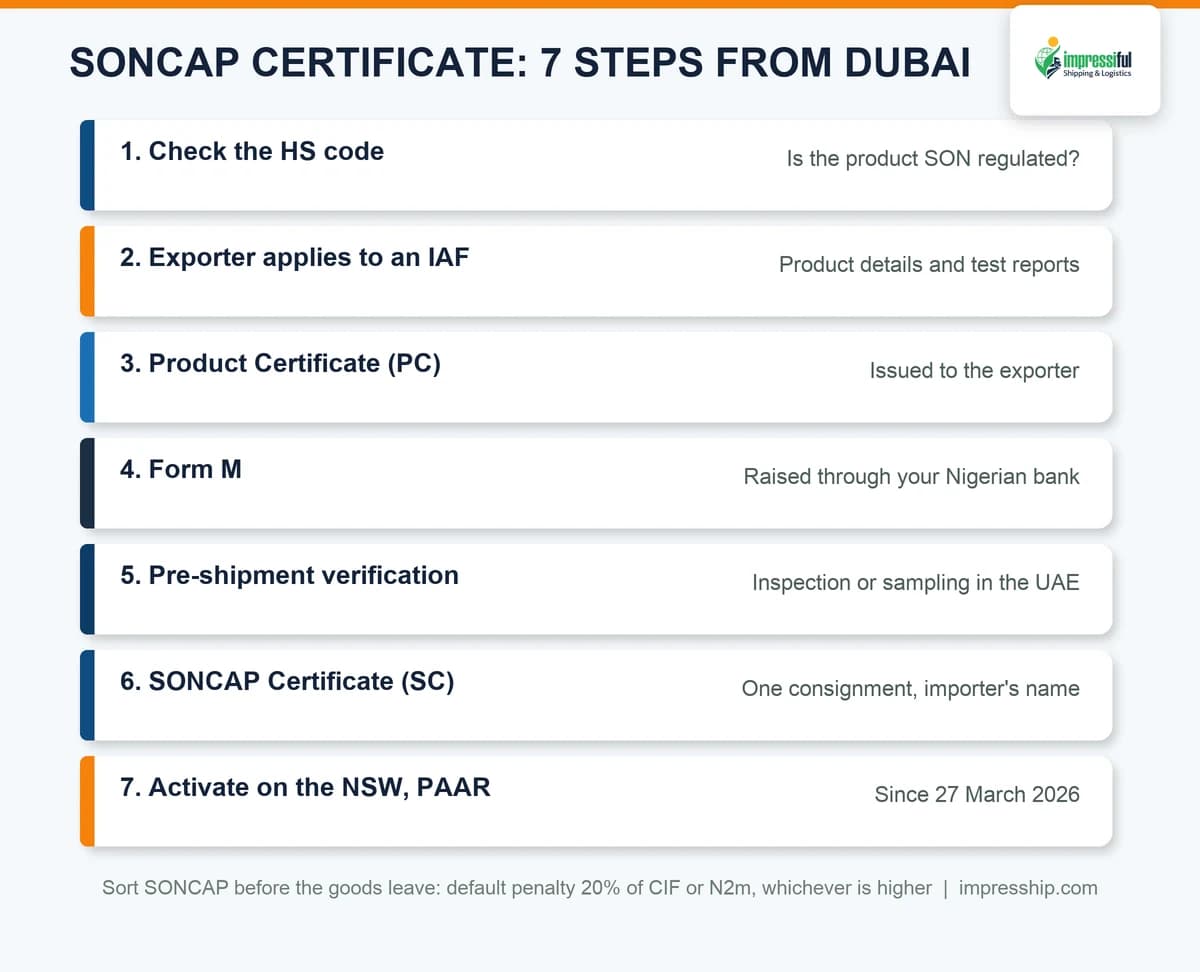
- Confirm the HS code and whether the product is SON regulated. Ask your supplier for a full product description and specifications, and agree the HS code with your clearing agent.
- Choose an IAF and send the product documents. The exporter, usually your Dubai supplier, applies to one of SON's accredited firms with the product details, test reports and supporting documents. SON says the IAFs are not assigned regions, so the exporter can use any of them.
- Get the Product Certificate. The IAF reviews the documents and tests, and the PC is issued to the exporter.
- Open the Form M. Your clearing agent raises the Form M through your Nigerian bank, quoting the Product Certificate. Our guide to customs clearance in Nigeria walks through Form M and the PAAR.
- Pre-shipment verification. Before the goods are shipped, the IAF verifies the consignment, which can include a physical inspection and sampling in the UAE.
- Get the SONCAP Certificate. Once the consignment is verified, the SC is issued in the importer's name for that shipment.
- Activate the certificates on the NSW and get the PAAR. The certificates are activated on Nigeria's National Single Window so the PAAR can be processed and the goods cleared.
You also need a Tax Identification Number (TIN) registered for trade: SON lists it as a key requirement for processing SONCAP certificates and import permits.
SONCAP on the National Single Window since March 2026#
SON announced in a public notice that from 27 March 2026, applications for import permits, including Product and Shipment Certificates, must be started and processed on the National Single Window (NSW). Certificates issued by IAFs are still generated on the SON portal, but activating them for the Form M, PAAR and cargo clearance must be done on the NSW. SON also said it no longer processes these documents through other channels.
The IAF list has changed too. In August 2026 SON published a notice on Bureau Veritas' voluntary withdrawal from the SONCAP scheme, so if your supplier's earlier Product Certificate came from Bureau Veritas, check with your clearing agent which accredited firm should handle your next SONCAP certificate.
Shipping regulated goods from Dubai to Lagos?
Send us the products, HS codes, quantities and your Form M or SONCAP status, and we will plan the booking and shipping documents around your Nigerian paperwork.
SONCAP certificate price: what SON lists#
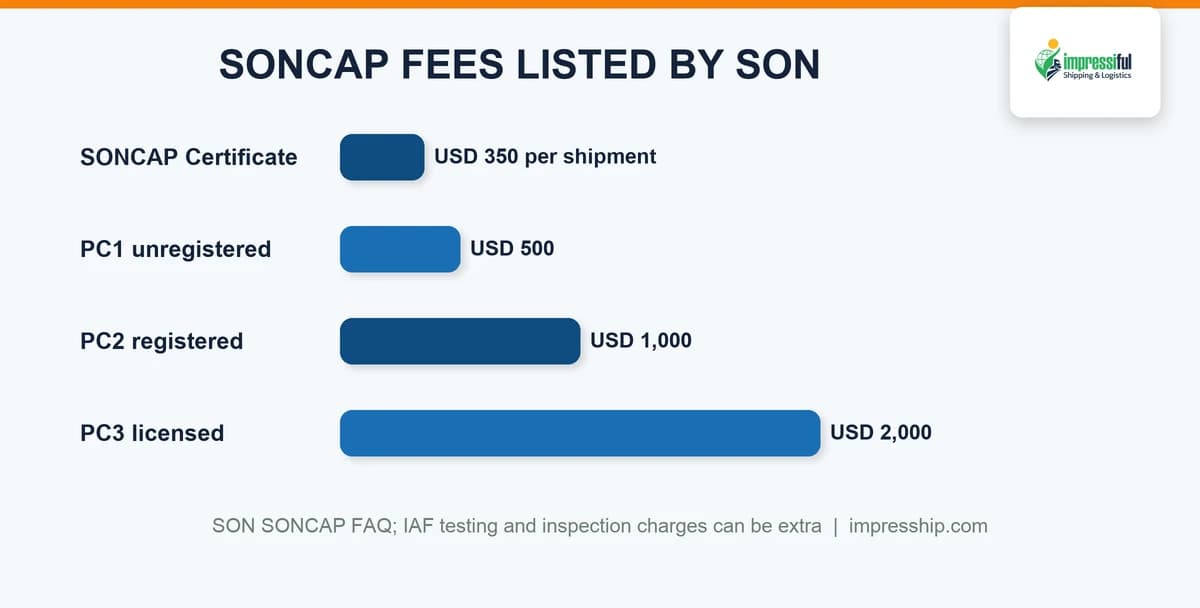
The SONCAP FAQ on SON's website lists these fees for the certificates:
| Certificate | Fee listed by SON |
|---|---|
| Product Certificate 1 (unregistered) | USD 500 |
| Product Certificate 2 (registered) | USD 1,000 |
| Product Certificate 3 (licensed) | USD 2,000 |
| SONCAP Certificate (per shipment) | USD 350 per certificate |
SON adds that an extra model on the same Product Certificate, covered by the same test report, costs USD 10 per month of validity per model. Testing, inspection and the IAF's own charges can come on top, so ask the IAF for a written quote. These are SON's published fees, not our charges.
The expensive mistake is shipping without the certificate. SON says SONCAP cannot be processed after the goods have left the country of origin, and that what applies then is the SONCAP default penalty: 20 percent of the CIF value of the consignment or 2 million naira, whichever is higher. On goods with a CIF value of USD 20,000, that is a penalty of at least USD 4,000.
SONCAP import permits for manufacturers#
Bona fide manufacturers in Nigeria importing raw materials, packaging or industrial machinery to produce SON regulated products can apply for a SONCAP Import Permit instead of offshore certification. SON also lists project specific items, humanitarian and charitable goods and other non-commercial products under this route. Goods for resale go through the normal SONCAP Product Certificate route.
SON's MANCAP scheme, which many importers confuse with SONCAP, is different: MANCAP certifies products made in Nigeria, while SONCAP covers imported products.
NAFDAC permits: the goods SONCAP does not cover#
Food, drugs, cosmetics, medical devices, chemicals, packaged water and similar products are regulated by NAFDAC (National Agency for Food and Drug Administration and Control), not SON. For these goods the usual rule is that the product must be registered with NAFDAC, or the importer must have NAFDAC's approval, before the Form M can be opened; NAFDAC publishes a guideline on authorisation to open Form M for regulated products. Some products, such as controlled drugs and certain chemicals, also need a permit to import and a permit to clear.
Since 27 March 2026, NAFDAC and SON permits are processed on the National Single Window. If you buy perfume, cosmetics, food supplements or cleaning chemicals in Dubai, check NAFDAC registration before you pay the supplier. Perfumes, aerosols and many chemicals are also dangerous goods for shipping, and every dangerous goods shipment we handle is subject to approval; for products that contain chemicals we work with the supplier to get the safety data sheet (MSDS).
SONCAP and the rest of your shipping documents#
The SONCAP and NAFDAC paperwork has to match the shipping documents. The product descriptions, quantities and HS codes on the Product Certificate, Form M, commercial invoice and packing list should tell the same story; our commercial invoice for export guide shows what customs compare. A certificate of origin may also be needed for some goods, as explained in our guide to the certificate of origin in Dubai.
Duty is a separate calculation from SONCAP. Our Nigeria import duty calculation guide shows how duty, levies and VAT are worked out on the CIF value.
For the freight itself, LCL sea freight from Dubai to Lagos is estimated at about USD 372 per CBM, and West African sea transit is about 30 to 48 days on our estimates. Our sea cargo currently loads at one of our partner ports: Sohar (most used) or Salalah in Oman, Jeddah, Khor Fakkan or Fujairah. These are sea freight estimates only: Dubai pickup, destination charges, duty and clearance are extra. See our Dubai to Nigeria shipping guide or the shipping calculator for your load.
Frequently asked questions#
What is SONCAP certification?#
SONCAP, the Standards Organisation of Nigeria Conformity Assessment Programme, is SON's pre-shipment certification for regulated imports: the goods are verified against Nigerian or approved standards in the exporting country before they ship. It produces two certificates: the Product Certificate (PC), issued to the exporter and used to open the Form M, and the SONCAP Certificate (SC), issued to the importer for one consignment and used to process the PAAR.
How much is a SONCAP certificate in Nigeria?#
SON's SONCAP FAQ lists USD 350 per SONCAP Certificate, and USD 500, USD 1,000 or USD 2,000 for a Product Certificate depending on whether the product is unregistered, registered or licensed. Testing and the accredited firm's own inspection charges can be added, so ask the firm for a written quote before you start.
How to get SONCAP certificate in Nigeria?#
Confirm that your product is SON regulated by its HS code, then have the exporter apply to one of SON's accredited firms for a Product Certificate. Use the PC to open the Form M, have the shipment verified before export, and obtain the SONCAP Certificate for that consignment. Since 27 March 2026 the certificates are activated on the National Single Window for the Form M and PAAR.
How do I activate my SONCAP certificate?#
Since 27 March 2026, SONCAP certificates are activated on the National Single Window (NSW). The accredited firm still generates the certificate on the SON portal; it is then activated on the NSW so it can be used for the Form M (Product Certificate) and for the PAAR and clearance (SONCAP Certificate). Your clearing agent usually handles this step, so give them the certificate details.
What is the difference between MANCAP and SONCAP?#
SONCAP covers imported products: regulated goods are verified in the exporting country before they are shipped to Nigeria. MANCAP, the Mandatory Conformity Assessment Programme, covers products manufactured in Nigeria, which carry the MANCAP certification instead. If you buy goods in Dubai for import, SONCAP is the scheme that applies.
Send your cargo details for a same-day quote#
Tell us what you are buying in Dubai, the HS codes, the CBM or weight and your Form M and SONCAP status. We will quote sea or air freight to Lagos with the destination charges spelled out, provide a telex release bill of lading, and handle customs clearance at destination through our partner agents, or hand over to your own clearing agent.
Request a same-day quote or message us on WhatsApp with your cargo details.